• 文献检索
  • 文档翻译
  • 深度研究
  • 学术资讯
  • Suppr Zotero 插件Zotero 插件
  • 邀请有礼
  • 套餐&价格
  • 历史记录
应用&插件
Suppr Zotero 插件Zotero 插件浏览器插件Mac 客户端Windows 客户端微信小程序
定价
高级版会员购买积分包购买API积分包
服务
文献检索文档翻译深度研究API 文档MCP 服务
关于我们
关于 Suppr公司介绍联系我们用户协议隐私条款
关注我们

Suppr 超能文献

核心技术专利:CN118964589B侵权必究
粤ICP备2023148730 号-1Suppr @ 2026

文献检索

告别复杂PubMed语法,用中文像聊天一样搜索,搜遍4000万医学文献。AI智能推荐,让科研检索更轻松。

立即免费搜索

文件翻译

保留排版,准确专业,支持PDF/Word/PPT等文件格式,支持 12+语言互译。

免费翻译文档

深度研究

AI帮你快速写综述,25分钟生成高质量综述,智能提取关键信息,辅助科研写作。

立即免费体验

使用可穿戴式传感器监测康复过程中儿童运动能力的变化。

Monitoring motor capacity changes of children during rehabilitation using body-worn sensors.

机构信息

Wearable Computing Lab., ETH Zurich, Gloriastrasse 35, Zurich, Switzerland.

出版信息

J Neuroeng Rehabil. 2013 Jul 30;10:83. doi: 10.1186/1743-0003-10-83.

DOI:10.1186/1743-0003-10-83
PMID:23899401
原文链接:https://pmc.ncbi.nlm.nih.gov/articles/PMC3751753/
Abstract

BACKGROUND

Rehabilitation services use outcome measures to track motor performance of their patients over time. State-of-the-art approaches use mainly patients' feedback and experts' observations for this purpose. We aim at continuously monitoring children in daily life and assessing normal activities to close the gap between movements done as instructed by caregivers and natural movements during daily life. To investigate the applicability of body-worn sensors for motor assessment in children, we investigated changes in movement capacity during defined motor tasks longitudinally.

METHODS

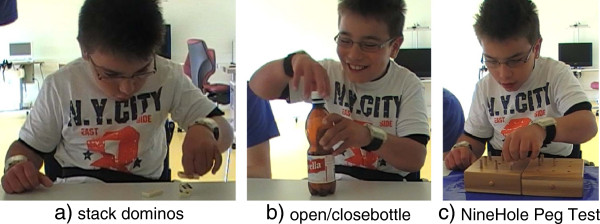
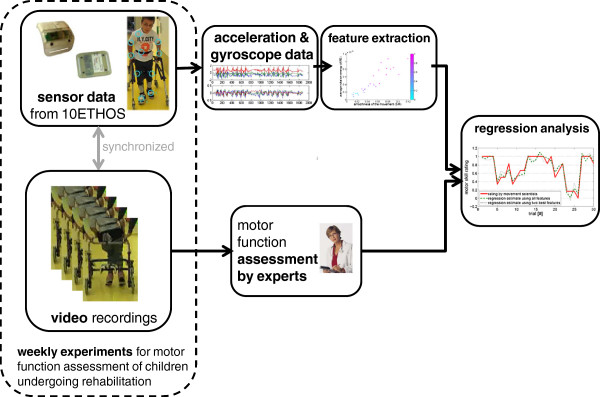
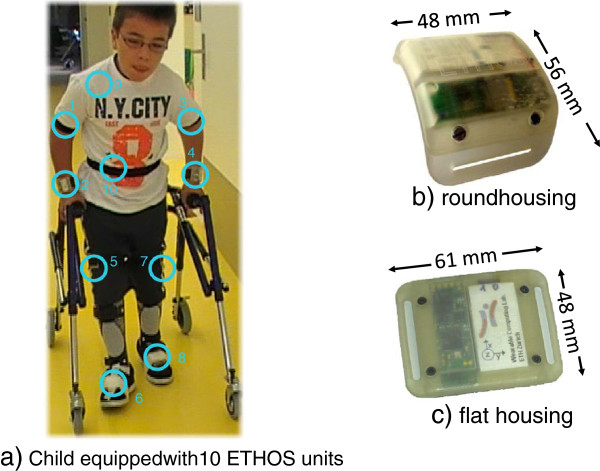
We performed a longitudinal study over four weeks with 4 children (2 girls; 2 diagnosed with Cerebral Palsy and 2 with stroke, on average 10.5 years old) undergoing rehabilitation. Every week, the children performed 10 predefined motor tasks. Capacity in terms of quality and quantity was assessed by experts and movement was monitored using 10 ETH Orientation Sensors (ETHOS), a small and unobtrusive inertial measurement unit. Features such as smoothness of movement were calculated from the sensor data and a regression was used to estimate the capacity from the features and their relation to clinical data. Therefore, the target and features were normalized to range from 0 to 1.

RESULTS

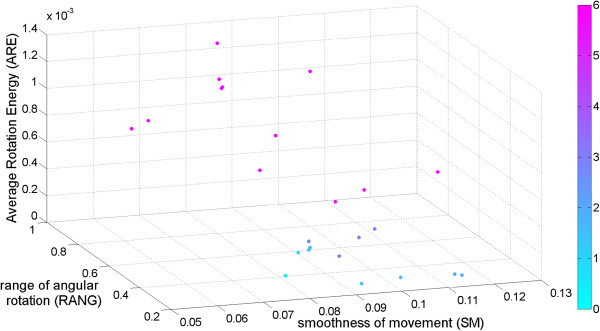
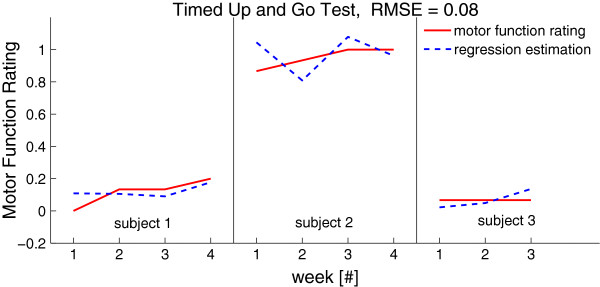
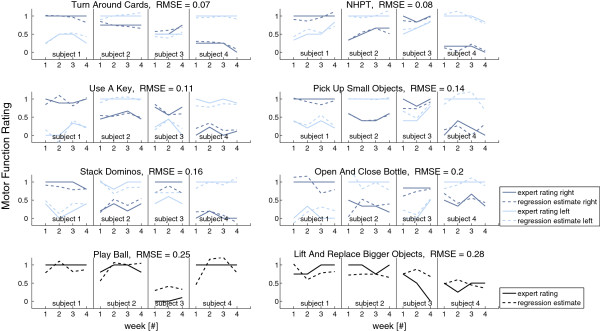
We achieved a mean RMS-error of 0.15 and a mean correlation value of 0.86 (p < 0.05 for all tasks) between our regression estimate of motor task capacity and experts' ratings across all tasks. We identified the most important features and were able to reduce the sensor setup from 10 to 3 sensors. We investigated features that provided a good estimate of the motor capacity independently of the task performed, e.g. smoothness of the movement.

CONCLUSIONS

We found that children's task capacity can be assessed from wearable sensors and that some of the calculated features provide a good estimate of movement capacity over different tasks. This indicates the potential of using the sensors in daily life, when little or no information on the task performed is available. For the assessment, the use of three sensors on both wrists and the hip suffices. With the developed algorithms, we plan to assess children's motor performance in daily life with a follow-up study.

摘要

背景

康复服务利用结果测量来跟踪患者的运动表现随时间的变化。最先进的方法主要使用患者的反馈和专家的观察来实现这一目的。我们的目标是在日常生活中持续监测儿童,并评估正常活动,以缩小照护者指导下的动作与日常生活中自然动作之间的差距。为了研究可穿戴传感器在儿童运动评估中的适用性,我们在四周的时间内对四个孩子(两个女孩;两个患有脑瘫,两个患有中风,平均年龄为 10.5 岁)进行了纵向研究。每周,孩子们都会完成 10 个预先定义的运动任务。专家会评估质量和数量方面的能力,使用 10 个 ETH 方位传感器(ETHOS)监测运动,ETHOS 是一种小型且不显眼的惯性测量单元。传感器数据计算得出运动的平滑度等特征,并使用回归分析来根据特征及其与临床数据的关系来估计能力。因此,目标和特征被归一化为 0 到 1 的范围。

结果

我们在所有任务中实现了回归估计运动任务能力与专家评分之间的平均均方根误差为 0.15 和平均相关值为 0.86(所有任务的 p 值均<0.05)。我们确定了最重要的特征,并能够将传感器设置从 10 个减少到 3 个。我们研究了一些特征,这些特征可以在不考虑执行任务的情况下很好地估计运动能力,例如运动的平滑度。

结论

我们发现可以从可穿戴传感器评估儿童的任务能力,并且一些计算出的特征可以很好地估计不同任务的运动能力。这表明传感器在日常生活中具有潜力,尤其是在任务信息很少或无法获得的情况下。评估时,在两个手腕和臀部使用三个传感器就足够了。我们计划使用开发的算法在后续研究中评估儿童的日常生活中的运动表现。
https://cdn.ncbi.nlm.nih.gov/pmc/blobs/3c5a/3751753/dd39cac30599/1743-0003-10-83-11.jpg
https://cdn.ncbi.nlm.nih.gov/pmc/blobs/3c5a/3751753/6089af24f298/1743-0003-10-83-1.jpg
https://cdn.ncbi.nlm.nih.gov/pmc/blobs/3c5a/3751753/4e9622ace0cb/1743-0003-10-83-2.jpg
https://cdn.ncbi.nlm.nih.gov/pmc/blobs/3c5a/3751753/512b33afd94f/1743-0003-10-83-3.jpg
https://cdn.ncbi.nlm.nih.gov/pmc/blobs/3c5a/3751753/f22d980b0d6e/1743-0003-10-83-4.jpg
https://cdn.ncbi.nlm.nih.gov/pmc/blobs/3c5a/3751753/78d926034ac5/1743-0003-10-83-5.jpg
https://cdn.ncbi.nlm.nih.gov/pmc/blobs/3c5a/3751753/150e27ec319d/1743-0003-10-83-6.jpg
https://cdn.ncbi.nlm.nih.gov/pmc/blobs/3c5a/3751753/ad5128817720/1743-0003-10-83-7.jpg
https://cdn.ncbi.nlm.nih.gov/pmc/blobs/3c5a/3751753/29129cf62a34/1743-0003-10-83-8.jpg
https://cdn.ncbi.nlm.nih.gov/pmc/blobs/3c5a/3751753/a0eb48c30c69/1743-0003-10-83-9.jpg
https://cdn.ncbi.nlm.nih.gov/pmc/blobs/3c5a/3751753/3f103ac55a8c/1743-0003-10-83-10.jpg
https://cdn.ncbi.nlm.nih.gov/pmc/blobs/3c5a/3751753/dd39cac30599/1743-0003-10-83-11.jpg
https://cdn.ncbi.nlm.nih.gov/pmc/blobs/3c5a/3751753/6089af24f298/1743-0003-10-83-1.jpg
https://cdn.ncbi.nlm.nih.gov/pmc/blobs/3c5a/3751753/4e9622ace0cb/1743-0003-10-83-2.jpg
https://cdn.ncbi.nlm.nih.gov/pmc/blobs/3c5a/3751753/512b33afd94f/1743-0003-10-83-3.jpg
https://cdn.ncbi.nlm.nih.gov/pmc/blobs/3c5a/3751753/f22d980b0d6e/1743-0003-10-83-4.jpg
https://cdn.ncbi.nlm.nih.gov/pmc/blobs/3c5a/3751753/78d926034ac5/1743-0003-10-83-5.jpg
https://cdn.ncbi.nlm.nih.gov/pmc/blobs/3c5a/3751753/150e27ec319d/1743-0003-10-83-6.jpg
https://cdn.ncbi.nlm.nih.gov/pmc/blobs/3c5a/3751753/ad5128817720/1743-0003-10-83-7.jpg
https://cdn.ncbi.nlm.nih.gov/pmc/blobs/3c5a/3751753/29129cf62a34/1743-0003-10-83-8.jpg
https://cdn.ncbi.nlm.nih.gov/pmc/blobs/3c5a/3751753/a0eb48c30c69/1743-0003-10-83-9.jpg
https://cdn.ncbi.nlm.nih.gov/pmc/blobs/3c5a/3751753/3f103ac55a8c/1743-0003-10-83-10.jpg
https://cdn.ncbi.nlm.nih.gov/pmc/blobs/3c5a/3751753/dd39cac30599/1743-0003-10-83-11.jpg

相似文献

1
Monitoring motor capacity changes of children during rehabilitation using body-worn sensors.使用可穿戴式传感器监测康复过程中儿童运动能力的变化。
J Neuroeng Rehabil. 2013 Jul 30;10:83. doi: 10.1186/1743-0003-10-83.
2
Assessment of upper limb use in children with typical development and neurodevelopmental disorders by inertial sensors: a systematic review.使用惯性传感器评估典型发育和神经发育障碍儿童的上肢使用情况:系统评价。
J Neuroeng Rehabil. 2018 Nov 6;15(1):94. doi: 10.1186/s12984-018-0447-y.
3
Clinical value of assessing motor performance in postacute stroke patients.评估急性后期脑卒中患者运动功能的临床价值。
J Neuroeng Rehabil. 2021 Jun 24;18(1):102. doi: 10.1186/s12984-021-00898-0.
4
Effect of therapist-based constraint-induced therapy at home on motor control, motor performance and daily function in children with cerebral palsy: a randomized controlled study.家庭治疗师主导的强制性诱导治疗对脑瘫儿童运动控制、运动表现和日常生活功能的影响:一项随机对照研究。
Clin Rehabil. 2013 Mar;27(3):236-45. doi: 10.1177/0269215512455652. Epub 2012 Sep 5.
5
Would a thermal sensor improve arm motion classification accuracy of a single wrist-mounted inertial device?腕部单惯性仪的热传感器是否能提高手臂运动分类精度?
Biomed Eng Online. 2019 May 7;18(1):53. doi: 10.1186/s12938-019-0677-7.
6
Reliability and sources of variation of the ABILHAND-Kids questionnaire in children with cerebral palsy.ABILHAND-Kids问卷在脑瘫儿童中的信度及变异来源
Disabil Rehabil. 2018 Mar;40(6):684-689. doi: 10.1080/09638288.2016.1272139. Epub 2017 Jan 9.
7
Using Wearable Inertial Sensors to Estimate Clinical Scores of Upper Limb Movement Quality in Stroke.使用可穿戴惯性传感器评估中风患者上肢运动质量的临床评分
Front Physiol. 2022 May 3;13:877563. doi: 10.3389/fphys.2022.877563. eCollection 2022.
8
Protocol of a systematic review on the application of wearable inertial sensors to quantify everyday life motor activity in people with mobility impairments.穿戴式惯性传感器在量化行动障碍者日常生活运动活动中的应用:系统评价方案。
Syst Rev. 2018 Oct 24;7(1):174. doi: 10.1186/s13643-018-0824-4.
9
Impaired motor planning and motor imagery in children with unilateral spastic cerebral palsy: challenges for the future of pediatric rehabilitation.运动规划和运动想象能力受损的单侧痉挛性脑瘫儿童:儿科康复的未来挑战。
Dev Med Child Neurol. 2013 Nov;55 Suppl 4:43-6. doi: 10.1111/dmcn.12306.
10
Improving activity recognition using a wearable barometric pressure sensor in mobility-impaired stroke patients.使用可穿戴气压传感器改善行动不便的中风患者的活动识别。
J Neuroeng Rehabil. 2015 Aug 25;12:72. doi: 10.1186/s12984-015-0060-2.

引用本文的文献

1
Validation of Low-Cost IMUs for Telerehabilitation Exercises.用于远程康复训练的低成本惯性测量单元的验证
Sensors (Basel). 2025 May 15;25(10):3129. doi: 10.3390/s25103129.
2
Wearable sensors in paediatric neurology.儿科神经学中的可穿戴传感器
Dev Med Child Neurol. 2025 Jul;67(7):834-853. doi: 10.1111/dmcn.16239. Epub 2025 Jan 31.
3
Upper extremity asymmetry due to nerve injuries or central neurologic conditions: a scoping review.上肢因神经损伤或中枢神经系统疾病所致的不对称:范围界定综述。

本文引用的文献

1
Beyond the standard clinical rating scales: fine-grained assessment of post-stroke motor functionality using wearable inertial sensors.超越标准临床评分量表:使用可穿戴惯性传感器对中风后运动功能进行细粒度评估。
Annu Int Conf IEEE Eng Med Biol Soc. 2012;2012:6111-5. doi: 10.1109/EMBC.2012.6347388.
2
Monitoring kinematic changes with fatigue in running using body-worn sensors.使用可穿戴传感器监测跑步过程中随疲劳产生的运动学变化。
IEEE Trans Inf Technol Biomed. 2012 Sep;16(5):983-90. doi: 10.1109/TITB.2012.2201950. Epub 2012 Jun 1.
3
Estimating Fugl-Meyer clinical scores in stroke survivors using wearable sensors.
J Neuroeng Rehabil. 2023 Nov 9;20(1):151. doi: 10.1186/s12984-023-01277-7.
4
Validation of an accelerometer system for measuring physical activity and sedentary behavior in healthy children and adolescents.验证一种加速度计系统,用于测量健康儿童和青少年的身体活动和久坐行为。
Eur J Pediatr. 2023 Aug;182(8):3639-3647. doi: 10.1007/s00431-023-05014-z. Epub 2023 Jun 1.
5
Reliability and Discriminative Validity of Wearable Sensors for the Quantification of Upper Limb Movement Disorders in Individuals with Dyskinetic Cerebral Palsy.可穿戴传感器在定量评估运动障碍型脑瘫患者上肢运动障碍中的可靠性和区分效度。
Sensors (Basel). 2023 Feb 1;23(3):1574. doi: 10.3390/s23031574.
6
Assessment of movement disorders using wearable sensors during upper limb tasks: A scoping review.上肢任务期间使用可穿戴传感器评估运动障碍:一项范围综述。
Front Robot AI. 2023 Jan 9;9:1068413. doi: 10.3389/frobt.2022.1068413. eCollection 2022.
7
Unsupervised IMU-based evaluation of at-home exercise programmes: a feasibility study.基于惯性测量单元的家庭锻炼计划无监督评估:一项可行性研究。
BMC Sports Sci Med Rehabil. 2022 Feb 19;14(1):28. doi: 10.1186/s13102-022-00417-1.
8
Smoothness metrics for reaching performance after stroke. Part 1: which one to choose?脑卒中后恢复运动功能的平滑度评估指标。第 1 部分:应该选择哪一个?
J Neuroeng Rehabil. 2021 Oct 26;18(1):154. doi: 10.1186/s12984-021-00949-6.
9
Wearable technology in stroke rehabilitation: towards improved diagnosis and treatment of upper-limb motor impairment.可穿戴技术在中风康复中的应用:改善上肢运动障碍的诊断和治疗。
J Neuroeng Rehabil. 2019 Nov 19;16(1):142. doi: 10.1186/s12984-019-0612-y.
10
Efficacy of an activity monitor as a biofeedback device in cerebral palsy.活动监测器作为生物反馈设备在脑瘫治疗中的疗效。
J Rehabil Assist Technol Eng. 2016 Nov 24;3:2055668316676032. doi: 10.1177/2055668316676032. eCollection 2016 Jan-Dec.
使用可穿戴传感器评估中风幸存者的Fugl-Meyer临床评分。
Annu Int Conf IEEE Eng Med Biol Soc. 2011;2011:5839-42. doi: 10.1109/IEMBS.2011.6091444.
4
Towards a movement quantification system capable of automatic evaluation of upper limb motor function after neurological injury.迈向一种能够自动评估神经损伤后上肢运动功能的运动量化系统。
Annu Int Conf IEEE Eng Med Biol Soc. 2011;2011:5456-60. doi: 10.1109/IEMBS.2011.6091392.
5
Assessment of arm activity using triaxial accelerometry in patients with a stroke.使用三轴加速度计评估脑卒中患者的手臂活动。
Arch Phys Med Rehabil. 2011 Sep;92(9):1437-42. doi: 10.1016/j.apmr.2011.02.021.
6
Tracking motor recovery in stroke survivors undergoing rehabilitation using wearable technology.使用可穿戴技术追踪中风幸存者康复过程中的运动恢复情况。
Annu Int Conf IEEE Eng Med Biol Soc. 2010;2010:6858-61. doi: 10.1109/IEMBS.2010.5626446.
7
Motor function assessment using wearable inertial sensors.使用可穿戴惯性传感器进行运动功能评估。
Annu Int Conf IEEE Eng Med Biol Soc. 2010;2010:86-9. doi: 10.1109/IEMBS.2010.5626156.
8
Rehabilitation in spine and spinal cord trauma.脊柱和脊髓创伤康复。
Spine (Phila Pa 1976). 2010 Oct 1;35(21 Suppl):S259-62. doi: 10.1097/BRS.0b013e3181f1a979.
9
Benefits of using outcome measures in pediatric rehabilitation.在儿科康复中使用结局指标的益处。
Phys Occup Ther Pediatr. 2010 Aug;30(3):165-7. doi: 10.3109/01942638.2010.484353.
10
Gait symmetry and regularity in transfemoral amputees assessed by trunk accelerations.利用躯干加速度评估股骨截肢者的步态对称性和规律性。
J Neuroeng Rehabil. 2010 Jan 19;7:4. doi: 10.1186/1743-0003-7-4.