Department of Physics and Astronomy, University of North Carolina at Chapel Hill, Chapel Hill, North Carolina 27599-3255, USA.
Opt Lett. 2013 Aug 1;38(15):2923-6. doi: 10.1364/OL.38.002923.
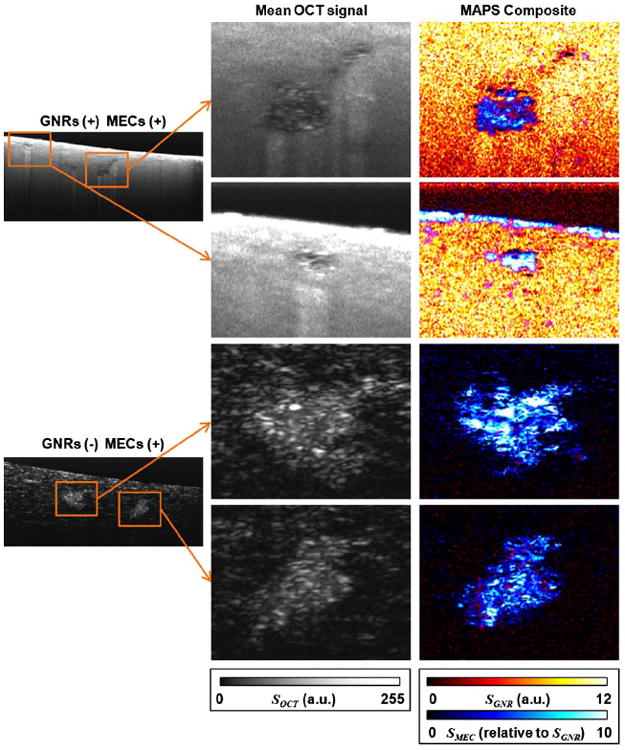
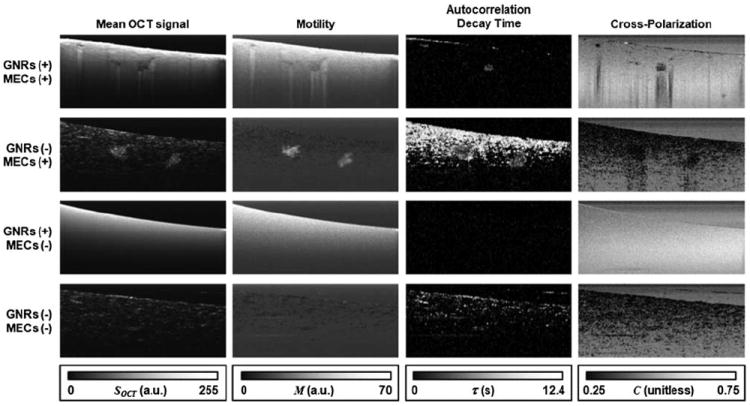
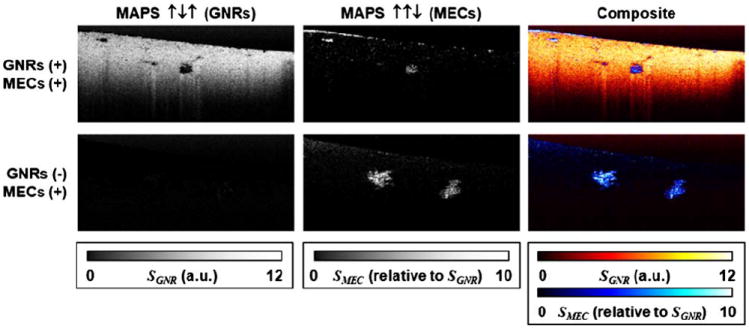
We propose a method for differentiating classes of light scatterers based upon their temporal and polarization properties computed from time series of polarization-sensitive optical coherence tomography (PS-OCT) images. The amplitude (motility) and time scale (autocorrelation decay time) of the speckle fluctuations are combined with the cross-polarization pixel-wise to render Motility-, autocorrelation-, and polarization-sensitive (MAPS) OCT contrast images. This combination of metrics provides high specificity for discriminating diffusive gold nanorods and mammary epithelial cell spheroids within 3D tissue culture, based on their unique MAPS signature. This has implications toward highly specific contrast in molecular (nanoparticle-based) and functional (cellular activity) imaging using standard PS-OCT hardware.
我们提出了一种基于时间序列偏振敏感光相干断层扫描(PS-OCT)图像计算的光散射体的时间和偏振特性来区分其类别的方法。散斑波动的幅度(运动性)和时间尺度(自相关衰减时间)与交叉偏振像素相结合,以呈现运动性、自相关性和偏振敏感(MAPS) OCT 对比图像。这种度量的组合为在 3D 组织培养中基于其独特的 MAPS 特征来区分扩散金纳米棒和乳腺上皮细胞球体提供了高度特异性。这对于使用标准 PS-OCT 硬件进行基于分子(基于纳米粒子)和功能(细胞活性)成像的高度特异性对比具有重要意义。