Geomicrobiology Group, Institute of Earth and Environmental Sciences, University of Potsdam Potsdam, Germany.
Front Microbiol. 2013 Jul 29;4:209. doi: 10.3389/fmicb.2013.00209. eCollection 2013.
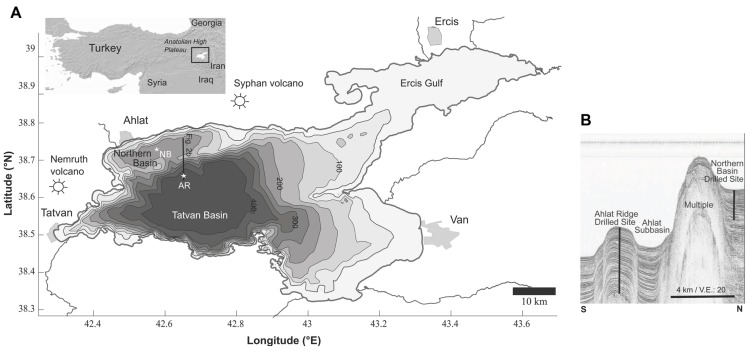
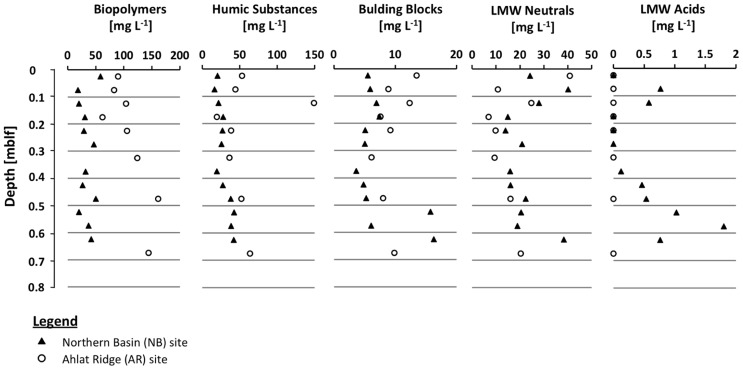
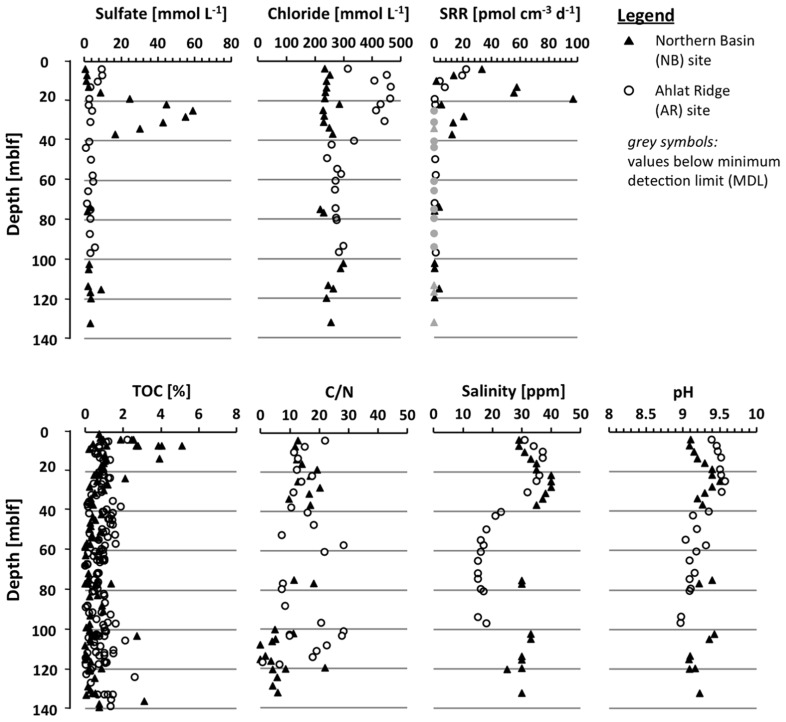
As part of the International Continental Drilling Program deep lake drilling project PaleoVan, we investigated sulfate reduction (SR) in deep sediment cores of the saline, alkaline (salinity 21.4‰, alkalinity 155 m mEq(-1), pH 9.81) Lake Van, Turkey. The cores were retrieved in the Northern Basin (NB) and at Ahlat Ridge (AR) and reached a maximum depth of 220 m. Additionally, 65-75 cm long gravity cores were taken at both sites. SR rates (SRR) were low (≤22 nmol cm(-3) day(-1)) compared to lakes with higher salinity and alkalinity, indicating that salinity and alkalinity are not limiting SR in Lake Van. Both sites differ significantly in rates and depth distribution of SR. In NB, SRR are up to 10 times higher than at AR. SR could be detected down to 19 mblf (meters below lake floor) at NB and down to 13 mblf at AR. Although SRR were lower at AR than at NB, organic matter (OM) concentrations were higher. In contrast, dissolved OM in the pore water at AR contained more macromolecular OM and less low molecular weight OM. We thus suggest, that OM content alone cannot be used to infer microbial activity at Lake Van but that quality of OM has an important impact as well. These differences suggest that biogeochemical processes in lacustrine sediments are reacting very sensitively to small variations in geological, physical, or chemical parameters over relatively short distances.
作为国际大陆钻探计划深湖钻探项目 PaleoVan 的一部分,我们研究了土耳其咸水、碱性(盐度 21.4‰,碱度 155 mEq(-1),pH 值 9.81)的凡湖深沉积物岩芯中的硫酸盐还原(SR)作用。这些岩芯是在北盆地(NB)和阿勒特山脊(AR)采集的,最大深度达到 220 米。此外,在这两个地点还采集了 65-75 厘米长的重力岩芯。与盐度和碱度更高的湖泊相比,SR 速率(SRR)较低(≤22 nmol cm(-3) day(-1)),表明盐度和碱度不是凡湖 SR 的限制因素。两个地点的 SR 速率和深度分布差异显著。在 NB,SRR 比 AR 高 10 倍。在 NB 可以检测到 SR 到 19 mblf(湖底以下的米数),而在 AR 则可以检测到 13 mblf。尽管 AR 的 SRR 比 NB 低,但有机物质(OM)浓度更高。相比之下,AR 孔隙水中的溶解 OM 含有更多的大分子 OM 和较少的低分子量 OM。因此,我们认为,OM 含量本身不能用来推断凡湖的微生物活性,而 OM 的质量也有重要影响。这些差异表明,湖泊沉积物中的生物地球化学过程对地质、物理或化学参数的微小变化非常敏感,而这些变化在相对较短的距离内发生。