I.R.C.C.S. Fondazione Ospedale San Camillo, Via Alberoni, 70-30126 Venezia-Lido, Italy.
J Neuroeng Rehabil. 2013 Aug 1;10:85. doi: 10.1186/1743-0003-10-85.
Recent evidence has demonstrated the efficacy of Virtual Reality (VR) for stroke rehabilitation nonetheless its benefits and limitations in large population of patients have not yet been studied.
To evaluate the effectiveness of non-immersive VR treatment for the restoration of the upper limb motor function and its impact on the activities of daily living capacities in post-stroke patients.
A pragmatic clinical trial was conducted among post-stroke patients admitted to our rehabilitation hospital. We enrolled 376 subjects who had a motor arm subscore on the Italian version of the National Institutes of Health Stroke Scale (It-NIHSS) between 1 and 3 and without severe neuropsychological impairments interfering with recovery. Patients were allocated to two treatments groups, receiving combined VR and upper limb conventional (ULC) therapy or ULC therapy alone. The treatment programs consisted of 2 hours of daily therapy, delivered 5 days per week, for 4 weeks. The outcome measures were the Fugl-Meyer Upper Extremity (F-M UE) and Functional Independence Measure (FIM) scales.
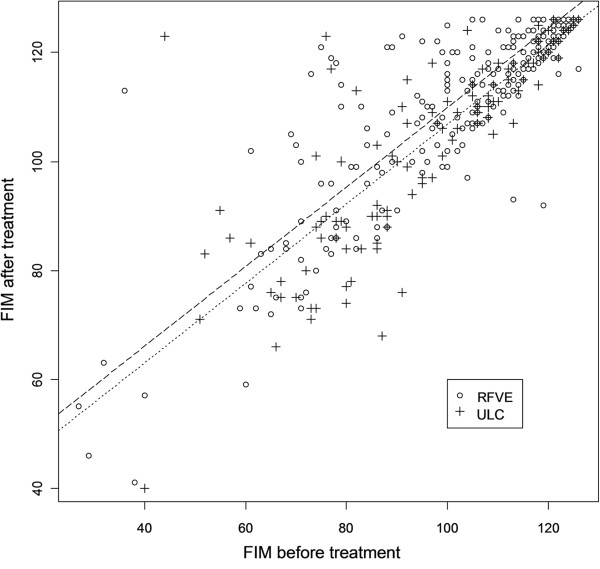
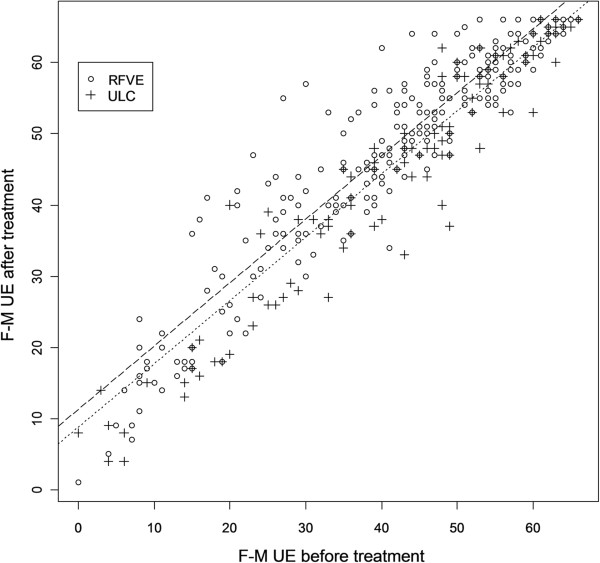
Both treatments significantly improved F-M UE and FIM scores, but the improvement obtained with VR rehabilitation was significantly greater than that achieved with ULC therapy alone. The estimated effect size of the minimal difference between groups in F-M UE and FIM scores was 2.5 ± 0.5 (P < 0.001) pts and 3.2 ± 1.2 (P = 0.007) pts, respectively.
VR rehabilitation in post-stroke patients seems more effective than conventional interventions in restoring upper limb motor impairments and motor related functional abilities.
Italian Ministry of Health IRCCS Research Programme 2590412.
最近的证据表明虚拟现实(VR)在中风康复方面的有效性,但在大量患者中,其益处和局限性尚未得到研究。
评估非沉浸式 VR 治疗对上肢运动功能恢复的效果及其对中风后患者日常生活活动能力的影响。
在我们的康复医院收治的中风后患者中进行了一项实用的临床试验。我们纳入了 376 名受试者,他们的意大利版国立卫生研究院中风量表(It-NIHSS)上肢运动亚评分在 1 到 3 之间,且没有严重的神经心理障碍干扰恢复。患者被分配到两个治疗组,分别接受 VR 和上肢常规(ULC)治疗联合治疗或 ULC 治疗。治疗方案包括每天 2 小时的治疗,每周 5 天,共 4 周。主要观察指标是 Fugl-Meyer 上肢量表(F-M UE)和功能独立性量表(FIM)评分。
两种治疗方法均显著改善了 F-M UE 和 FIM 评分,但 VR 康复治疗的改善明显优于 ULC 治疗。F-M UE 和 FIM 评分中两组间最小差异的估计效应大小分别为 2.5 ± 0.5(P < 0.001)分和 3.2 ± 1.2(P = 0.007)分。
VR 康复治疗在中风后患者中似乎比常规干预更能有效恢复上肢运动功能障碍和运动相关功能能力。
意大利卫生部 IRCCS 研究计划 2590412。