Children's Hospital Oakland Research Institute, 5700 Martin Luther King Jr. Way, Oakland, CA 94609 USA.
Curr Alzheimer Res. 2013 Oct;10(8):809-17. doi: 10.2174/15672050113109990156.
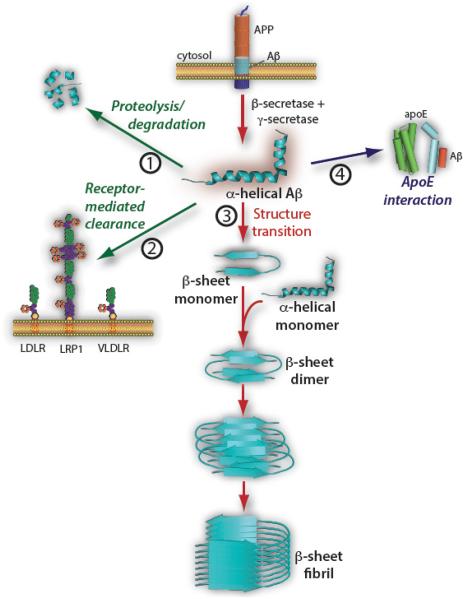
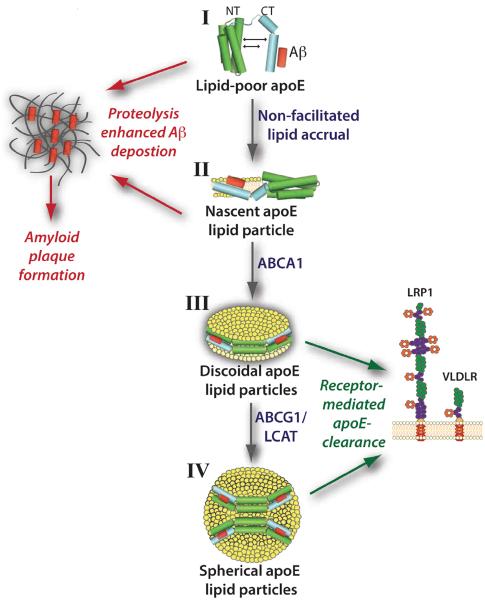
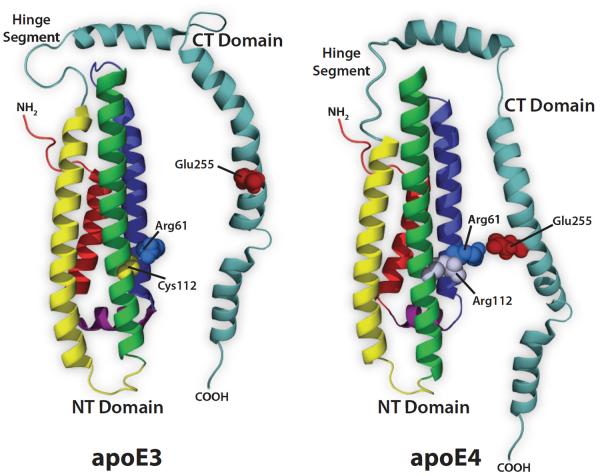
A key feature of Alzheimer's disease (AD) is deposition of extracellular amyloid plaque comprised chiefly of the amyloid β (Aβ) peptide. Studies of Aβ have shown that it may be catabolized by proteolysis or cleared from brain via members of the low-density lipoprotein receptor family. Alternatively, Aβ can undergo a conformational transition from α-helix to β-sheet, a conformer that displays a propensity to self-associate, oligomerize and form fibrils. Furthermore, β- sheet conformers catalyze conversion of other α-helical Aβ peptides to β-sheet, feeding the oligomer and fibril assembly process. A factor that influences the fate of Aβ in the extracellular space is apolipoprotein (apo) E. Polymorphism at position 112 or 158 in apoE give rise to three major isoforms. One isoform in particular, apoE4 (Arg at 112 and 158), has generated considerable interest since the discovery that it is the major genetic risk factor for development of late onset AD. Despite this striking correlation, the molecular mechanism underlying apoE4's association with AD remains unclear. A tertiary structural feature distinguishing apoE4 from apoE2 and apoE3, termed domain interaction, is postulated to affect the conformation and orientation of its' two independently folded domains. This feature has the potential to influence apoE4's interaction with Aβ, its sensitivity to proteolysis or its lipid accrual and receptor binding activities. Thus, domain interaction may constitute the principal molecular feature of apoE4 that predisposes carriers to late onset AD. By understanding the contribution of apoE4 to AD at the molecular level new therapeutic or prevention strategies will emerge.
阿尔茨海默病(AD)的一个主要特征是细胞外淀粉样斑块的沉积,主要由淀粉样β(Aβ)肽组成。对 Aβ 的研究表明,它可能通过低密度脂蛋白受体家族的成员被蛋白水解代谢或从大脑中清除。或者,Aβ 可以经历从α-螺旋到β-折叠的构象转变,这种构象具有自缔合、寡聚化和形成纤维的倾向。此外,β-折叠构象物催化其他α-螺旋 Aβ 肽向β-折叠的转化,为寡聚体和纤维组装过程提供原料。影响细胞外 Aβ 命运的一个因素是载脂蛋白(apo)E。apoE 位置 112 或 158 的多态性产生三种主要的同工型。特别是一种同工型,apoE4(Arg 在 112 和 158),自发现它是晚发性 AD 发展的主要遗传风险因素以来引起了相当大的兴趣。尽管存在这种显著相关性,但 apoE4 与 AD 相关的分子机制仍不清楚。apoE4 与 apoE2 和 apoE3 区分开来的一个三级结构特征,称为结构域相互作用,据推测会影响其两个独立折叠结构域的构象和取向。该特征有可能影响 apoE4 与 Aβ 的相互作用、对蛋白水解的敏感性及其脂质积累和受体结合活性。因此,结构域相互作用可能构成 apoE4 使携带者易患晚发性 AD 的主要分子特征。通过了解 apoE4 在分子水平上对 AD 的贡献,新的治疗或预防策略将出现。