San Joaquín Valley Agricultural Sciences Center, Department of Agriculture, ARS, Parlier, California, United States of America.
PLoS One. 2013 Jun 19;8(6):e67442. doi: 10.1371/journal.pone.0067442. Print 2013.
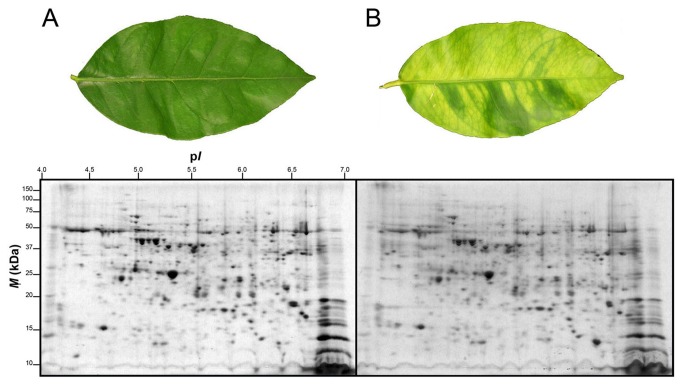
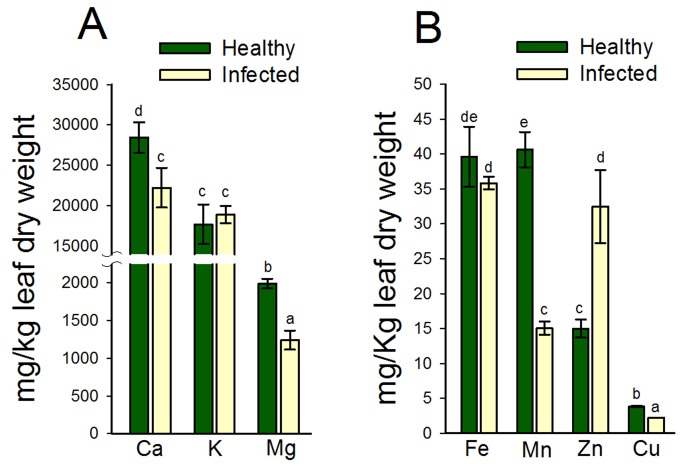
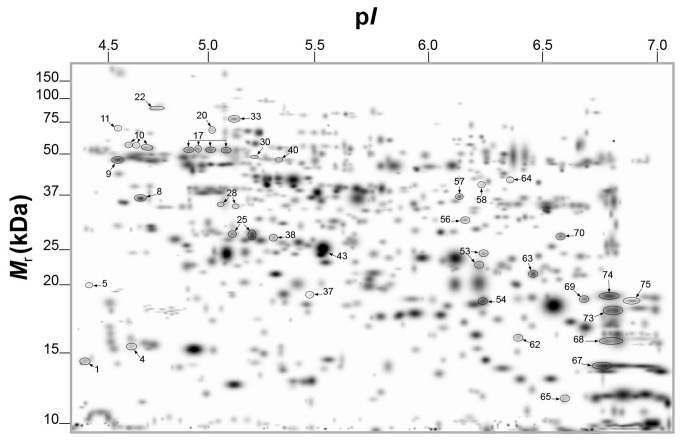
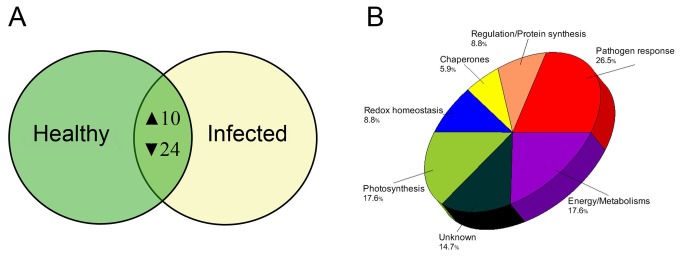
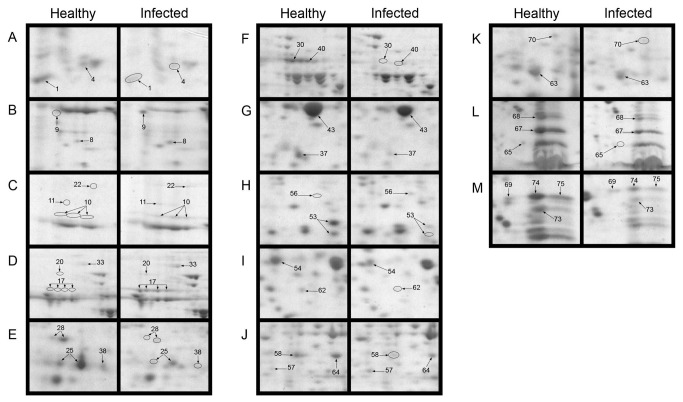
Citrus huanglongbing (HLB) is a highly destructive disease of citrus presumably caused by 'Candidatus Liberibacterasiaticus' (Las), a gram-negative, insect-transmitted, phloem-limited α-proteobacterium. Although almost all citrus plants are susceptible to HLB, reports have shown reduced susceptibility to Las infection in lemon (Citrus limon) plants. The aim of this study is to identify intra-species specific molecular mechanisms associated with Las-induced responses in lemon plants. To achieve this, comparative 2-DE and mass spectrometry, in addition to Inductively Coupled Plasma Spectroscopy (ICPS) analyses, were applied to investigate differences in protein accumulation and the concentrations of cationic elements in leaves of healthy and Las-infected lemon plants. Results showed a differential accumulation of 27 proteins, including an increase in accumulation of starch synthase but decrease in the production of photosynthesis-related proteins in Las-infected lemon plants compared to healthy plants. Furthermore, there was a 6% increase (P > 0.05) in K concentration in leaves of lemon plants upon Las infection, which support results from previous studies and might represent a common response pattern of citrus plants to Las infection. Interestingly, contrary to reports from prior studies, this study showed a general reduction in the production of defense-related pathogen-response proteins but a 128% increase in Zn concentration in lemon plants in response to Las infection. Taken together, this study sheds light on general and intra-species specific responses associated with the response of citrus plants to Las.
黄龙病是一种极具破坏性的柑橘病害,据推测是由“亚洲韧皮杆菌”(Las)引起的,Las 是一种革兰氏阴性、昆虫传播、韧皮部局限的α-变形菌。虽然几乎所有的柑橘植物都容易感染黄龙病,但有报道表明柠檬(Citrus limon)植物对 Las 感染的敏感性降低。本研究的目的是鉴定与柠檬植物中 Las 诱导的反应相关的种内特异性分子机制。为此,应用比较 2-DE 和质谱分析,以及电感耦合等离子体光谱分析(ICPS),来研究健康和 Las 感染柠檬植物叶片中蛋白质积累和阳离子元素浓度的差异。结果表明,在 Las 感染的柠檬植物中,有 27 种蛋白质的积累存在差异,包括淀粉合酶的积累增加,但与光合作用相关的蛋白质产量减少。此外,Las 感染后柠檬植物叶片中 K 浓度增加了 6%(P>0.05),这与先前的研究结果一致,可能代表了柑橘植物对 Las 感染的共同反应模式。有趣的是,与先前的研究报告相反,本研究表明,柠檬植物中防御相关的病原体反应蛋白的产量普遍减少,但对 Las 感染的反应中 Zn 浓度增加了 128%。总之,本研究揭示了柑橘植物对 Las 反应相关的一般和种内特异性反应。