Ingeniería Forestal y del Medio Natural, Universidad de Extremadura, Plasencia, Cáceres, Spain.
PLoS One. 2013 Jul 26;8(7):e70148. doi: 10.1371/journal.pone.0070148. Print 2013.
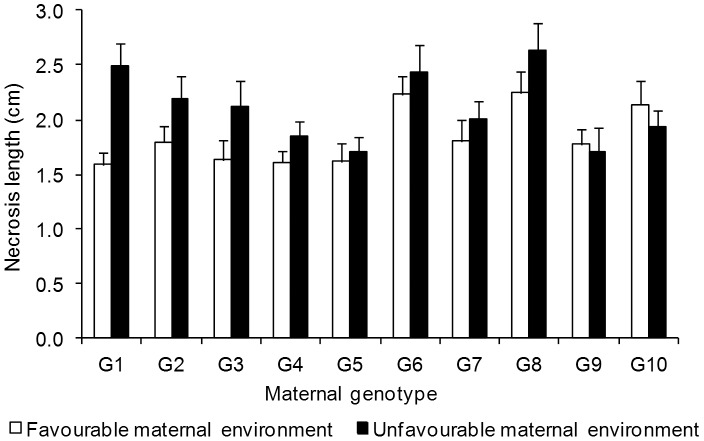
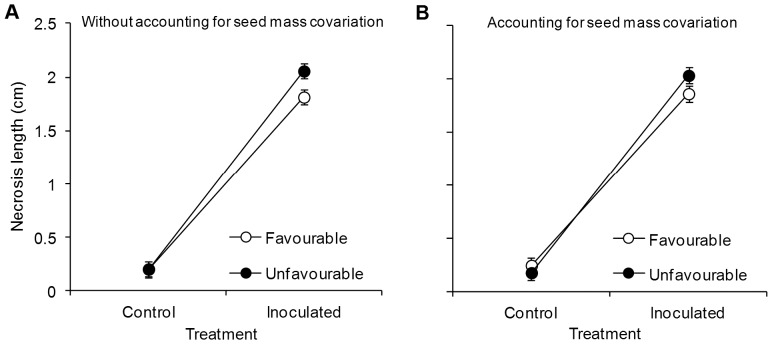
The resistance to abiotic stress is increasingly recognised as being impacted by maternal effects, given that environmental conditions experienced by parent (mother) trees affect stress tolerance in offspring. We hypothesised that abiotic environmental maternal effects may also mediate the resistance of trees to biotic stress. The influence of maternal environment and maternal genotype and the interaction of these two factors on early resistance of Pinus pinaster half-sibs to the Fusarium circinatum pathogen was studied using 10 mother genotypes clonally replicated in two contrasting environments. Necrosis length of infected seedlings was 16% shorter in seedlings grown from favourable maternal environment seeds than in seedlings grown from unfavourable maternal environment seeds. Damage caused by F. circinatum was mediated by maternal environment and maternal genotype, but not by seed mass. Mechanisms unrelated to seed provisioning, perhaps of epigenetic nature, were probably involved in the transgenerational plasticity of P. pinaster, mediating its resistance to biotic stress. Our findings suggest that the transgenerational resistance of pines due to an abiotic stress may interact with the defensive response of pines to a biotic stress.
越来越多的人认识到,非生物胁迫的抗性受到母体效应的影响,因为亲代(母亲)树木所经历的环境条件会影响后代的胁迫耐受性。我们假设非生物环境的母体效应也可能调节树木对生物胁迫的抗性。使用在两个不同环境中克隆复制的 10 个母本基因型,研究了母体环境和母本基因型对 Pinus pinaster 半同胞早期对 Fusarium circinatum 病原体抗性的影响,以及这两个因素的相互作用。与在不利的母体环境种子中生长的幼苗相比,在有利的母体环境种子中生长的感染幼苗的坏死长度短 16%。由 F. circinatum 引起的损伤受母体环境和母本基因型调节,但不受种子质量调节。与种子供应无关的机制,可能具有表观遗传性质,可能参与了 P. pinaster 的跨代可塑性,调节其对生物胁迫的抗性。我们的研究结果表明,由于非生物胁迫导致的松树的跨代抗性可能与松树对生物胁迫的防御反应相互作用。