Department of Biostatistics, Johns Hopkins Bloomberg School of Public Health, Baltimore, Maryland, USA.
Environ Health Perspect. 2013 Oct;121(10):1111-9. doi: 10.1289/ehp.1206273. Epub 2013 Aug 9.
Environmental health research employs a variety of metrics to measure heat exposure, both to directly study the health effects of outdoor temperature and to control for temperature in studies of other environmental exposures, including air pollution. To measure heat exposure, environmental health studies often use heat index, which incorporates both air temperature and moisture. However, the method of calculating heat index varies across environmental studies, which could mean that studies using different algorithms to calculate heat index may not be comparable.
We investigated 21 separate heat index algorithms found in the literature to determine a) whether different algorithms generate heat index values that are consistent with the theoretical concepts of apparent temperature and b) whether different algorithms generate similar heat index values.
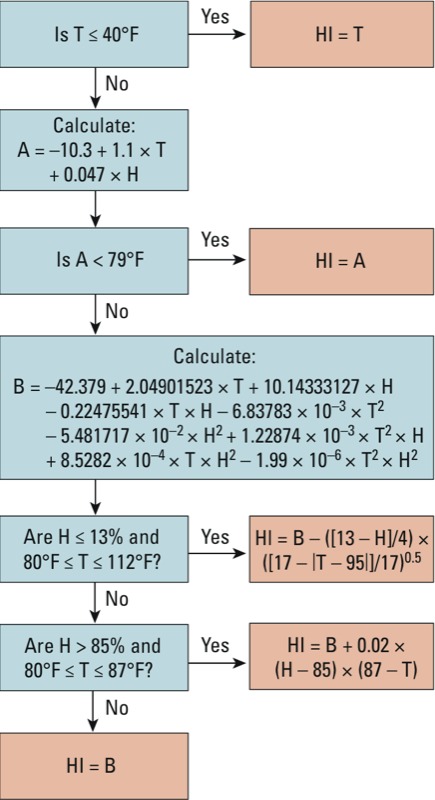
Although environmental studies differ in how they calculate heat index values, most studies' heat index algorithms generate values consistent with apparent temperature. Additionally, most different algorithms generate closely correlated heat index values. However, a few algorithms are potentially problematic, especially in certain weather conditions (e.g., very low relative humidity, cold weather). To aid environmental health researchers, we have created open-source software in R to calculate the heat index using the U.S. National Weather Service's algorithm.
We identified 21 separate heat index algorithms used in environmental research. Our analysis demonstrated that methods to calculate heat index are inconsistent across studies. Careful choice of a heat index algorithm can help ensure reproducible and consistent environmental health research.
环境健康研究采用了各种指标来衡量热暴露,这些指标既可以直接研究室外温度对健康的影响,也可以在研究其他环境暴露因素(包括空气污染)时控制温度。为了测量热暴露,环境健康研究通常使用包含空气温度和湿度的热指数。然而,不同的环境研究采用不同的方法来计算热指数,这可能意味着使用不同算法来计算热指数的研究可能无法进行比较。
我们调查了文献中发现的 21 种不同的热指数算法,以确定:a)不同的算法是否生成与表观温度的理论概念一致的热指数值,以及 b)不同的算法是否生成相似的热指数值。
尽管环境研究在计算热指数值的方法上有所不同,但大多数研究的热指数算法生成的值与表观温度一致。此外,大多数不同的算法生成的热指数值密切相关。然而,有几种算法可能存在问题,尤其是在某些天气条件下(例如,非常低的相对湿度、寒冷的天气)。为了帮助环境健康研究人员,我们使用 R 语言创建了开源软件,以使用美国国家气象局的算法来计算热指数。
我们确定了 21 种在环境研究中使用的不同热指数算法。我们的分析表明,计算热指数的方法在研究中不一致。仔细选择热指数算法可以帮助确保环境健康研究的可重复性和一致性。