Unit for Social and Community Psychiatry, Barts and the London School of Medicine and Dentistry, Queen Mary University of London, London, United Kingdom.
PLoS One. 2013 Aug 2;8(8):e70252. doi: 10.1371/journal.pone.0070252. Print 2013.
There is an emerging evidence base for the use of music therapy in the treatment of severe mental illness. Whilst different models of music therapy have been developed in mental health care, none have specifically accounted for the features and context of acute in-patient settings. This review aimed to identify how music therapy is provided for acute adult psychiatric in-patients and what outcomes have been reported.
A systematic review using medical, psychological and music therapy databases. Papers describing music therapy with acute adult psychiatric in-patients were included. Analysis utilised narrative synthesis.
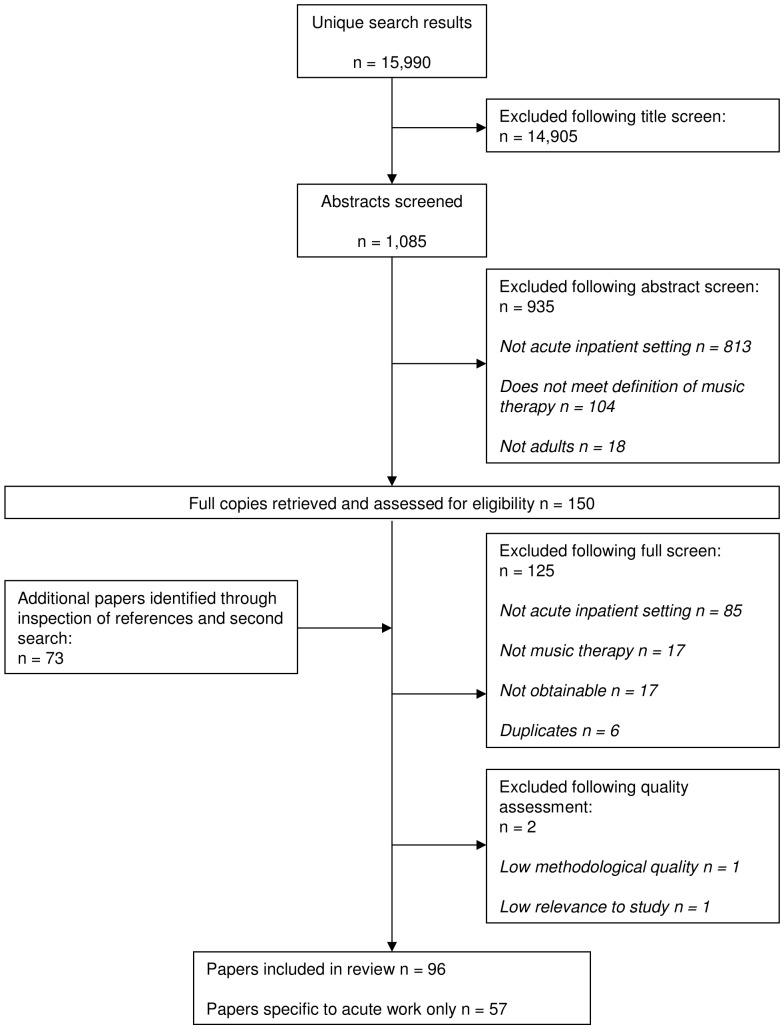
98 papers were identified, of which 35 reported research findings. Open group work and active music making for nonverbal expression alongside verbal reflection was emphasised. Aims were engagement, communication and interpersonal relationships focusing upon immediate areas of need rather than longer term insight. The short stay, patient diversity and institutional structure influenced delivery and resulted in a focus on single sessions, high session frequency, more therapist direction, flexible use of musical activities, predictable musical structures, and clear realistic goals. Outcome studies suggested effectiveness in addressing a range of symptoms, but were limited by methodological shortcomings and small sample sizes. Studies with significant positive effects all used active musical participation with a degree of structure and were delivered in four or more sessions.
No single clearly defined model exists for music therapy with adults in acute psychiatric in-patient settings, and described models are not conclusive. Greater frequency of therapy, active structured music making with verbal discussion, consistency of contact and boundaries, an emphasis on building a therapeutic relationship and building patient resources may be of particular importance. Further research is required to develop specific music therapy models for this patient group that can be tested in experimental studies.
音乐疗法在治疗严重精神疾病方面的应用有了新的证据基础。尽管在精神卫生保健中已经开发出不同的音乐治疗模式,但没有一种模式专门考虑到急性住院环境的特点和背景。本综述旨在确定音乐疗法如何用于急性成年精神病住院患者,以及报告了哪些结果。
使用医学、心理和音乐治疗数据库进行系统综述。纳入描述急性成年精神病住院患者音乐治疗的论文。分析采用叙述性综合。
确定了 98 篇论文,其中 35 篇报告了研究结果。强调开放式团体工作和非言语表达的主动音乐创作以及言语反思。目标是参与、沟通和人际关系,重点是即时的需求领域,而不是长期的洞察力。短暂的停留、患者的多样性和机构结构影响了交付,导致专注于单次治疗、高治疗频率、更多治疗师指导、灵活使用音乐活动、可预测的音乐结构和明确的现实目标。结果研究表明,该方法在解决一系列症状方面具有有效性,但受到方法学缺陷和小样本量的限制。具有显著积极效果的研究都使用了具有一定结构的主动音乐参与,并进行了 4 次或更多次治疗。
在急性精神病住院患者中,没有明确的单一音乐治疗模式存在,描述的模式也不具有结论性。更频繁的治疗、主动的结构化音乐创作与言语讨论、接触和界限的一致性、强调建立治疗关系和建立患者资源可能特别重要。需要进一步研究为这一患者群体开发特定的音乐治疗模式,以便在实验研究中进行测试。