Département de Démographie, Université de Montréal, Montreal, Quebec, Canada.
PLoS One. 2013 Aug 5;8(8):e69586. doi: 10.1371/journal.pone.0069586. Print 2013.
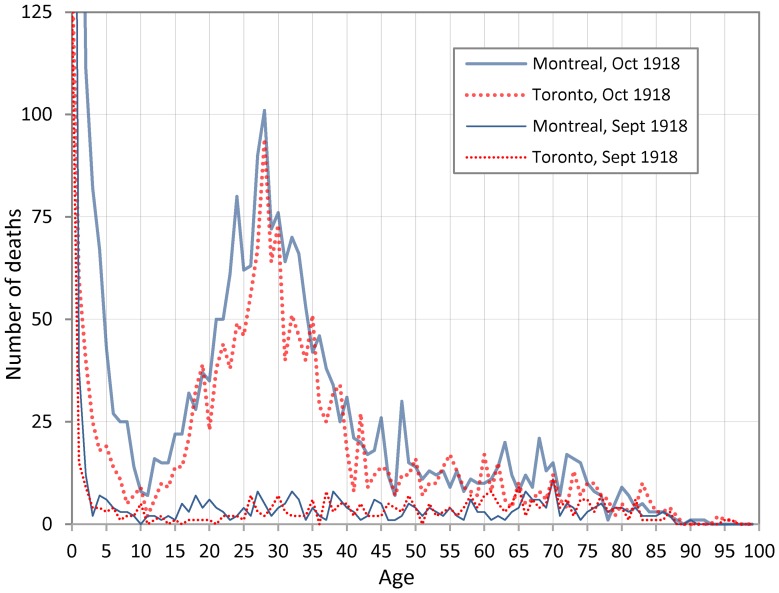
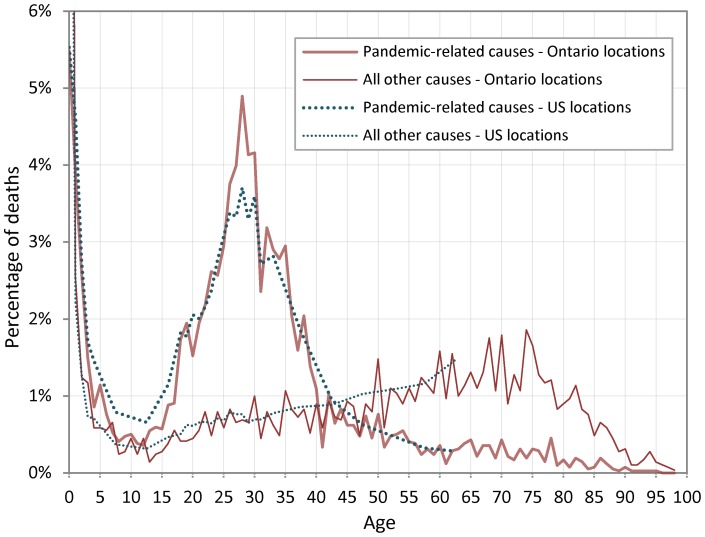
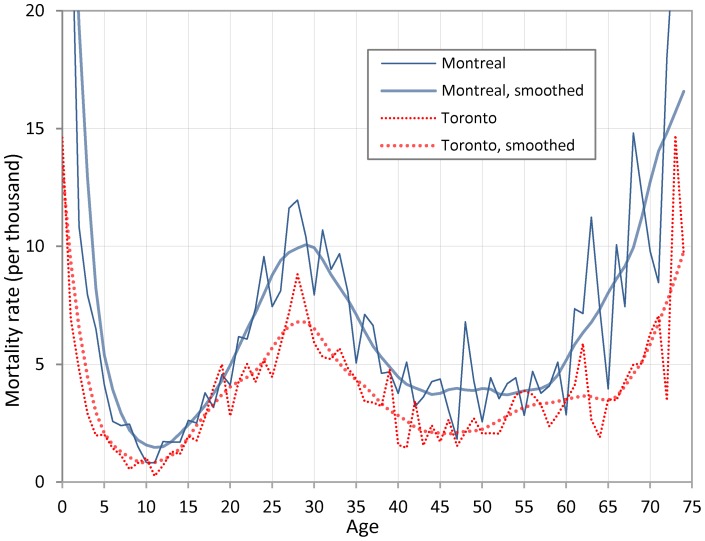
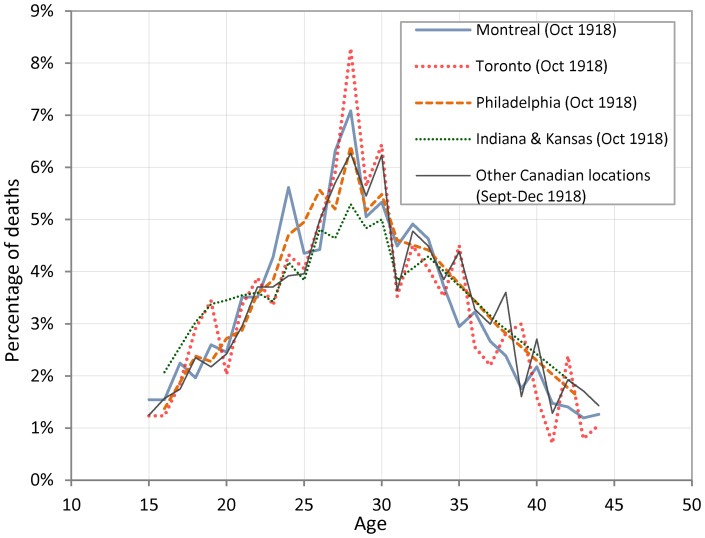
The worldwide spread of a novel influenza A (H1N1) virus in 2009 showed that influenza remains a significant health threat, even for individuals in the prime of life. This paper focuses on the unusually high young adult mortality observed during the Spanish flu pandemic of 1918. Using historical records from Canada and the U.S., we report a peak of mortality at the exact age of 28 during the pandemic and argue that this increased mortality resulted from an early life exposure to influenza during the previous Russian flu pandemic of 1889-90. We posit that in specific instances, development of immunological memory to an influenza virus strain in early life may lead to a dysregulated immune response to antigenically novel strains encountered in later life, thereby increasing the risk of death. Exposure during critical periods of development could also create holes in the T cell repertoire and impair fetal maturation in general, thereby increasing mortality from infectious diseases later in life. Knowledge of the age-pattern of susceptibility to mortality from influenza could improve crisis management during future influenza pandemics.
2009 年,新型甲型流感(H1N1)病毒在全球范围内传播,这表明流感仍然是一个重大的健康威胁,即使是在青壮年人群中也是如此。本文重点关注了 1918 年西班牙流感大流行期间观察到的异常高的年轻成年人死亡率。我们利用来自加拿大和美国的历史记录,报告了大流行期间死亡率在 28 岁时达到峰值,并认为这种死亡率的增加是由于在 1889-90 年俄罗斯流感大流行期间早年接触流感病毒所致。我们假设,在某些情况下,早年对流感病毒株产生的免疫记忆可能导致对以后生活中遇到的抗原性新型病毒株产生失调的免疫反应,从而增加死亡风险。在发育的关键时期暴露也可能导致 T 细胞库出现漏洞,并普遍损害胎儿成熟度,从而增加以后生活中死于传染病的风险。了解对流感死亡率的易感性的年龄模式可以改善未来流感大流行期间的危机管理。