Division of Applied Medicine, University of Aberdeen, Aberdeen, United Kingdom.
PLoS One. 2013 Aug 5;8(8):e70436. doi: 10.1371/journal.pone.0070436. Print 2013.
Epidemiological studies suggest three daily servings of whole-grain foods (WGF) might lower cardiovascular disease risk, at least partly by lowering serum lipid levels. We have assessed the effects of consuming three daily portions of wholegrain food (provided as wheat or a mixture of wheat and oats) on lipoprotein subclass size and concentration in a dietary randomised controlled trial involving middle aged healthy individuals.
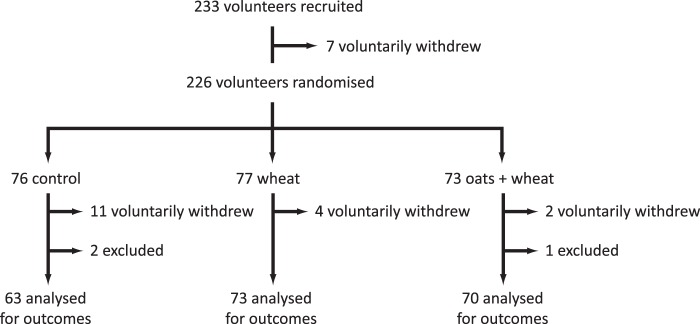
After a 4-week run-in period on a refined diet, volunteers were randomly allocated to a control (refined diet), wheat, or wheat + oats group for 12 weeks. Our servings were determined in order to significantly increase the intakes of non starch polysaccharides to the UK Dietary Reference Value of 18 g per day in the whole grain groups (18.5 g and 16.8 g per day in the wheat and wheat + oats groups respectively in comparison with 11.3 g per day in the control group). Outcome measures were serum lipoprotein subclasses' size and concentration. Habitual dietary intake was assessed prior and during the intervention. Of the 233 volunteers recruited, 24 withdrew and 3 were excluded.
At baseline, significant associations were found between lipoprotein size and subclasses' concentrations and some markers of cardiovascular risk such as insulin resistance, blood pressure and serum Inter cellular adhesion molecule 1 concentration. Furthermore, alcohol and vitamin C intake were positively associated with an anti-atherogenic lipoprotein profile, with regards to lipoprotein size and subclasses' distribution. However, none of the interventions with whole grain affected lipoprotein size and profile.
Our results indicate that three portions of wholegrain foods, irrelevant of the type (wheat or oat-based) do not reduce cardiovascular risk by beneficially altering the size and distribution of lipoprotein subclasses.
www.Controlled-Trials.com ISRCTN 27657880.
流行病学研究表明,每天食用三份全谷物食品(WGF)可能降低心血管疾病的风险,这至少部分是通过降低血清脂质水平实现的。我们评估了每天食用三份全谷物食品(提供小麦或小麦和燕麦的混合物)对脂蛋白亚类大小和浓度的影响,这是一项涉及中年健康个体的饮食随机对照试验。
在精制饮食的 4 周适应期后,志愿者被随机分配到对照组(精制饮食)、小麦组或小麦+燕麦组,进行 12 周的试验。我们的份量是为了显著增加非淀粉多糖的摄入量,使全谷物组达到英国膳食参考值的 18 克/天(与对照组相比,小麦组和小麦+燕麦组分别为 18.5 克和 16.8 克/天,而对照组为 11.3 克/天)。测量指标为血清脂蛋白亚类的大小和浓度。在干预前后评估习惯性饮食摄入量。在招募的 233 名志愿者中,24 人退出,3 人被排除。
在基线时,脂蛋白大小与亚类浓度之间存在显著关联,并且一些心血管风险标志物如胰岛素抵抗、血压和血清细胞间黏附分子 1 浓度也存在显著关联。此外,酒精和维生素 C 的摄入量与脂蛋白大小和亚类分布的抗动脉粥样硬化脂蛋白谱呈正相关。然而,全谷物的任何干预都没有影响脂蛋白的大小和特征。
我们的结果表明,三份全谷物食品(无论类型如何,小麦或燕麦为基础)并不能通过有益地改变脂蛋白亚类的大小和分布来降低心血管风险。
www.Controlled-Trials.com ISRCTN 27657880。