The Centre for Medication Safety and Service Quality, Imperial College Healthcare NHS Trust, Charing Cross Hospital, Fulham Palace Road, London, W6 8RF, UK,
Drug Saf. 2013 Dec;36(12):1151-7. doi: 10.1007/s40264-013-0092-0.
Prescribing errors are common. It has been suggested that the severity as well as the frequency of errors should be assessed when measuring prescribing error rates. This would provide more clinically relevant information, and allow more complete evaluation of the effectiveness of interventions designed to reduce errors.
The objective of this systematic review was to describe the tools used to assess prescribing error severity in studies reporting hospital prescribing error rates.
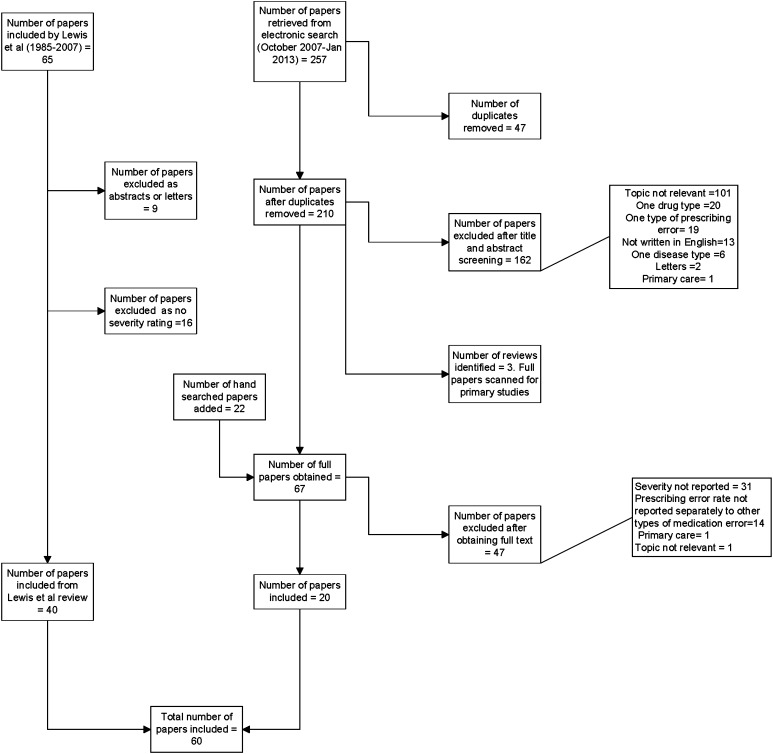
The following databases were searched: MEDLINE, EMBASE, International Pharmaceutical Abstracts, and CINAHL (January 1985-January 2013).
We included studies that reported the detection and rate of prescribing errors in prescriptions for adult and/or pediatric hospital inpatients, or elaborated on the properties of severity assessment tools used by these studies. Studies not published in English, or that evaluated errors for only one disease or drug class, one route of administration, or one type of prescribing error, were excluded, as were letters and conference abstracts. One reviewer screened all abstracts and obtained complete articles. A second reviewer assessed 10 % of all abstracts and complete articles to check reliability of the screening process.
Tools were appraised for country and method of development, whether the tool assessed actual or potential harm, levels of severity assessed, and results of any validity and reliability studies.
Fifty-seven percent of 107 studies measuring prescribing error rates included an assessment of severity. Forty tools were identified that assessed severity, only two of which had acceptable reliability and validity. In general, little information was given on the method of development or ease of use of the tools, although one tool required four reviewers and was thus potentially time consuming.
The review was limited to studies written in English. One of the review authors was also the author of one of the tools, giving a potential source of bias.
A wide range of severity assessment tools are used in the literature. Developing a basis of comparison between tools would potentially be helpful in comparing findings across studies. There is a potential need to establish a less time-consuming method of measuring severity of prescribing error, with acceptable international reliability and validity.
开具处方错误较为常见。在衡量处方错误率时,不仅应评估错误的严重程度,还应评估其发生频率。这将提供更具临床意义的信息,并能更全面地评估旨在减少错误的干预措施的效果。
本系统评价旨在描述报告医院处方错误率的研究中用于评估处方错误严重程度的工具。
检索了以下数据库:MEDLINE、EMBASE、国际药学文摘和 CINAHL(1985 年 1 月至 2013 年 1 月)。
我们纳入了报告成人和/或儿科住院患者处方中检测到的和/或报告处方错误率的研究,以及详述这些研究所用严重程度评估工具特征的研究。排除未以英文发表的研究,或仅评估一种疾病或一类药物、一种给药途径或一种类型的处方错误的研究,也排除信件和会议摘要。一位评审员筛选所有摘要并获取全文。第二位评审员评估了 10%的摘要和全文,以检查筛选过程的可靠性。
评估工具的开发国家和方法、工具评估实际或潜在危害、评估的严重程度级别以及任何有效性和可靠性研究的结果。
在报告处方错误率的 107 项研究中,57%包括对严重程度的评估。共确定了 40 种评估严重程度的工具,其中仅有 2 种工具具有可接受的信度和效度。一般而言,关于工具的开发方法或易用性的信息很少,但有一种工具需要 4 位评审员,因此可能会很耗时。
本评价仅纳入了以英文发表的研究。本评价的一位评审员也是其中一种工具的作者,这可能会造成潜在的偏倚。
文献中使用了多种严重程度评估工具。在工具之间建立一个比较基础可能有助于比较研究间的结果。可能需要建立一种更耗时少、具有可接受的国际信度和效度的测量处方错误严重程度的方法。