Laboratory of Medical Microbiology and Immunology, St. Elisabeth Hospital, Tilburg, The Netherlands; Department of Medical Microbiology, Albert Schweitzer Hospital, Dordrecht, The Netherlands.
Influenza Other Respir Viruses. 2014 Mar;8(2):243-9. doi: 10.1111/irv.12153. Epub 2013 Aug 20.
For the detection of respiratory pathogens, the sampling strategy may influence the diagnostic yield. Ideally, samples from the lower respiratory tract are collected, but they are difficult to obtain.
In this study, we compared the diagnostic yield in sputum and oropharyngeal samples (OPS) for the detection of respiratory pathogens in patients with community-acquired pneumonia (CAP), with the objective to optimize our diagnostic testing algorithm.
Matched sputum samples, OPS, blood cultures, serum, and urine samples were taken from patients (>18 years) with CAP and tested for the presence of possible respiratory pathogens using bacterial cultures, PCR for 17 viruses and five bacteria and urinary antigen testing.
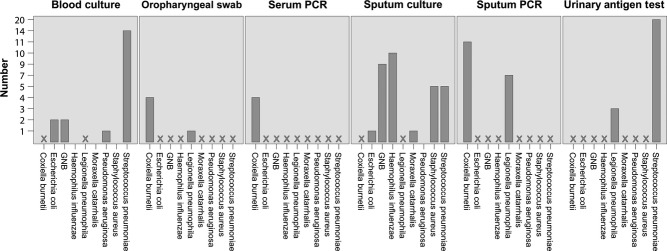
When using only conventional methods, that is, blood cultures, sputum culture, urinary antigen tests, a pathogen was detected in 49·6% of patients (n = 57). Adding molecular detection assays increased the yield to 80%. A pathogen was detected in 77 of the 115 patients in OPS or sputum samples by PCR. The sensitivity of the OPS was lower than that of the sputum samples (57% versus 74%). In particular, bacterial pathogens were more often detected in sputum samples. The sensitivity of OPS for the detection of most viruses was higher than in sputum samples (72% versus 66%), except for human rhinovirus and respiratory syncytial virus.
Addition of PCR on both OPS and sputum samples significantly increased the diagnostic yield. For molecular detection of bacterial pathogens, a sputum sample is imperative, but for detection of most viral pathogens, an OPS is sufficient.
为了检测呼吸道病原体,采样策略可能会影响诊断率。理想情况下,应采集下呼吸道样本,但此类样本难以获取。
本研究旨在比较社区获得性肺炎(CAP)患者痰液和口咽拭子(OPS)样本检测呼吸道病原体的诊断率,以期优化诊断检测算法。
采集 CAP 患者配对的痰液、OPS、血培养、血清和尿液样本,使用细菌培养、17 种病毒和 5 种细菌的 PCR 以及尿抗原检测,检测可能的呼吸道病原体。
仅使用血培养、痰培养和尿抗原检测等常规方法时,49.6%(n=57)的患者可检测到病原体。增加分子检测方法可将检出率提高至 80%。115 例患者中有 77 例在 OPS 或痰液样本中通过 PCR 检测到病原体。OPS 的敏感性低于痰液样本(57%比 74%)。特别是,痰液样本中更常检测到细菌病原体。OPS 检测大多数病毒的敏感性高于痰液样本(72%比 66%),但人鼻病毒和呼吸道合胞病毒除外。
在 OPS 和痰液样本上增加 PCR 可显著提高诊断率。对于细菌病原体的分子检测,必须采集痰液样本,但对于大多数病毒病原体的检测,OPS 即可满足需求。