Weathers Judah, Brotman Melissa A, Deveney Christen M, Kim Pilyoung, Zarate Carlos, Fromm Stephen, Pine Daniel, Leibenluft Ellen
Section on Bipolar Spectrum Disorders, Emotion and Development Branch, National Institute of Mental Health, National Institutes of Health, U.S. Department of Health and Human Services, Bethesda, MD, USA.
Psychiatry Res. 2013 Oct 30;214(1):56-65. doi: 10.1016/j.pscychresns.2013.05.002. Epub 2013 Aug 17.
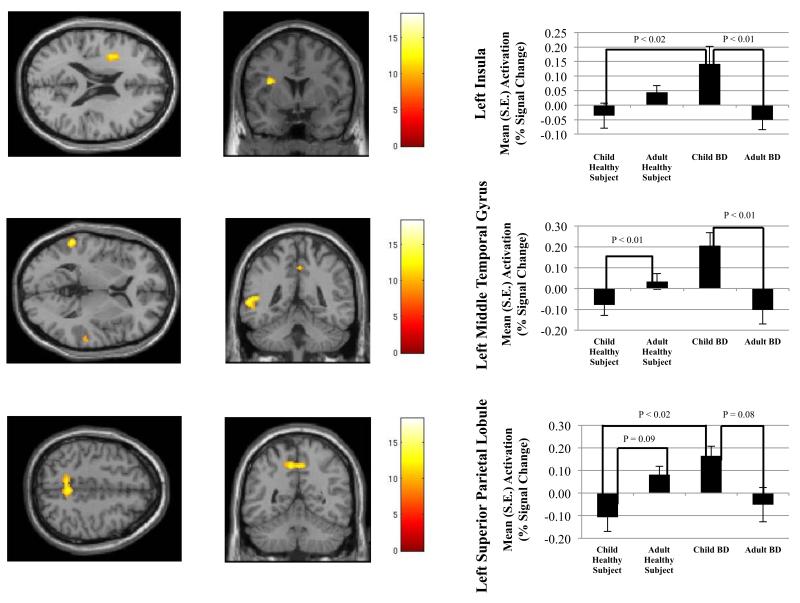
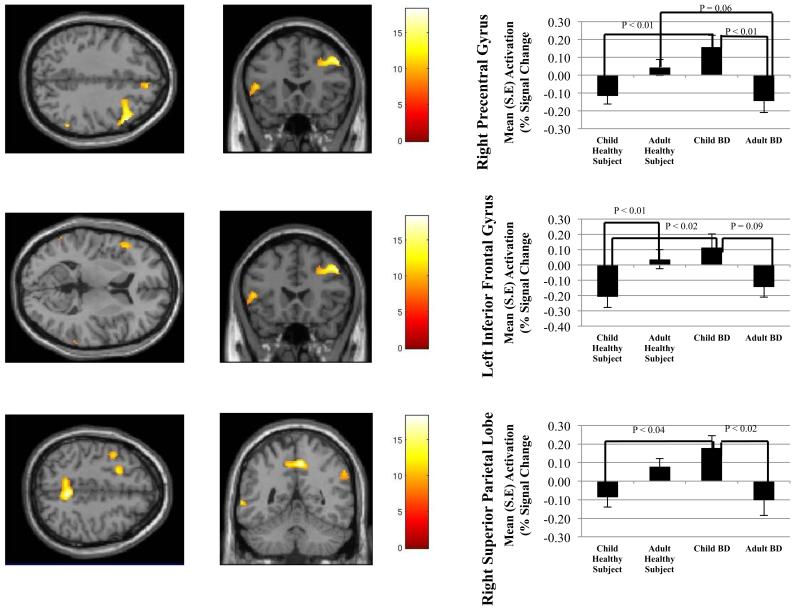
Cross-sectional neuroimaging studies are an important first step in examining developmental differences in brain function between adults and youth with bipolar disorder (BD). Impaired response flexibility may contribute to reduced ability to modify goal-directed behavior in BD appropriately. We compared neural circuitry mediating this process in child (CBD) vs. adult BD (ABD) and age-matched healthy subjects. fMRI data from 15 CBD, 23 ABD, 20 healthy children, and 27 healthy adults were acquired during a response flexibility paradigm, a task where subjects inhibit a prepotent response and execute an alternative response. When successfully executing an alternate response, CBD showed frontal, parietal, and temporal hyperactivation relative to healthy children and ABD, while ABD hypoactivated these regions relative to healthy adults. Previous studies of response flexibility in healthy volunteers revealed frontal, temporal, and parietal cortex hyperactivation in children and hypoactivation in adults. Relative to age-matched healthy subjects, we found hyperactivation in these regions in CBD and hypoactivation in ABD. This suggests that our findings in patients may represent the extreme extension of the age-related response flexibility activation differences found in healthy subjects. Future studies should use longitudinal fMRI to examine the developmental trajectory of the neural circuitry mediating response flexibility in BD.
横断面神经影像学研究是检验双相情感障碍(BD)成人和青少年脑功能发育差异的重要第一步。反应灵活性受损可能导致双相情感障碍患者适当改变目标导向行为的能力下降。我们比较了儿童双相情感障碍(CBD)与成人双相情感障碍(ABD)以及年龄匹配的健康受试者中介导这一过程的神经回路。在一个反应灵活性范式任务中,即受试者抑制优势反应并执行替代反应的任务期间,获取了15名儿童双相情感障碍患者、23名成人双相情感障碍患者、20名健康儿童和27名健康成人的功能磁共振成像(fMRI)数据。在成功执行替代反应时,相对于健康儿童和成人双相情感障碍患者,儿童双相情感障碍患者的额叶、顶叶和颞叶出现激活增强,而成人双相情感障碍患者相对于健康成人这些区域激活减弱。先前对健康志愿者反应灵活性的研究表明,儿童的额叶、颞叶和顶叶皮质激活增强,而成人激活减弱。相对于年龄匹配的健康受试者,我们发现儿童双相情感障碍患者这些区域激活增强,成人双相情感障碍患者激活减弱。这表明我们在患者中的发现可能代表了在健康受试者中发现的与年龄相关的反应灵活性激活差异的极端情况。未来的研究应该使用纵向功能磁共振成像来研究双相情感障碍中介导反应灵活性的神经回路的发育轨迹。