Neurocentre Magendie, Physiopathologie de la Plasticité Neuronale, U862, INSERM, 146 rue Léo Saignat, Bordeaux, 33076, France,
Psychopharmacology (Berl). 2013 Oct;229(3):387-413. doi: 10.1007/s00213-013-3224-4. Epub 2013 Aug 21.
Several theories propose alternative explanations for drug addiction.
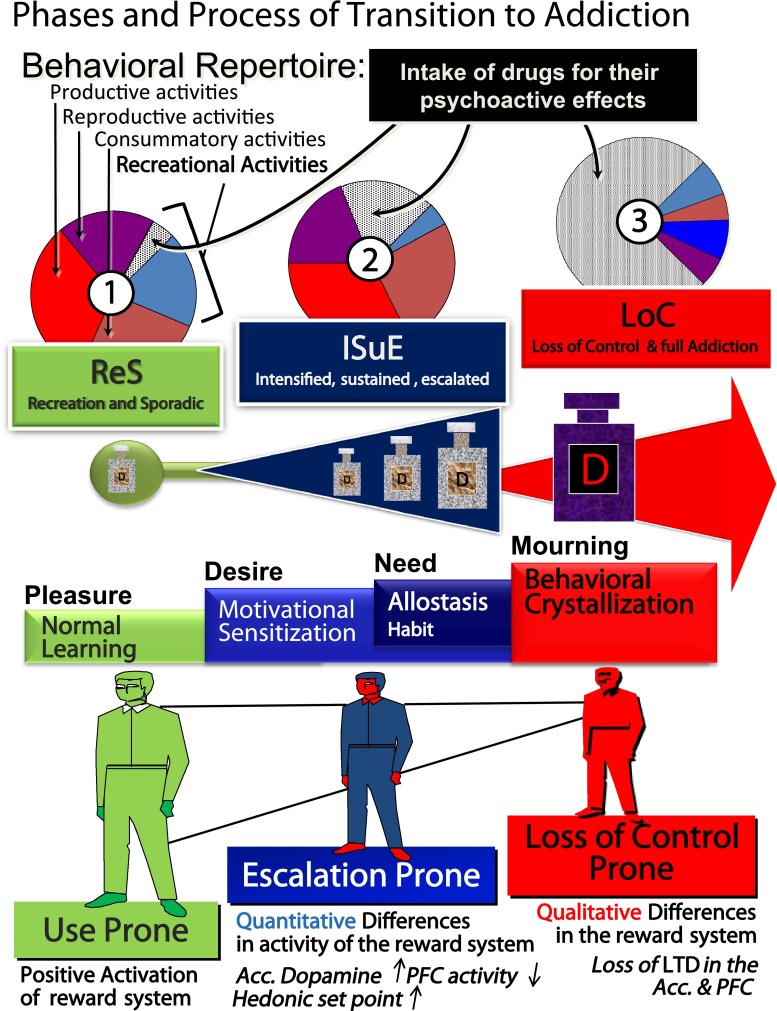
We propose a general theory of transition to addiction that synthesizes knowledge generated in the field of addiction into a unitary explanatory frame.
Transition to addiction results from a sequential three-step interaction between: (1) individual vulnerability; (2) degree/amount of drug exposure. The first step, sporadic recreational drug use is a learning process mediated by overactivation of neurobiological substrates of natural rewards that allows most individuals to perceive drugs as highly rewarding stimuli. The second, intensified, sustained, escalated drug use occurs in some vulnerable individuals who have a hyperactive dopaminergic system and impaired prefrontal cortex function. Sustained and prolonged drug use induces incentive sensitization and an allostatic state that makes drugs strongly wanted and needed. Habit formation can also contribute to stabilizing sustained drug use. The last step, loss of control of drug intake and full addiction, is due to a second vulnerable phenotype. This loss-of-control-prone phenotype is triggered by long-term drug exposure and characterized by long-lasting loss of synaptic plasticity in reward areas in the brain that induce a form of behavioral crystallization resulting in loss of control of drug intake. Because of behavioral crystallization, drugs are now not only wanted and needed but also pathologically mourned when absent.
This general theory demonstrates that drug addiction is a true psychiatric disease caused by a three-step interaction between vulnerable individuals and amount/duration of drug exposure.
有几种理论对药物成瘾提出了替代解释。
我们提出了一种成瘾的一般理论,将成瘾领域产生的知识综合到一个统一的解释框架中。
成瘾的转变是个体易感性与药物暴露程度/量的顺序三步相互作用的结果。第一步,偶尔的消遣性药物使用是一个由神经生物学自然奖赏基质过度激活介导的学习过程,使大多数人将药物视为高度奖赏的刺激。第二步,在一些易感性个体中,强化、持续、升级的药物使用发生,他们的多巴胺能系统过度活跃,前额叶皮层功能受损。持续和长期的药物使用会导致激励敏化和适应状态,使药物强烈地被渴望和需要。习惯形成也可能有助于稳定持续的药物使用。最后一步,即对药物摄入的控制丧失和完全成瘾,是由于第二种易感性表型。这种易失控表型是由长期的药物暴露触发的,其特征是大脑奖励区域的突触可塑性长期丧失,导致行为结晶化,从而导致对药物摄入的控制丧失。由于行为结晶化,药物不仅被渴望和需要,而且在不存在时还会被病态地哀悼。
该一般理论表明,药物成瘾是一种真正的精神疾病,由易感性个体与药物暴露量/时间的三步相互作用引起。