Joint Influenza Research Centre (SUMC/HKU), Shantou University Medical College, Shantou 515041, China.
Nature. 2013 Oct 10;502(7470):241-4. doi: 10.1038/nature12515. Epub 2013 Aug 21.
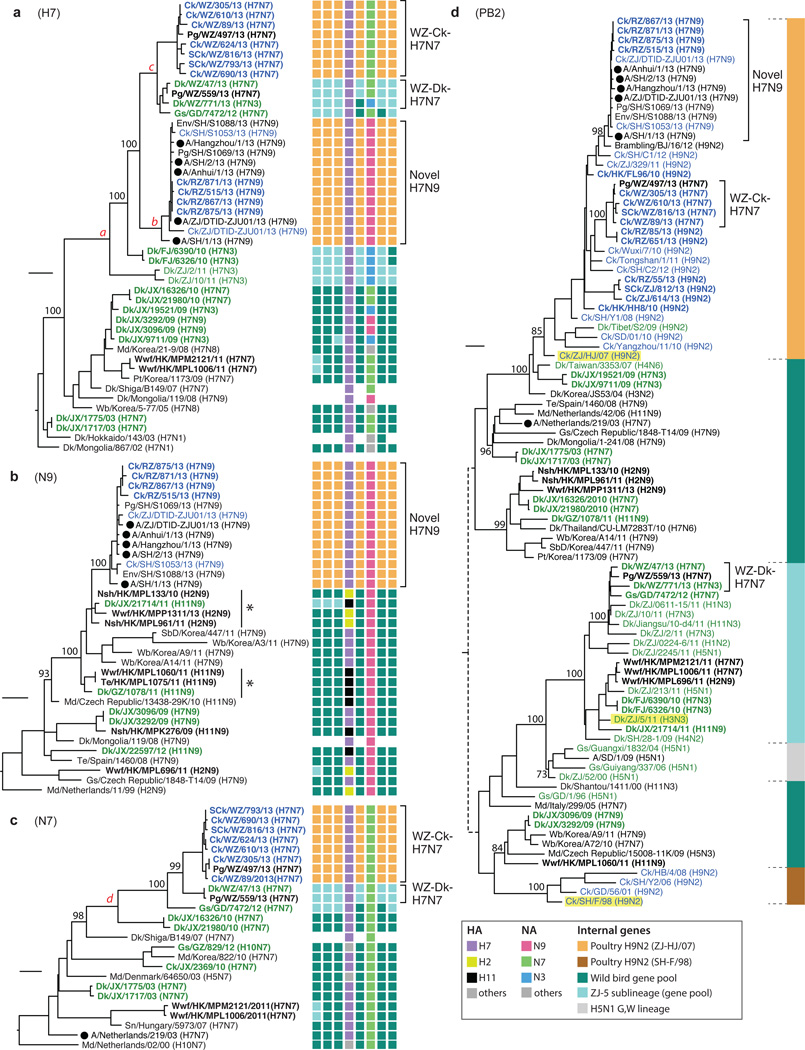
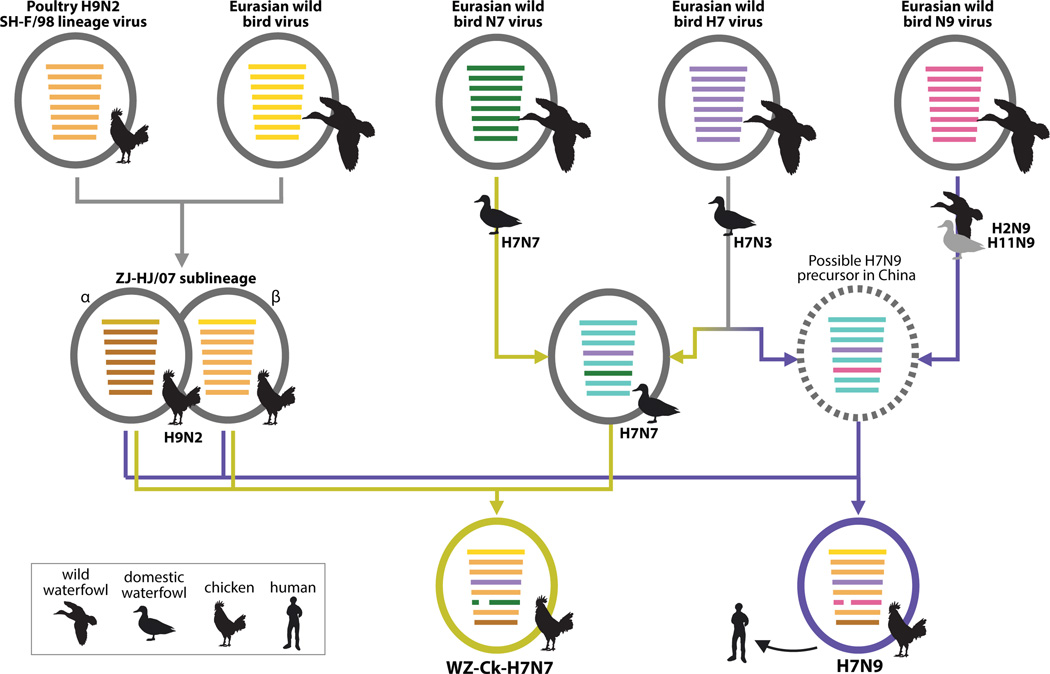
A novel H7N9 influenza A virus first detected in March 2013 has since caused more than 130 human infections in China, resulting in 40 deaths. Preliminary analyses suggest that the virus is a reassortant of H7, N9 and H9N2 avian influenza viruses, and carries some amino acids associated with mammalian receptor binding, raising concerns of a new pandemic. However, neither the source populations of the H7N9 outbreak lineage nor the conditions for its genesis are fully known. Using a combination of active surveillance, screening of virus archives, and evolutionary analyses, here we show that H7 viruses probably transferred from domestic duck to chicken populations in China on at least two independent occasions. We show that the H7 viruses subsequently reassorted with enzootic H9N2 viruses to generate the H7N9 outbreak lineage, and a related previously unrecognized H7N7 lineage. The H7N9 outbreak lineage has spread over a large geographic region and is prevalent in chickens at live poultry markets, which are thought to be the immediate source of human infections. Whether the H7N9 outbreak lineage has, or will, become enzootic in China and neighbouring regions requires further investigation. The discovery here of a related H7N7 influenza virus in chickens that has the ability to infect mammals experimentally, suggests that H7 viruses may pose threats beyond the current outbreak. The continuing prevalence of H7 viruses in poultry could lead to the generation of highly pathogenic variants and further sporadic human infections, with a continued risk of the virus acquiring human-to-human transmissibility.
一种新型 H7N9 流感病毒于 2013 年 3 月首次被发现,此后已在中国导致超过 130 人感染,造成 40 人死亡。初步分析表明,该病毒是 H7、N9 和 H9N2 禽流感病毒的重组病毒,携带一些与哺乳动物受体结合相关的氨基酸,引发了对新的大流行的担忧。然而,H7N9 爆发谱系的来源人群及其起源条件都不完全清楚。我们采用主动监测、病毒档案筛查和进化分析相结合的方法,表明 H7 病毒可能至少两次从家养鸭转移到中国的鸡群中。我们表明,H7 病毒随后与地方性的 H9N2 病毒重组,产生了 H7N9 爆发谱系,以及一个相关的、以前未被识别的 H7N7 谱系。H7N9 爆发谱系已经在很大的地理区域传播,并在活禽市场的鸡群中流行,活禽市场被认为是人类感染的直接来源。H7N9 爆发谱系是否已经或将会在中国和周边地区成为地方性病毒,需要进一步调查。我们在鸡群中发现了一种相关的 H7N7 流感病毒,它具有实验感染哺乳动物的能力,这表明 H7 病毒可能会带来超出当前爆发范围的威胁。H7 病毒在禽类中的持续流行可能会导致高致病性变异株的产生,并进一步导致散发性人类感染,病毒继续有获得人际传播能力的风险。