1Department of Psychology, University of Graz, Graz, Austria.
Front Hum Neurosci. 2013 Aug 15;7:478. doi: 10.3389/fnhum.2013.00478. eCollection 2013.
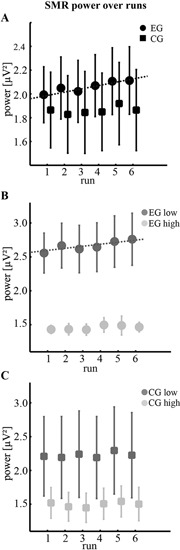
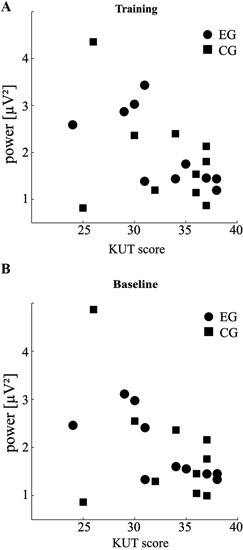
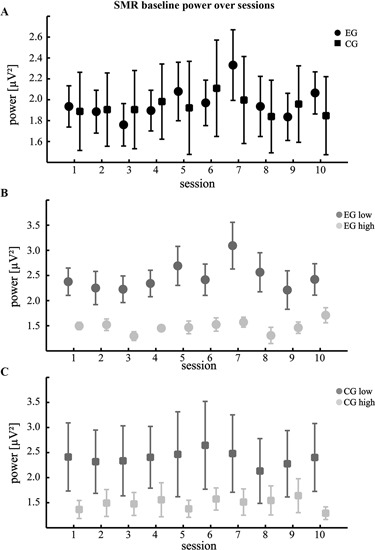
Technological progress in computer science and neuroimaging has resulted in many approaches that aim to detect brain states and translate them to an external output. Studies from the field of brain-computer interfaces (BCI) and neurofeedback (NF) have validated the coupling between brain signals and computer devices; however a cognitive model of the processes involved remains elusive. Psychological parameters usually play a moderate role in predicting the performance of BCI and NF users. The concept of a locus of control, i.e., whether one's own action is determined by internal or external causes, may help to unravel inter-individual performance capacities. Here, we present data from 20 healthy participants who performed a feedback task based on EEG recordings of the sensorimotor rhythm (SMR). One group of 10 participants underwent 10 training sessions where the amplitude of the SMR was coupled to a vertical feedback bar. The other group of ten participants participated in the same task but relied on sham feedback. Our analysis revealed that a locus of control score focusing on control beliefs with regard to technology negatively correlated with the power of SMR. These preliminary results suggest that participants whose confidence in control over technical devices is high might consume additional cognitive resources. This higher effort in turn may interfere with brain states of relaxation as reflected in the SMR. As a consequence, one way to improve control over brain signals in NF paradigms may be to explicitly instruct users not to force mastery but instead to aim at a state of effortless relaxation.
计算机科学和神经影像学的技术进步带来了许多方法,旨在检测大脑状态并将其转换为外部输出。脑机接口 (BCI) 和神经反馈 (NF) 领域的研究已经验证了大脑信号与计算机设备之间的耦合;然而,涉及的过程认知模型仍然难以捉摸。心理参数通常在预测 BCI 和 NF 用户的表现方面起着中等作用。控制源的概念,即一个人的行为是由内部还是外部原因决定的,可能有助于揭示个体之间的表现能力。在这里,我们展示了来自 20 名健康参与者的数据,他们根据感觉运动节律 (SMR) 的脑电图记录执行反馈任务。一组 10 名参与者接受了 10 次训练,在此期间,SMR 的幅度与垂直反馈条耦合。另一组 10 名参与者参与了相同的任务,但依赖于虚假反馈。我们的分析表明,关注与技术相关的控制信念的控制源得分与 SMR 的功率呈负相关。这些初步结果表明,对技术设备控制信心高的参与者可能会消耗更多的认知资源。这种更高的努力反过来可能会干扰 SMR 反映的放松状态的大脑状态。因此,改善 NF 范式中对脑信号控制的一种方法可能是明确指示用户不要强行掌握,而是要努力达到轻松放松的状态。