Department of Bio-science Engineering, University of Antwerp, Antwerp, Belgium.
PLoS One. 2013 Aug 15;8(8):e72145. doi: 10.1371/journal.pone.0072145. eCollection 2013.
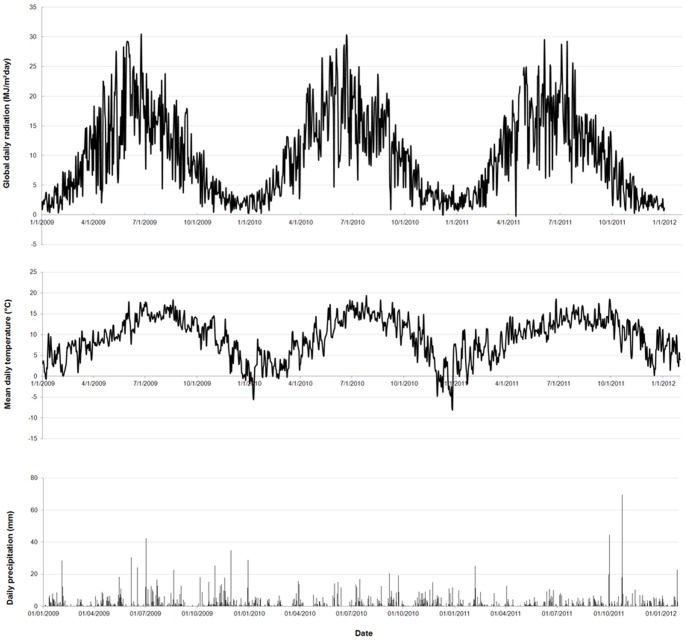
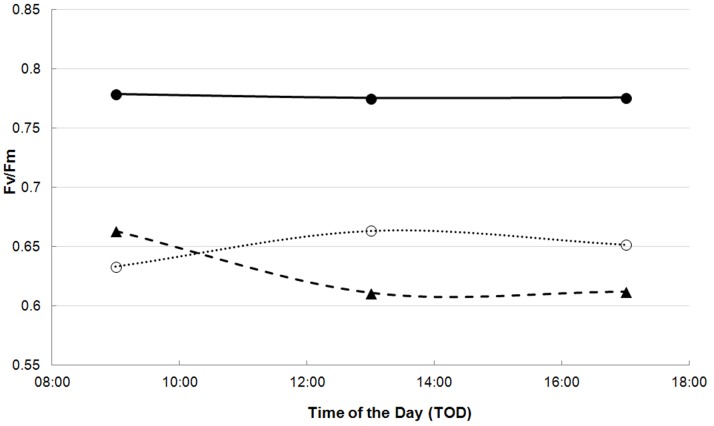
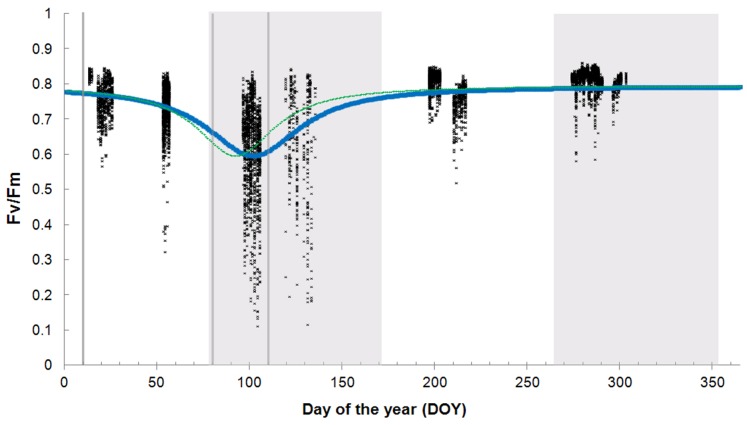
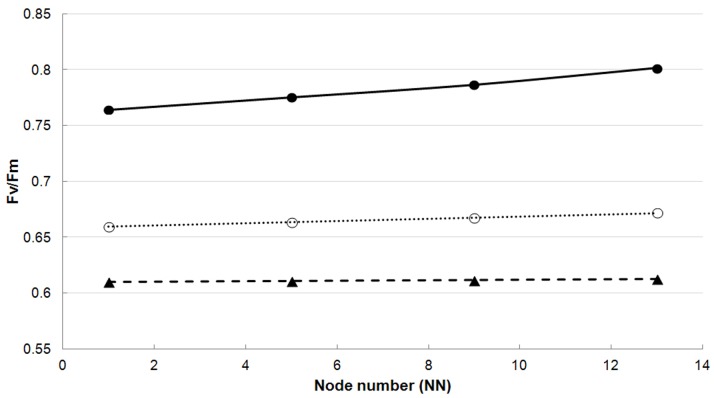
In recent years, temperate bamboo species have been introduced in Europe not only as an ornamental plant, but also as a new biomass crop. To measure adaptation stress of bamboo to the climate of Western Europe, chlorophyll fluorescence was measured on a diurnal and seasonal basis in Ballyboughal, Co. Dublin, Ireland. Measurements were attained on the leaves of each node of Phyllostachys humilis. The most frequently used parameter in chlorophyll fluorescence is the photosynthetic efficiency (Fv/Fm). A seasonal dip - as well as a larger variation - of Fv/Fm in spring compared to the rest of the year was observed. Over the year, the upper leaves of the plant perform better than the bottom leaves. These findings were linked to environmental factors such as light intensity, air temperature and precipitation, as increased light intensities, decreasing air temperatures and their interactions, also with precipitation levels have an effect on the photosynthetic efficiency (Fv/Fm) in these plants.
近年来,温带竹种不仅作为观赏植物被引入欧洲,还作为一种新的生物质作物。为了衡量竹子对西欧气候的适应压力,在爱尔兰都柏林郡巴利布夫尔(Ballyboughal)对菲黄竹(Phyllostachys humilis)的叶片进行了日变化和季节变化的叶绿素荧光测量。叶绿素荧光最常用的参数是光合效率(Fv/Fm)。与一年中的其他时间相比,春季 Fv/Fm 出现季节性下降和更大的变化。一年中,植物的上部叶片比下部叶片表现更好。这些发现与环境因素有关,如光照强度、空气温度和降水,因为光照强度增加、空气温度降低以及它们与降水水平的相互作用都会影响这些植物的光合效率(Fv/Fm)。