Luchenski Serena A, Reed Julie E, Marston Cicely, Papoutsi Chrysanthi, Majeed Azeem, Bell Derek
NIHR CLAHRC for Northwest London, Imperial College London, Chelsea & Westminster Hospital NHS Foundation Trust, London, United Kingdom.
J Med Internet Res. 2013 Aug 23;15(8):e160. doi: 10.2196/jmir.2701.
The development and implementation of electronic health records (EHRs) remains an international challenge. Better understanding of patient and public attitudes and the factors that influence overall levels of support toward EHRs is needed to inform policy.
To explore patient and public attitudes toward integrated EHRs used simultaneously for health care provision, planning and policy, and health research.
Cross-sectional questionnaire survey administered to patients and members of the public who were recruited from a stratified cluster random sample of 8 outpatient clinics of a major teaching hospital and 8 general practices in London (United Kingdom).
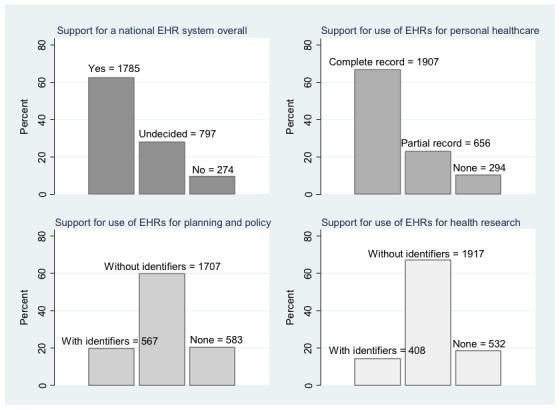
5331 patients and members of the public responded to the survey, with 2857 providing complete data for the analysis presented here. There were moderately high levels of support for integrated EHRs used simultaneously for health care provision, planning and policy, and health research (1785/2857, 62.47%), while 27.93% (798/2857) of participants reported being undecided about whether or not they would support EHR use. There were higher levels of support for specific uses of EHRs. Most participants were in favor of EHRs for personal health care provision (2563/2857, 89.71%), with 66.75% (1907/2857) stating that they would prefer their complete, rather than limited, medical history to be included. Of those "undecided" about integrated EHRs, 87.2% (696/798) were nevertheless in favor of sharing their full (373/798, 46.7%) or limited (323/798, 40.5%) records for health provision purposes. There were similar high levels of support for use of EHRs in health services policy and planning (2274/2857, 79.59%) and research (2325/2857, 81.38%), although 59.75% (1707/2857) and 67.10% (1917/2857) of respondents respectively would prefer their personal identifiers to be removed. Multivariable analysis showed levels of overall support for EHRs decreasing with age. Respondents self-identifying as Black British were more likely to report being undecided or unsupportive of national EHRs. Frequent health services users were more likely to report being supportive than undecided.
Despite previous difficulties with National Health Service (NHS) technology projects, patients and the public generally support the development of integrated EHRs for health care provision, planning and policy, and health research. This support, however, varies between social groups and is not unqualified; relevant safeguards must be in place and patients should be guided in their decision-making process, including increased awareness about the benefits of EHRs for secondary uses.
电子健康记录(EHRs)的开发与实施仍是一项国际挑战。为政策提供依据,需要更好地了解患者和公众的态度以及影响对EHRs总体支持水平的因素。
探讨患者和公众对同时用于医疗保健提供、规划与政策以及健康研究的综合EHRs的态度。
对从英国伦敦一家主要教学医院的8家门诊诊所和8家全科诊所的分层整群随机样本中招募的患者和公众成员进行横断面问卷调查。
5331名患者和公众成员对调查做出了回应,其中2857人提供了完整数据用于此处的分析。对于同时用于医疗保健提供、规划与政策以及健康研究的综合EHRs,支持水平适中偏高(1785/2857,62.47%),而27.93%(798/2857)的参与者表示对是否支持使用EHRs尚未决定。对EHRs的特定用途支持水平更高。大多数参与者赞成使用EHRs进行个人医疗保健(2563/2857,89.71%),66.75%(1907/2857)的人表示他们希望纳入完整而非有限的病史。在那些对综合EHRs“尚未决定”的人中,87.2%(696/798)仍然赞成出于医疗保健目的分享其完整(373/798,46.7%)或有限(323/他798,40.5%)的记录。对在卫生服务政策和规划(2274/2857,79.59%)以及研究(2325/2857,81.38%)中使用EHRs也有类似较高的支持水平,尽管分别有59.75%(1707/2857)和67.10%(1917/2857)的受访者更希望去除他们的个人标识符。多变量分析显示,对EHRs的总体支持水平随年龄增长而下降。自我认定为英国黑人的受访者更有可能表示对国家EHRs尚未决定或不支持。频繁使用卫生服务的人更有可能表示支持而非尚未决定。
尽管此前国民医疗服务体系(NHS)的技术项目存在困难,但患者和公众总体上支持开发用于医疗保健提供、规划与政策以及健康研究的综合EHRs。然而,这种支持在不同社会群体之间存在差异且并非毫无保留;必须有相关保障措施,并且在患者的决策过程中应给予指导,包括提高对EHRs二次使用益处的认识。