Children's Hospital Informatics Program, Children's Hospital Boston, Boston, MA, USA.
BMC Med Inform Decis Mak. 2012 May 22;12:39. doi: 10.1186/1472-6947-12-39.
Data stored in personally controlled health records (PCHRs) may hold value for clinicians and public health entities, if patients and their families will share them. We sought to characterize consumer willingness and unwillingness (reticence) to share PCHR data across health topics, and with different stakeholders, to advance understanding of this issue.
Cross-sectional 2009 Web survey of repeat PCHR users who were patients over 18 years old or parents of patients, to assess willingness to share their PCHR data with an-out-of-hospital provider to support care, and the state/local public health authority to support monitoring; the odds of reticence to share PCHR information about ten exemplary health topics were estimated using a repeated measures approach.
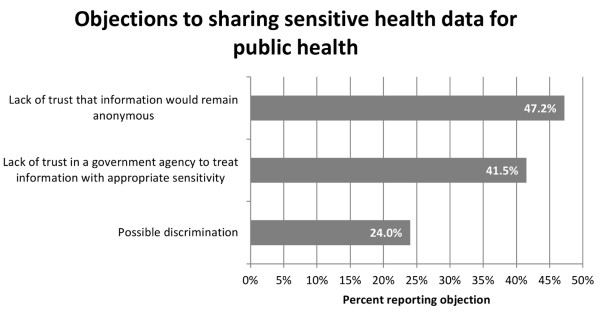
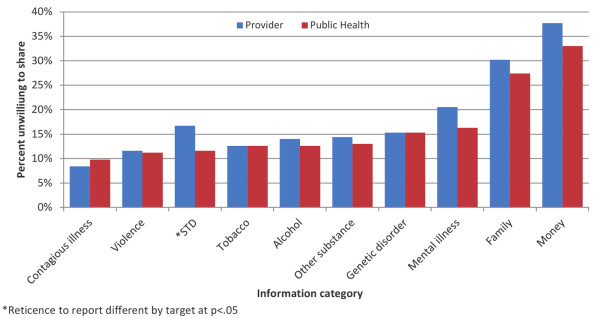
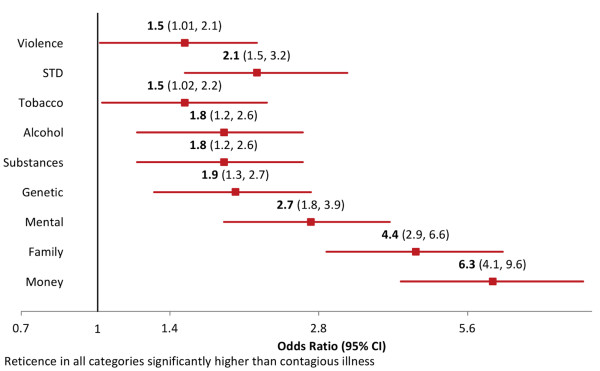
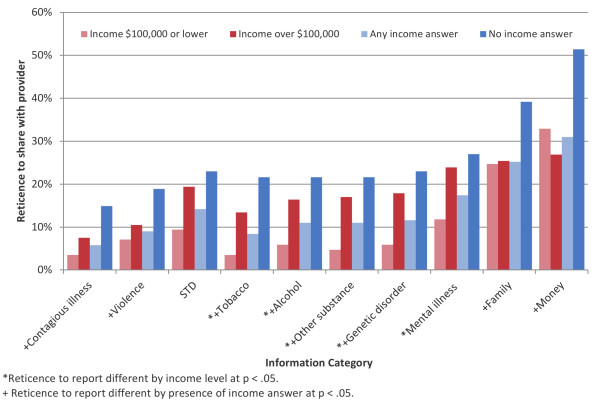
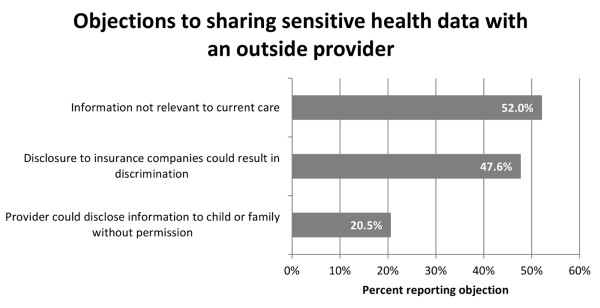
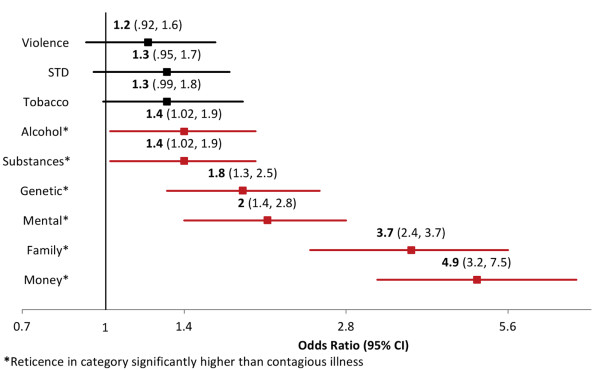
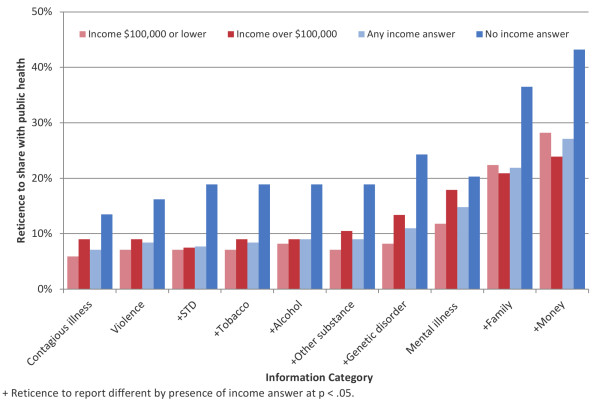
Of 261 respondents (56% response rate), more reported they would share all information with the state/local public health authority (63.3%) than with an out-of-hospital provider (54.1%) (OR 1.5, 95% CI 1.1, 1.9; p = .005); few would not share any information with these parties (respectively, 7.9% and 5.2%). For public health sharing, reticence was higher for most topics compared to contagious illness (ORs 4.9 to 1.4, all p-values < .05), and reflected concern about anonymity (47.2%), government insensitivity (41.5%), discrimination (24%). For provider sharing, reticence was higher for all topics compared to contagious illness (ORs 6.3 to 1.5, all p-values < .05), and reflected concern for relevance (52%), disclosure to insurance (47.6%) and/or family (20.5%).
Pediatric patients and their families are often willing to share electronic health information to support health improvement, but remain cautious. Robust trust models for PCHR sharing are needed.
如果患者及其家属愿意共享个人健康记录(PCHR)中的数据,那么这些数据对于临床医生和公共卫生实体可能具有价值。我们旨在描述患者及其家属在不同健康主题和不同利益相关者方面共享 PCHR 数据的意愿和不情愿(保留)程度,以深入了解这一问题。
2009 年,我们对重复使用 PCHR 的患者或患者家长进行了横断面网络调查,以评估他们是否愿意将其 PCHR 数据与院外提供者共享以支持治疗,以及是否愿意与州/地方公共卫生当局共享以支持监测。使用重复测量方法估计不愿共享十个典型健康主题的 PCHR 信息的几率。
在 261 名受访者(56%的回应率)中,更多人表示愿意将所有信息与州/地方公共卫生当局(63.3%)共享,而不是与院外提供者(54.1%)共享(OR 1.5,95%CI 1.1,1.9;p=0.005);很少有人不愿意与这些利益相关者共享任何信息(分别为 7.9%和 5.2%)。对于公共卫生共享,与传染性疾病相比,大多数主题的保留率更高(OR 4.9 至 1.4,所有 p 值均<.05),这反映了对匿名性(47.2%)、政府敏感性(41.5%)、歧视(24%)的担忧。对于提供者共享,与传染性疾病相比,所有主题的保留率都更高(OR 6.3 至 1.5,所有 p 值均<.05),这反映了对相关性(52%)、向保险(47.6%)和/或家庭(20.5%)披露的担忧。
儿科患者及其家属通常愿意共享电子健康信息以支持健康改善,但仍持谨慎态度。需要建立强大的 PCHR 共享信任模型。