School of Medicine, University of Glasgow, Glasgow, United Kingdom.
PLoS One. 2013 Aug 14;8(8):e71854. doi: 10.1371/journal.pone.0071854. eCollection 2013.
Sitting time and breaks in sitting influence cardio-metabolic health. New monitors (e.g. activPAL™) may be more accurate for measurement of sitting time and breaks in sitting although how to optimize measurement accuracy is not yet clear. One important issue is the minimum sitting/upright period (MSUP) to define a new posture. Using the activPAL™, we investigated the effect of variations in MSUP on total sitting time and breaks in sitting, and also determined the criterion validity of different activPAL™ settings for both constructs.
We varied setting of MSUP in 23 children (mean (SD) age 4.5 y (0.7)) who wore activPAL™ (24 hr/d) for 5-7 d. We first studied activPAL™ using the default setting of 10 s MSUP and then reduced this to 5 s, 2 s and 1 s. In a second study, in a convenience sample of 30 pre-school children (mean age 4.1 y (SD 0.5)) we validated the activPAL™ measures of sitting time and breaks in sitting at different MSUP settings against direct observation.
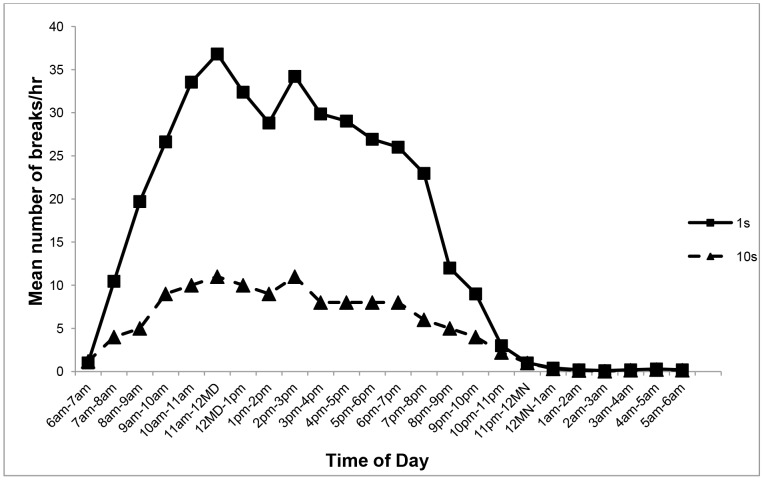
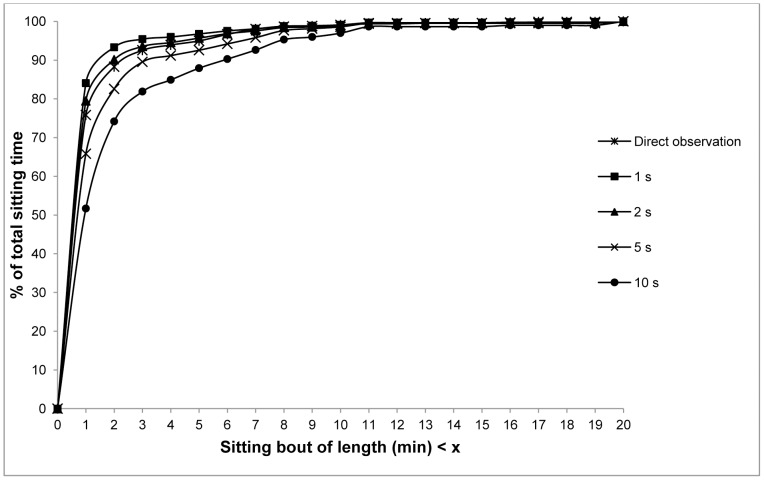
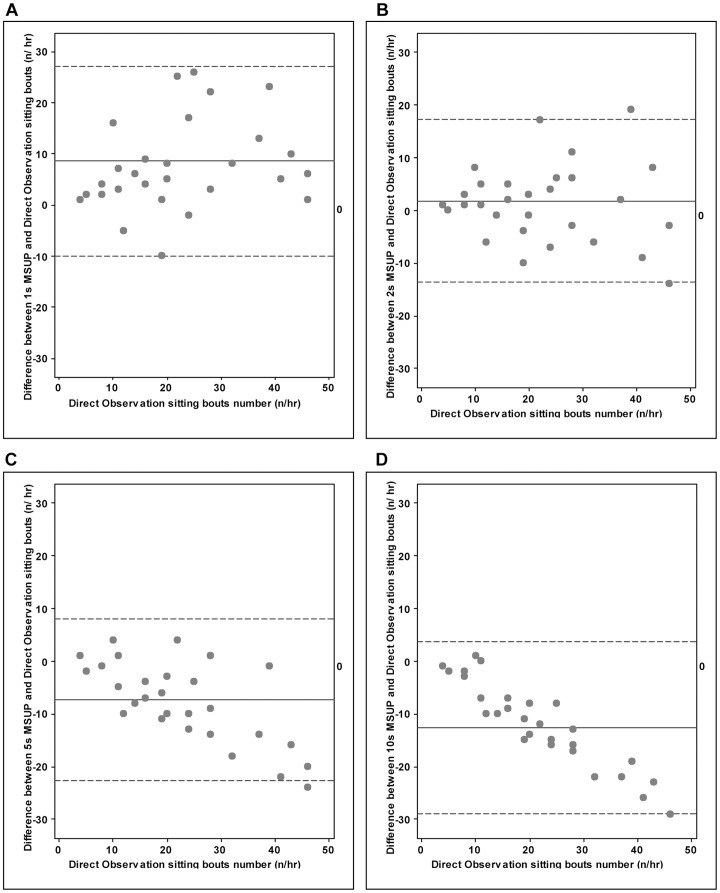
Comparing settings of 10, 5, 2 and 1 s, there were no significant differences in sitting time (6.2 hr (1.0), 6.3 hr (1.0), 6.4 hr (1.0) and 6.3 hr (1.6), respectively) between settings but there were significant increases in the apparent number of breaks - (8(3), 14(2), 21(4) and 28 (6)/h) at 10, 5, 2 and 1 s settings, respectively. In comparison with direct observation, a 2 s setting had the smallest error relative to direct observation (95% limits of agreement: -14 to +17 sitting bouts/hr, mean difference 1.83, p = 0.2).
With activPAL™, breaks in sitting, but not total sitting time, are highly sensitive to the setting of MSUP, with 2 s optimal for young children. The MSUP to define a new posture will need to be empirically determined if accurate measurements of number of breaks in sitting are to be obtained.
坐姿时间和坐姿间断会影响心血管代谢健康。新的监测仪(如 activPAL™)可能更准确地测量坐姿时间和坐姿间断,但如何优化测量准确性尚不清楚。一个重要问题是定义新姿势的最小坐姿/直立期(MSUP)。本研究使用 activPAL™,研究了 MSUP 变化对总坐姿时间和坐姿间断的影响,并确定了不同 activPAL™设置在这两个结构上的标准效度。
我们让 23 名(平均年龄 4.5 岁(0.7)岁)儿童佩戴 activPAL™(每天 24 小时)5-7 天,改变 MSUP 的设置。我们首先使用 activPAL™的默认设置(10 秒 MSUP)进行研究,然后将其减少到 5 秒、2 秒和 1 秒。在第二项研究中,我们使用便利样本(30 名学龄前儿童,平均年龄 4.1 岁(0.5 岁)),根据不同的 MSUP 设置,验证了 activPAL™测量坐姿时间和坐姿间断的准确性。
比较 10、5、2 和 1 s 的设置,坐姿时间没有显著差异(分别为 6.2 小时(1.0)、6.3 小时(1.0)、6.4 小时(1.0)和 6.3 小时(1.6)),但明显增加了看似的休息次数(分别为 8(3)、14(2)、21(4)和 28(6)/小时)在 10、5、2 和 1 s 的设置下。与直接观察相比,2 s 设置与直接观察的误差最小(95% 一致性界限:-14 至+17 坐姿次数/小时,平均差异 1.83,p=0.2)。
使用 activPAL™,坐姿间断而非总坐姿时间对 MSUP 的设置非常敏感,对于幼儿来说,2 s 是最佳选择。如果要准确测量坐姿间断次数,需要通过实证确定定义新姿势的 MSUP。