Giurgiu Marco, Kolb Simon, Nigg Carina, Burchartz Alexander, Timm Irina, Becker Marlissa, Rulf Ellen, Doster Ann-Kathrin, Koch Elena, Bussmann Johannes B J, Nigg Claudio, Ebner-Priemer Ulrich W, Woll Alexander
Department of Sports and Sports Science, Karlsruhe Institute of Technology, Karlsruhe, Germany.
Department of Psychiatry and Psychotherapy, Central Institute of Mental Health, Mannheim, Germany.
BMJ Open Sport Exerc Med. 2022 May 12;8(2):e001267. doi: 10.1136/bmjsem-2021-001267. eCollection 2022.
Studies that assess all three dimensions of the integrative 24-hour physical behaviour (PB) construct, namely, intensity, posture/activity type and biological state, are on the rise. However, reviews on validation studies that cover intensity, posture/activity type and biological state assessed via wearables are missing.
Systematic review. The risk of bias was evaluated by using the QUADAS-2 tool with nine signalling questions separated into four domains (ie, patient selection/study design, index measure, criterion measure, flow and time).
Peer-reviewed validation studies from electronic databases as well as backward and forward citation searches (1970-July 2021).
Wearable validation studies with children and adolescents (age <18 years). Required indicators: (1) study protocol must include real-life conditions; (2) validated device outcome must belong to one dimension of the 24-hour PB construct; (3) the study protocol must include a criterion measure; (4) study results must be published in peer-reviewed English language journals.
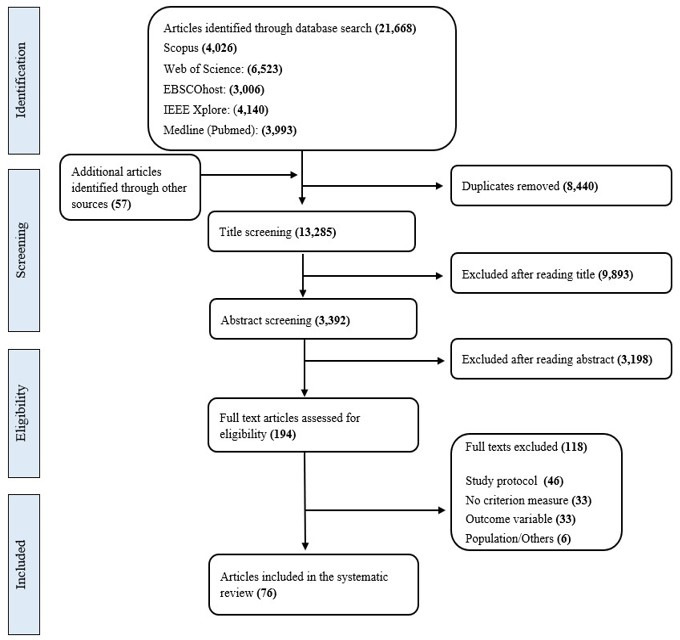
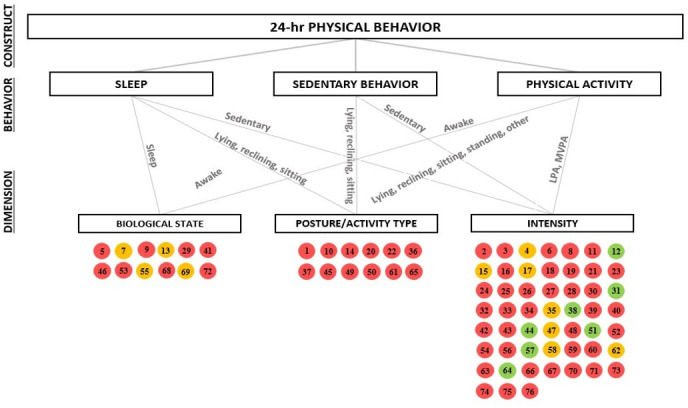
Out of 13 285 unique search results, 76 articles with 51 different wearables were included and reviewed. Most studies (68.4%) validated an intensity measure outcome such as energy expenditure, but only 15.9% of studies validated biological state outcomes, while 15.8% of studies validated posture/activity type outcomes. We identified six wearables that had been used to validate outcomes from two different dimensions and only two wearables (ie, ActiGraph GT1M and ActiGraph GT3X+) that validated outcomes from all three dimensions. The percentage of studies meeting a given quality criterion ranged from 44.7% to 92.1%. Only 18 studies were classified as 'low risk' or 'some concerns'.
Validation studies on biological state and posture/activity outcomes are rare in children and adolescents. Most studies did not meet published quality principles. Standardised protocols embedded in a validation framework are needed.
CRD42021230894.
评估24小时综合身体行为(PB)结构所有三个维度(即强度、姿势/活动类型和生理状态)的研究正在增加。然而,关于通过可穿戴设备评估强度、姿势/活动类型和生理状态的验证研究的综述却缺失。
系统综述。使用QUADAS - 2工具评估偏倚风险,该工具包含九个信号问题,分为四个领域(即患者选择/研究设计、指标测量、标准测量、流程和时间)。
电子数据库中的同行评审验证研究以及向后和向前的引文检索(1970年 - 2021年7月)。
针对儿童和青少年(年龄<18岁)的可穿戴设备验证研究。所需指标:(1)研究方案必须包括现实生活条件;(2)经过验证的设备结果必须属于24小时PB结构的一个维度;(3)研究方案必须包括标准测量;(4)研究结果必须发表在同行评审的英文期刊上。
在13285个独特的搜索结果中,纳入并审查了76篇文章,涉及51种不同的可穿戴设备。大多数研究(68.4%)验证了强度测量结果,如能量消耗,但只有15.9%的研究验证了生理状态结果,而15.8%的研究验证了姿势/活动类型结果。我们确定了六种可穿戴设备曾用于验证来自两个不同维度的结果,只有两种可穿戴设备(即ActiGraph GT1M和ActiGraph GT3X +)验证了来自所有三个维度的结果。符合给定质量标准的研究百分比在44.7%至92.1%之间。只有18项研究被归类为“低风险”或“有一些担忧”。
儿童和青少年中关于生理状态和姿势/活动结果的验证研究很少。大多数研究未达到已发表的质量原则。需要在验证框架中嵌入标准化方案。
PROSPERO注册号:CRD42021230894。