Thomas Laura A, Kim Pilyoung, Bones Brian L, Hinton Kendra E, Milch Hannah S, Reynolds Richard C, Adleman Nancy E, Marsh Abigail A, Blair R J R, Pine Daniel S, Leibenluft Ellen
Emotion and Development Branch, National Institute of Mental Health, National Institutes of Health, Department of Health and Human Services, Bethesda, Maryland ; National Institute on Drug Abuse, National Institutes of Health, Department of Health and Human Services, Bethesda, Maryland.
Neuroimage Clin. 2013 Jan 1;2:637-645. doi: 10.1016/j.nicl.2013.04.007.
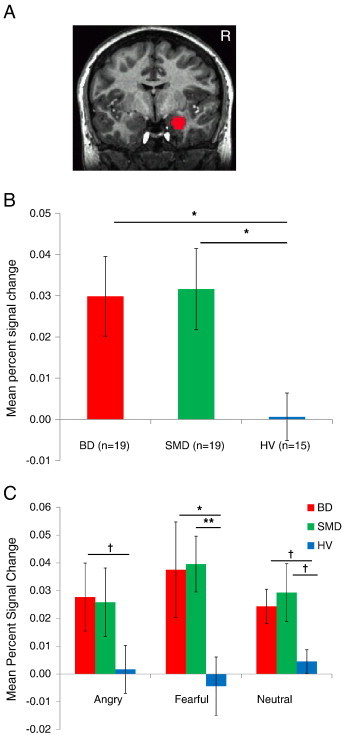
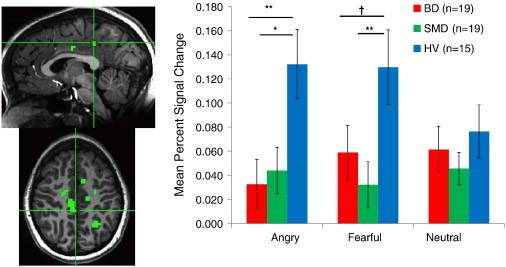
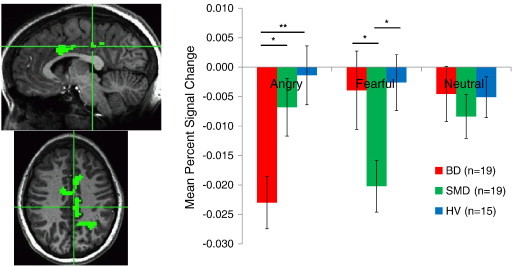
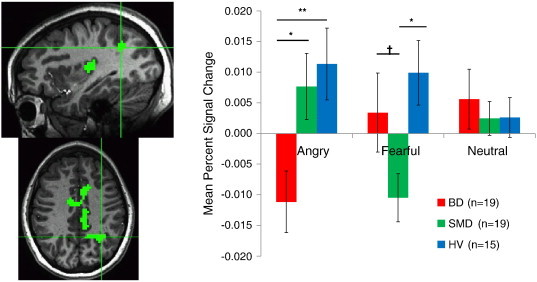
A major controversy in child psychiatry is whether bipolar disorder (BD) presents in children as severe, non-episodic irritability (operationalized here as severe mood dysregulation, SMD), rather than with manic episodes as in adults. Both classic, episodic BD and SMD are severe mood disorders characterized by deficits in processing emotional stimuli. Neuroimaging techniques can be used to test whether the pathophysiology mediating these deficits are similar across the two phenotypes. Amygdala dysfunction during face emotion processing is well-documented in BD, but little is known about amygdala dysfunction in chronically irritable youth. We compared neural activation in SMD (n=19), BD (n=19), and healthy volunteer (HV; n=15) youths during an implicit face-emotion processing task with angry, fearful and neutral expressions. In the right amygdala, both SMD and BD exhibited greater activity across all expressions than HV. However, SMD and BD differed from each other and HV in posterior cingulate cortex, posterior insula, and inferior parietal lobe. In these regions, only SMD showed deactivation in response to fearful expressions, whereas only BD showed deactivation in response to angry expressions. Thus, during implicit face emotion processing, youth with BD and those with SMD exhibit similar amygdala dysfunction but different abnormalities in regions involved in information monitoring and integration.
儿童精神病学中的一个主要争议点在于,双相情感障碍(BD)在儿童中是否表现为严重的、非发作性的易激惹(在此定义为严重情绪失调,SMD),而非像在成人中那样表现为躁狂发作。典型的发作性BD和SMD都是严重的情绪障碍,其特征在于处理情绪刺激方面存在缺陷。神经成像技术可用于测试介导这些缺陷的病理生理学在这两种表型中是否相似。在BD中,面部情绪处理过程中的杏仁核功能障碍已有充分记录,但对于长期易激惹的青少年的杏仁核功能障碍却知之甚少。我们比较了SMD组(n = 19)、BD组(n = 19)和健康志愿者(HV;n = 15)在进行带有愤怒、恐惧和中性表情的内隐面部情绪处理任务时的神经激活情况。在右侧杏仁核中,SMD组和BD组在所有表情下的活动都比HV组更强烈。然而,SMD组和BD组在扣带回后部、脑岛后部和顶下小叶与HV组存在差异。在这些区域,只有SMD组在面对恐惧表情时表现出失活,而只有BD组在面对愤怒表情时表现出失活。因此,在内隐面部情绪处理过程中,BD患儿和SMD患儿表现出相似的杏仁核功能障碍,但在涉及信息监测和整合的区域存在不同的异常情况。