Sanford-Burnham Medical Research Institute La Jolla, CA, USA ; A. A. Kharkevich Institute for Information Transmission Problems, Russian Academy of Sciences Moscow, Russia.
Front Microbiol. 2013 Aug 23;4:244. doi: 10.3389/fmicb.2013.00244. eCollection 2013.
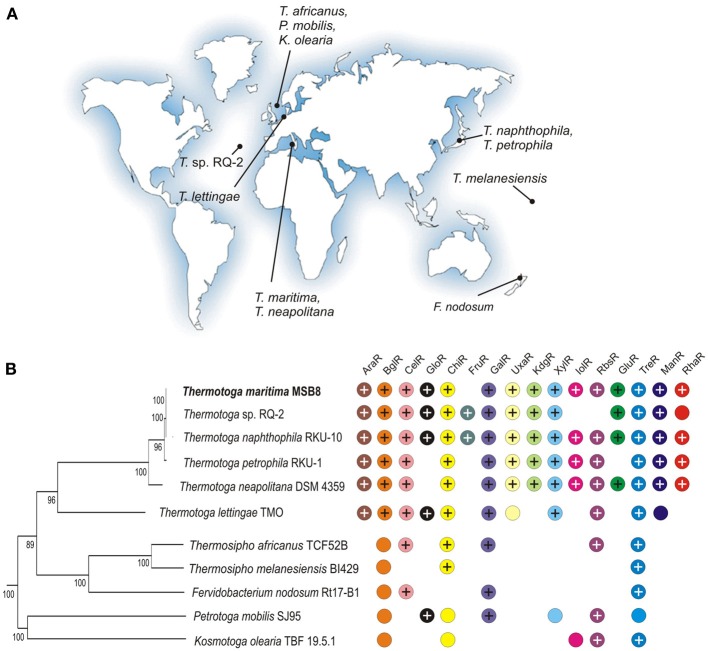
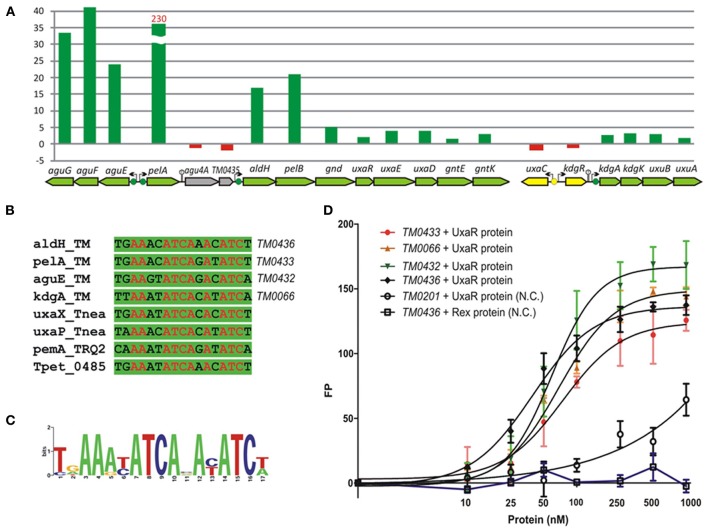
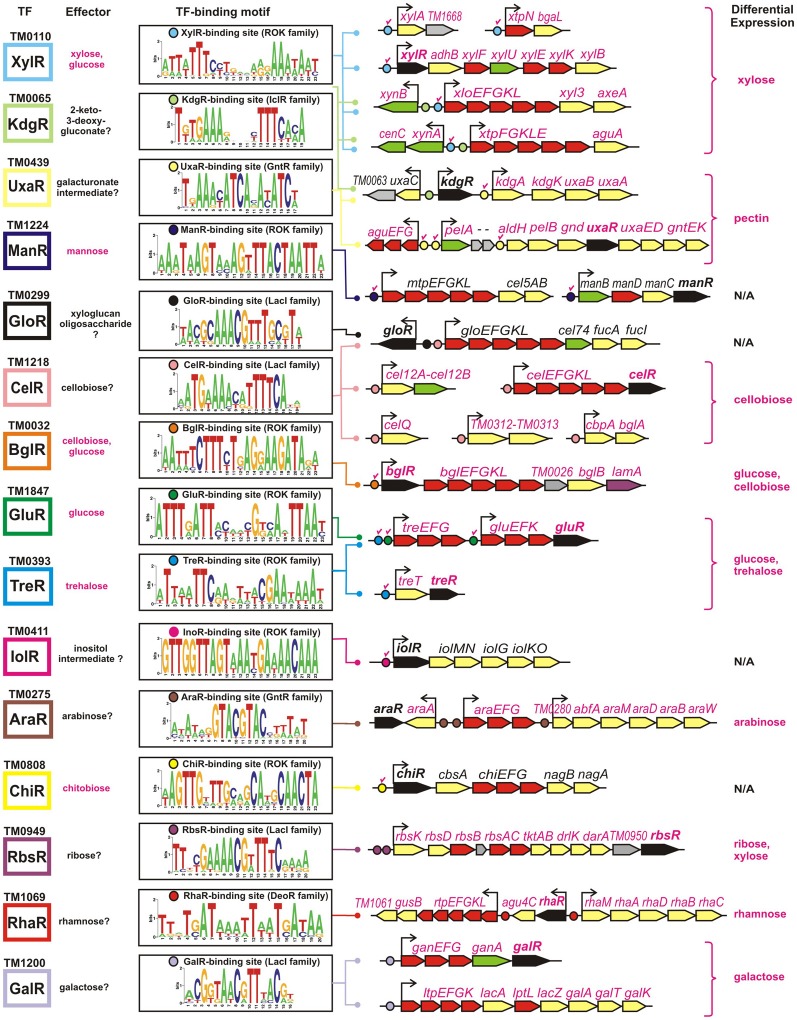
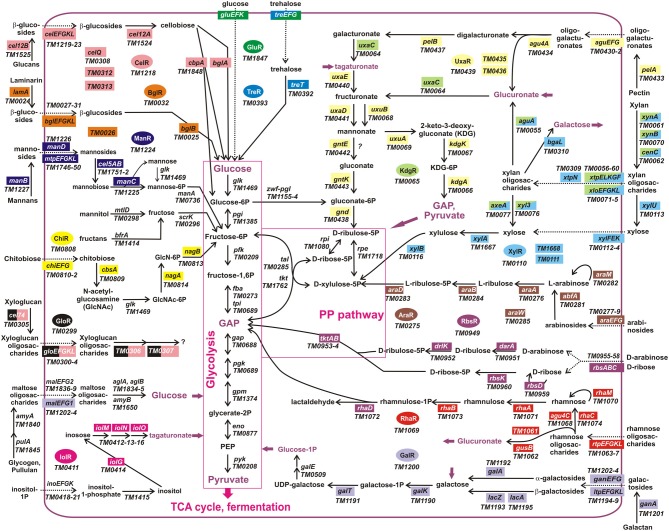
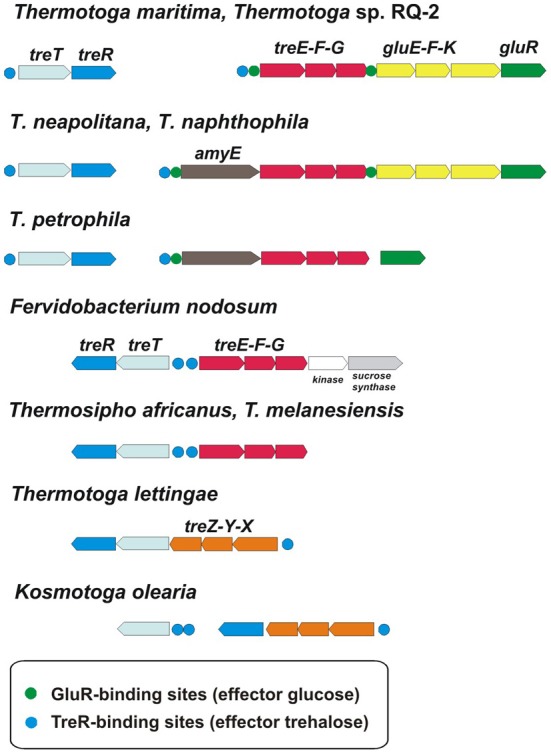
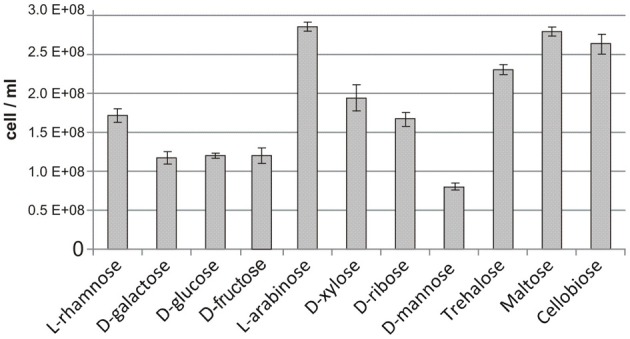
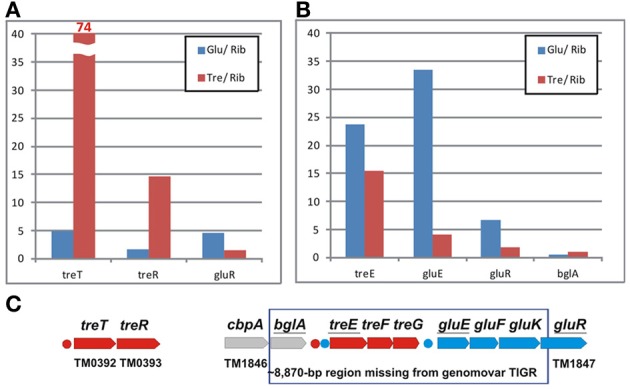
Hyperthermophilic bacteria from the Thermotogales lineage can produce hydrogen by fermenting a wide range of carbohydrates. Previous experimental studies identified a large fraction of genes committed to carbohydrate degradation and utilization in the model bacterium Thermotoga maritima. Knowledge of these genes enabled comprehensive reconstruction of biochemical pathways comprising the carbohydrate utilization network. However, transcriptional factors (TFs) and regulatory mechanisms driving this network remained largely unknown. Here, we used an integrated approach based on comparative analysis of genomic and transcriptomic data for the reconstruction of the carbohydrate utilization regulatory networks in 11 Thermotogales genomes. We identified DNA-binding motifs and regulons for 19 orthologous TFs in the Thermotogales. The inferred regulatory network in T. maritima contains 181 genes encoding TFs, sugar catabolic enzymes and ABC-family transporters. In contrast to many previously described bacteria, a transcriptional regulation strategy of Thermotoga does not employ global regulatory factors. The reconstructed regulatory network in T. maritima was validated by gene expression profiling on a panel of mono- and disaccharides and by in vitro DNA-binding assays. The observed upregulation of genes involved in catabolism of pectin, trehalose, cellobiose, arabinose, rhamnose, xylose, glucose, galactose, and ribose showed a strong correlation with the UxaR, TreR, BglR, CelR, AraR, RhaR, XylR, GluR, GalR, and RbsR regulons. Ultimately, this study elucidated the transcriptional regulatory network and mechanisms controlling expression of carbohydrate utilization genes in T. maritima. In addition to improving the functional annotations of associated transporters and catabolic enzymes, this research provides novel insights into the evolution of regulatory networks in Thermotogales.
嗜热菌科的嗜热菌可以通过发酵广泛的碳水化合物来产生氢气。以前的实验研究在模式细菌海栖热袍菌中鉴定出了大量与碳水化合物降解和利用相关的基因。这些基因的知识使包括碳水化合物利用网络在内的生化途径的全面重建成为可能。然而,驱动该网络的转录因子(TFs)和调节机制在很大程度上仍然未知。在这里,我们使用基于比较基因组学和转录组学数据的综合方法,重建了 11 株嗜热菌科细菌的碳水化合物利用调控网络。我们鉴定了嗜热菌科 19 个同源 TF 的 DNA 结合基序和调控区。推断的海栖热袍菌调控网络包含 181 个编码 TF、糖分解代谢酶和 ABC 家族转运蛋白的基因。与许多以前描述的细菌不同,嗜热菌的转录调控策略不使用全局调控因子。在一组单糖和二糖上进行基因表达谱分析,并进行体外 DNA 结合测定,验证了海栖热袍菌的重建调控网络。参与果胶、海藻糖、纤维二糖、阿拉伯糖、鼠李糖、木糖、葡萄糖、半乳糖和核糖分解代谢的基因的上调表达与 UxaR、TreR、BglR、CelR、AraR、RhaR、XylR、GluR、GalR 和 RbsR 调控区强烈相关。最终,这项研究阐明了控制海栖热袍菌碳水化合物利用基因表达的转录调控网络和机制。除了改进相关转运蛋白和分解代谢酶的功能注释外,这项研究还为嗜热菌科调控网络的进化提供了新的见解。