Laboratoire de Psychologie Sociale et Cognitive, Centre national de la recherche scientifique, Université Blaise Pascal, Clermont-Ferrand, France.
PLoS One. 2013 Aug 21;8(8):e71424. doi: 10.1371/journal.pone.0071424. eCollection 2013.
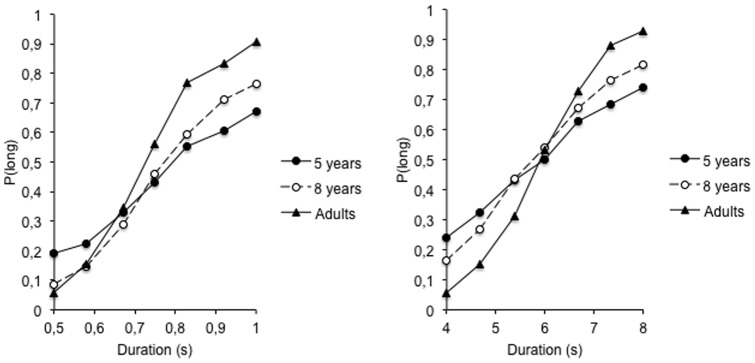
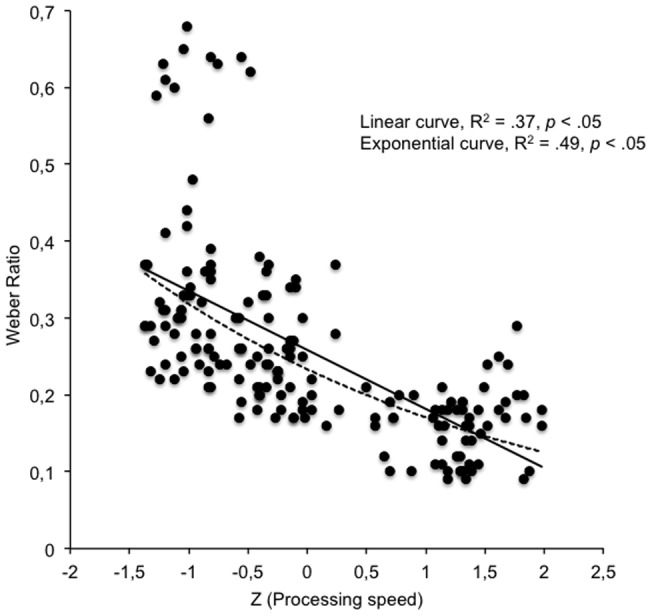
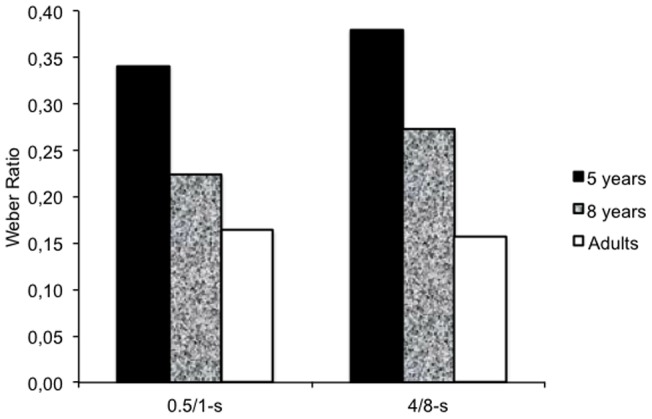
The aim of this study was to examine whether age-related changes in the speed of information processing are the best predictors of the increase in sensitivity to time throughout childhood. Children aged 5 and 8 years old, as well adults, were given two temporal bisection tasks, one with short (0.5/1-s) and the other with longer (4/8-s) anchor durations. In addition, the participants' scores on different neuropsychological tests assessing both information processing speed and other dimensions of cognitive control (short-term memory, working memory, selective attention) were calculated. The results showed that the best predictor of individual variances in sensitivity to time was information processing speed, although working memory also accounted for some of the individual differences in time sensitivity, albeit to a lesser extent. In sum, the faster the information processing speed of the participants, the higher their sensitivity to time was. These results are discussed in the light of the idea that the development of temporal capacities has its roots in the maturation of the dynamic functioning of the brain.
本研究旨在探讨信息加工速度的年龄变化是否是儿童时期时间敏感性增加的最佳预测指标。5 岁和 8 岁的儿童以及成年人接受了两种时间二分任务,一种是短(0.5/1 秒)锚定持续时间,另一种是长(4/8 秒)锚定持续时间。此外,还计算了参与者在不同神经心理学测试中的分数,这些测试评估了信息处理速度以及认知控制的其他维度(短期记忆、工作记忆、选择性注意)。结果表明,信息处理速度是个体对时间敏感性差异的最佳预测指标,尽管工作记忆也在一定程度上解释了个体对时间敏感性的差异,但程度较小。总之,参与者的信息处理速度越快,他们对时间的敏感性就越高。这些结果是在时间能力的发展源于大脑动态功能成熟的观点下进行讨论的。