Stanford University School of Medicine, Department of Microbiology & Immunology, Baxter Laboratory for Stem Cell Biology, 269 Campus Drive, Stanford, CA 94305-5175, USA.
Curr Opin Immunol. 2013 Aug;25(4):484-94. doi: 10.1016/j.coi.2013.07.004. Epub 2013 Aug 31.
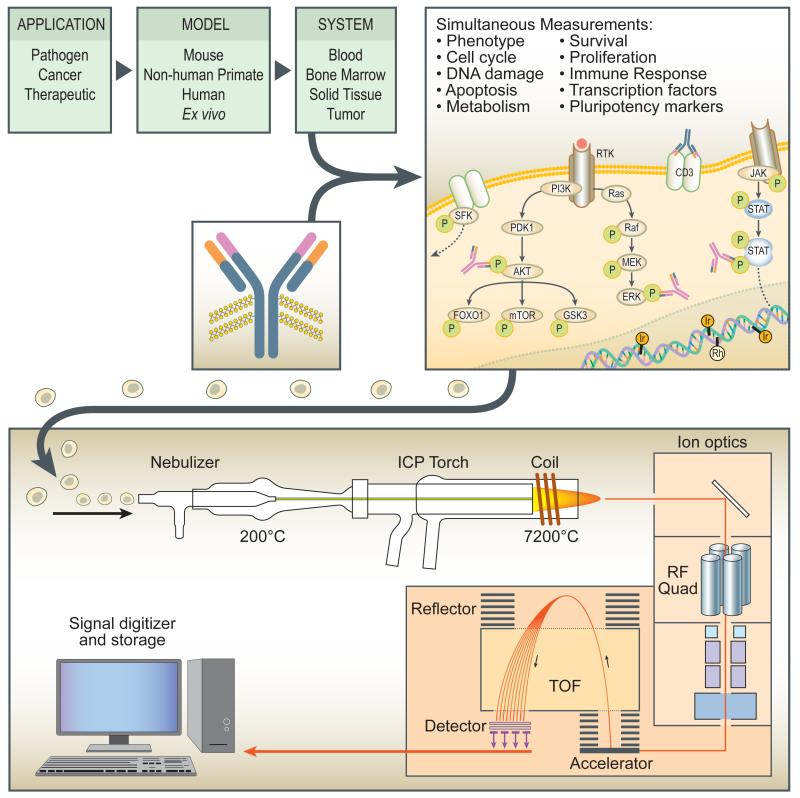
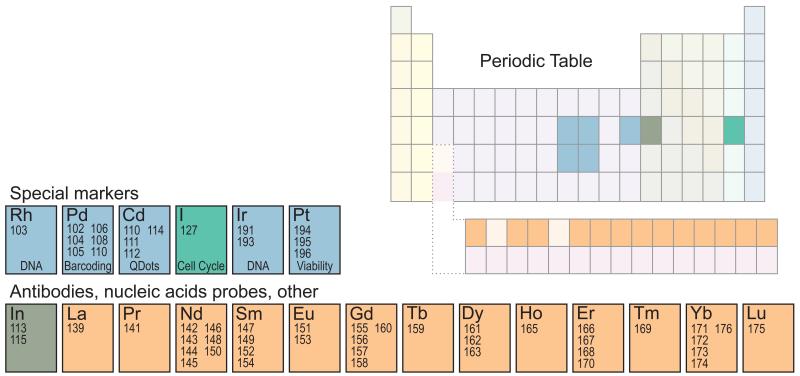
Mass cytometry facilitates high-dimensional, quantitative analysis of the effects of bioactive molecules on cell populations at single-cell resolution. Datasets are generated with panels of up to 45 antibodies. Each antibody is conjugated to a polymer chelated with a stable metal isotope, usually in the lanthanide series of the periodic table. Antibody panels recognize surface markers to delineate cell types simultaneously with intracellular signaling molecules to measure biological functions, such as metabolism, survival, DNA damage, cell cycle and apoptosis, to provide an overall determination of the network state of an individual cell. This review will cover the basics of mass cytometry as well as outline assays developed for the platform that enhance the immunologist's analytical arsenal.
液质流式细胞术以单细胞分辨率促进生物活性分子对细胞群体的高维、定量分析。数据集由多达 45 个抗体组成的面板生成。每个抗体都与螯合稳定金属同位素的聚合物偶联,通常是元素周期表中的镧系元素。抗体面板通过识别表面标志物来同时划定细胞类型,同时测量细胞内信号分子以测量生物学功能,如代谢、存活、DNA 损伤、细胞周期和细胞凋亡,从而全面确定单个细胞的网络状态。本综述将涵盖液质流式细胞术的基础知识,并概述为该平台开发的增强免疫学家分析工具包的检测方法。