Department of Urology, University of Wisconsin School of Medicine and Public Health, Madison, Wisconsin.
Prostate. 2013 Dec;73(16):1721-30. doi: 10.1002/pros.22716. Epub 2013 Sep 2.
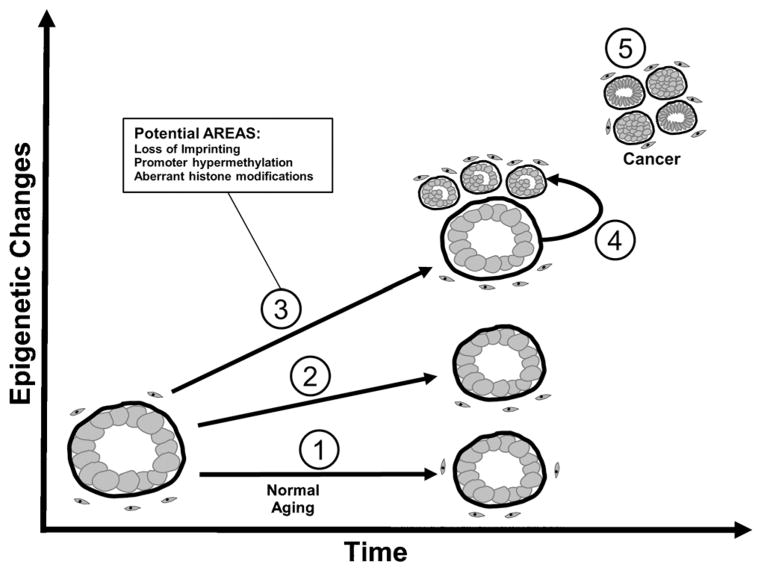
Increasing age is a significant risk factor for prostate cancer. The prostate is exposed to environmental and endogenous stress that may underlie this remarkable incidence. DNA methylation, genomic imprinting, and histone modifications are examples of epigenetic factors known to undergo change in the aging and cancerous prostate. In this review we examine the data linking epigenetic alterations in the prostate with aging to cancer development.
An online search of current and past peer reviewed literature on epigenetic changes with cancer and aging was performed. Relevant articles were analyzed.
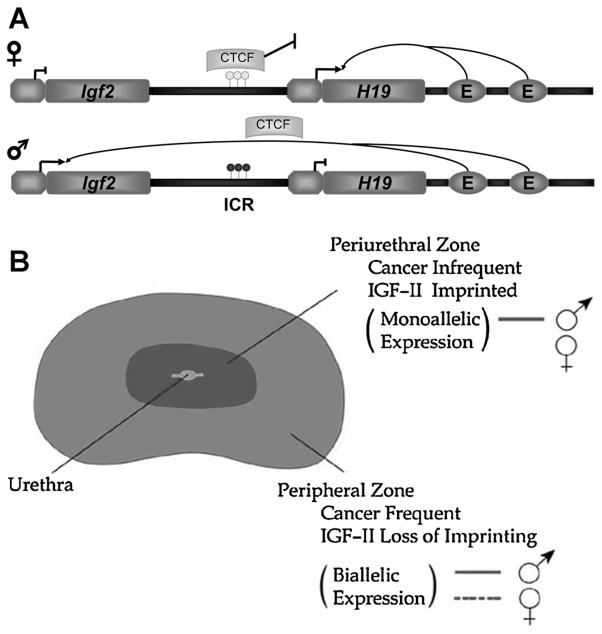
Epigenetic changes are responsible for modifying expression of oncogenes and tumor suppressors. Several of these changes may represent a field defect that predisposes to cancer development. Focal hypermethylation occurs at CpG islands in the promoters of certain genes including GSTP1, RARβ2, and RASSF1A with both age and cancer, while global hypomethylation is seen in prostate cancer and known to occur in the colon and other organs. A loss of genomic imprinting is responsible for biallelic expression of the well-known Insulin-like Growth Factor 2 (IGF2) gene. Loss of imprinting (LOI) at IGF2 has been documented in cancer and is also known to occur in benign aging prostate tissue marking the presence of cancer. Histone modifications have the ability to dictate chromatin structure and direct gene expression.
Epigenetic changes with aging represent molecular mechanisms to explain the increased susceptibly of the prostate to develop cancer in older men. These changes may provide an opportunity for diagnostic and chemopreventive strategies given the epigenome can be modified.
年龄增长是前列腺癌的一个重要危险因素。前列腺易受到环境和内源性压力的影响,而这些压力可能是导致前列腺癌发病率显著上升的原因。DNA 甲基化、基因组印迹和组蛋白修饰是已知在衰老和癌变前列腺中发生变化的表观遗传因素的例子。在这篇综述中,我们研究了将前列腺中与衰老相关的表观遗传改变与癌症发展联系起来的相关数据。
对关于表观遗传改变与癌症和衰老相关的当前和过去同行评议文献进行了在线搜索。对相关文章进行了分析。
表观遗传变化负责修饰癌基因和肿瘤抑制基因的表达。其中一些变化可能代表了一种易患癌症的局灶性缺陷。在某些基因的启动子中,CpG 岛上会发生特定的局灶性高甲基化,包括 GSTP1、RARβ2 和 RASSF1A,这与年龄和癌症都有关,而前列腺癌中则出现了全基因组低甲基化,已知在结肠和其他器官中也会出现这种情况。基因组印迹的丧失导致了众所周知的胰岛素样生长因子 2 (IGF2) 基因的双等位基因表达。IGF2 的印迹丢失(LOI)已在癌症中得到证实,也已知在良性衰老的前列腺组织中发生,标志着癌症的存在。组蛋白修饰具有改变染色质结构和指导基因表达的能力。
随着年龄的增长,表观遗传变化代表了一种分子机制,可以解释为什么老年人的前列腺更容易发生癌症。鉴于表观基因组可以被修饰,这些变化可能为诊断和化学预防策略提供了机会。