Su Yu-Jen, Liao Shang-Chih, Cheng Ben-Chung, Hwang Jyh-Chang, Chen Jin-Bor
Division of Nephrology, Kaohsiung Chang Gung Memorial Hospital and Chang Gung University College of Medicine, 123 Ta Pei Rd, Kaohsiung, Niao Song District, Taiwan.
BMC Nephrol. 2013 Sep 4;14:185. doi: 10.1186/1471-2369-14-185.
The aim of this study was to evaluate whether a high baseline level of high-sensitivity C-reactive protein (hs-CRP) or changes in the level predicts the risk of peritonitis in patients on continuous ambulatory peritoneal dialysis (CAPD).
A prospective, cross-sectional, case-control study was conducted in a single hospital-based PD unit. A total of 327 patients were included in the study. Serum hs-CRP was measured annually for 2 years. Patients were divided into 4 groups according to the changes in annual hs-CRP levels (at baseline and at 1 year intervals): group 1 (from <5 mg/L to <5 mg/L, n = 171), group 2 (from <5 mg/L to ≥5 mg/L, n = 45), group 3 (from ≥5 mg/L to <5 mg/L, n = 45), and group 4 (from ≥5 mg/L to ≥5 mg/L, n = 80). Demographics, biochemistry results, PD adequacy indices, and peritonitis risk were compared between the groups.
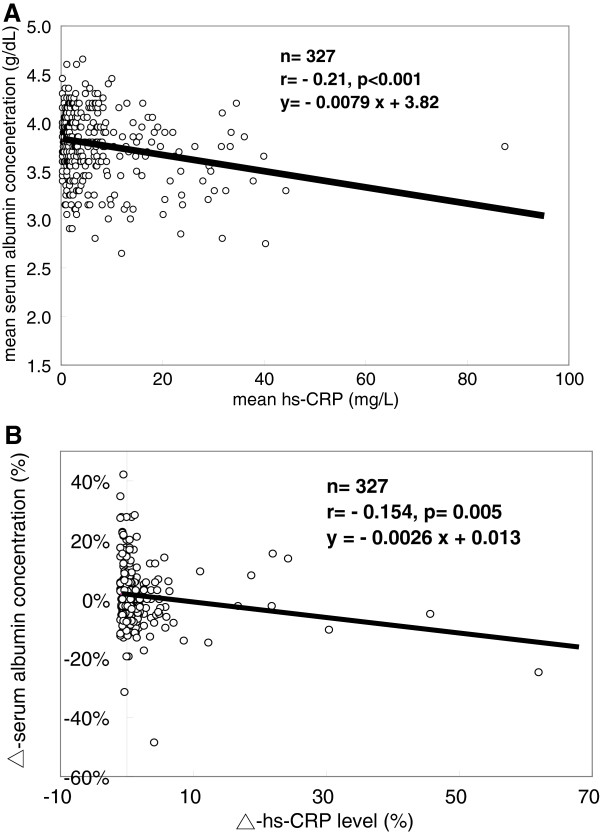
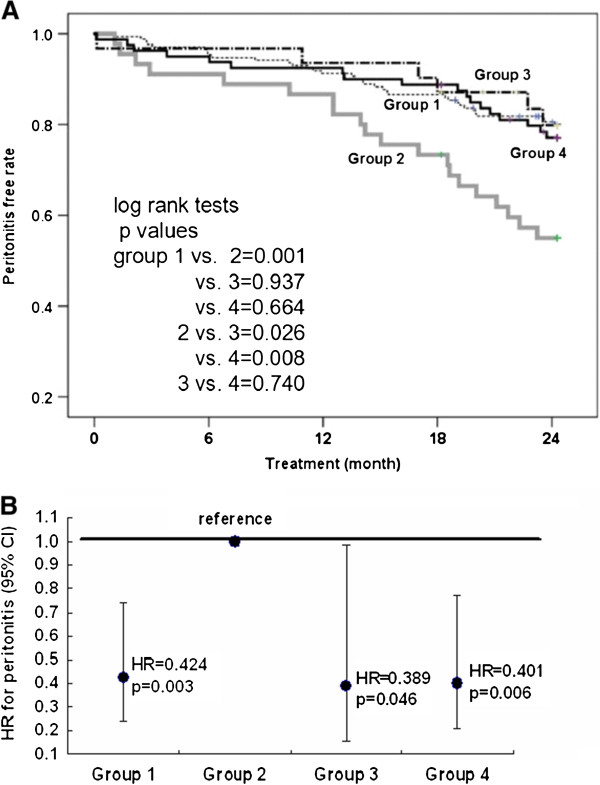
The initial serum albumin level was similar in the 4 groups (p = 0.12). There was a negative linear correlation between the serial albumin change (∆alb) and serial hs-CRP change (∆hs-CRP; r = -0.154, p = 0.005). The hazard ratio (HR) for peritonitis was significantly higher in group 2 (HR = 1, reference) than in group 4 (HR = 0.401, 95% CI 0.209 - 0.769). Group 2 had a greater serum albumin decline rate (∆alb: -3% ± 9%) and hs-CRP elevation rate (∆hs-CRP: 835% ± 1232%) compared to those for the other groups.
A progressive increase in the hs-CRP level was associated with a corresponding decline in the serum albumin level. Progressive rather than persistently high levels of serum hs-CRP predicted peritonitis risk in CAPD patients.
本研究旨在评估高敏C反应蛋白(hs-CRP)的基线水平升高或其水平变化是否可预测持续性非卧床腹膜透析(CAPD)患者发生腹膜炎的风险。
在一家单一的医院腹膜透析中心进行了一项前瞻性、横断面、病例对照研究。共有327例患者纳入研究。连续2年每年检测血清hs-CRP。根据每年hs-CRP水平的变化(基线及每年间隔)将患者分为4组:第1组(从<5mg/L至<5mg/L,n = 171),第2组(从<5mg/L至≥5mg/L,n = 45),第3组(从≥5mg/L至<5mg/L,n = 45),第4组(从≥5mg/L至≥5mg/L,n = 80)。比较各组间的人口统计学、生化结果、腹膜透析充分性指标及腹膜炎风险。
4组患者的初始血清白蛋白水平相似(p = 0.12)。血清白蛋白变化量(∆alb)与hs-CRP变化量(∆hs-CRP)之间存在负线性相关(r = -0.154,p = 0.005)。第2组腹膜炎的风险比(HR)显著高于第4组(HR = 1,参照组)(HR = 0.401,95%CI 0.209 - 0.769)。与其他组相比,第2组血清白蛋白下降率(∆alb:-3% ± 9%)和hs-CRP升高率(∆hs-CRP:835% ± 1232%)更大。
hs-CRP水平的逐渐升高与血清白蛋白水平相应下降相关。血清hs-CRP水平逐渐升高而非持续高水平可预测CAPD患者发生腹膜炎的风险。