Department of Infectious Diseases, Copenhagen University Hospital, Hvidovre, Denmark.
PLoS One. 2013 Aug 23;8(8):e72743. doi: 10.1371/journal.pone.0072743. eCollection 2013.
There is limited knowledge of serotypes that cause non-bacteremic pneumococcal pneumonia (NBP). Here we report serotypes, their associated disease potential and coverage of pneumococcal conjugate vaccines (PCV) in adults with NBP and compare these to bacteremic pneumonia (BP).
Adults with pneumonia and Streptococcus pneumoniae isolated from the lower respiratory tract or blood were included 1 year in a population-based design in Denmark. Pneumonia was defined as a new infiltrate on chest radiograph in combination with clinical symptoms or elevated white blood count or plasma C-reactive protein. All isolates were serotyped using type-specific pneumococcal rabbit antisera. All values are medians with interquartile ranges.
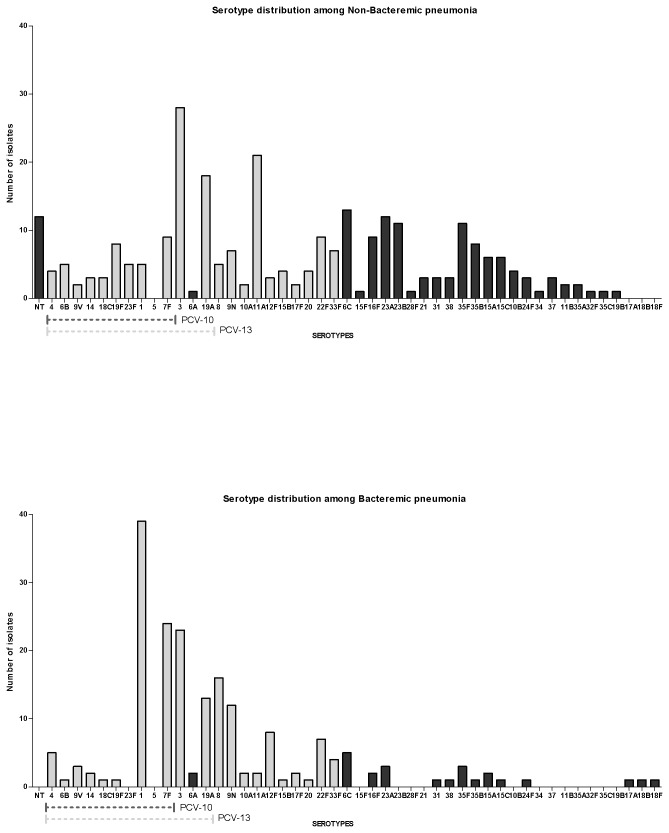
There were 272 cases of NBP and 192 cases of BP. Ninety-nine percent were hospitalized. NBP and BP cases were of comparable age and sex but NBP cases had more respiratory symptoms and less severe disease compared to BP cases. In total, 46 different serotypes were identified. Among NBP cases, 5 serotypes accounted for nearly a third of isolates. PCV10 and -13 types covered 17% (95% confidence interval (CI): 11-23%) and 34% (95% CI: 25-43%) of NBP isolates, respectively. In contrast, the five most frequent serotypes accounted for two-thirds of BP isolates. PCV10 and -13 types covered 39% (95% CI: 30-48%) and 64% (95% CI: 48-79) of BP isolates, respectively. More severe NBP disease was associated with infection with invasive serotypes while there was an inverse relationship for BP.
Only a third of cases of adult non-bacteremic pneumococcal pneumonia would potentially be preventable with the use of PCV13 and just one sixth of cases with the use of PCV10 indicating that PCVs with increased valency are needed to increase vaccine coverage for NBP in adults. PCV13 could potentially prevent two-thirds of adult bacteremic pneumococcal pneumonia.
导致非菌血症性肺炎链球菌性肺炎(NBP)的血清型知之甚少。在此,我们报告了丹麦一项基于人群的研究中,NBP 患者的血清型、相关疾病的潜在风险以及与肺炎球菌结合疫苗(PCV)的覆盖情况,并与菌血症性肺炎(BP)进行了比较。
在一项为期 1 年的基于人群的设计中,纳入了患有肺炎且从下呼吸道或血液中分离出肺炎链球菌的成年人。肺炎的定义是胸部 X 光片上出现新的浸润影,同时伴有临床症状或白细胞计数或血浆 C 反应蛋白升高。所有分离株均采用特定型别的肺炎球菌兔抗血清进行血清型鉴定。所有数值均为中位数和四分位间距。
共纳入 272 例 NBP 患者和 192 例 BP 患者。99%的患者住院。NBP 和 BP 患者的年龄和性别相当,但与 BP 患者相比,NBP 患者的呼吸道症状更多,疾病严重程度更轻。共鉴定出 46 种不同的血清型。在 NBP 患者中,有 5 种血清型占分离株的近三分之一。PCV10 和 -13 型分别覆盖了 NBP 分离株的 17%(95%置信区间[CI]:11-23%)和 34%(95% CI:25-43%)。相比之下,五种最常见的血清型占 BP 分离株的三分之二。PCV10 和 -13 型分别覆盖了 BP 分离株的 39%(95% CI:30-48%)和 64%(95% CI:48-79%)。更严重的 NBP 疾病与侵袭性血清型感染有关,而 BP 则相反。
成人非菌血症性肺炎链球菌性肺炎中,使用 PCV13 预防的病例仅占三分之一,而使用 PCV10 预防的病例仅占六分之一,这表明需要使用更高价的 PCV 来增加成人 NBP 的疫苗覆盖率。PCV13 可能预防成人菌血症性肺炎链球菌性肺炎的三分之二。