Institute of Structural and Molecular Biology, Division of Biosciences, University College London, London WC1E 6BT, UK.
Structure. 2013 Sep 3;21(9):1500-8. doi: 10.1016/j.str.2013.08.006.
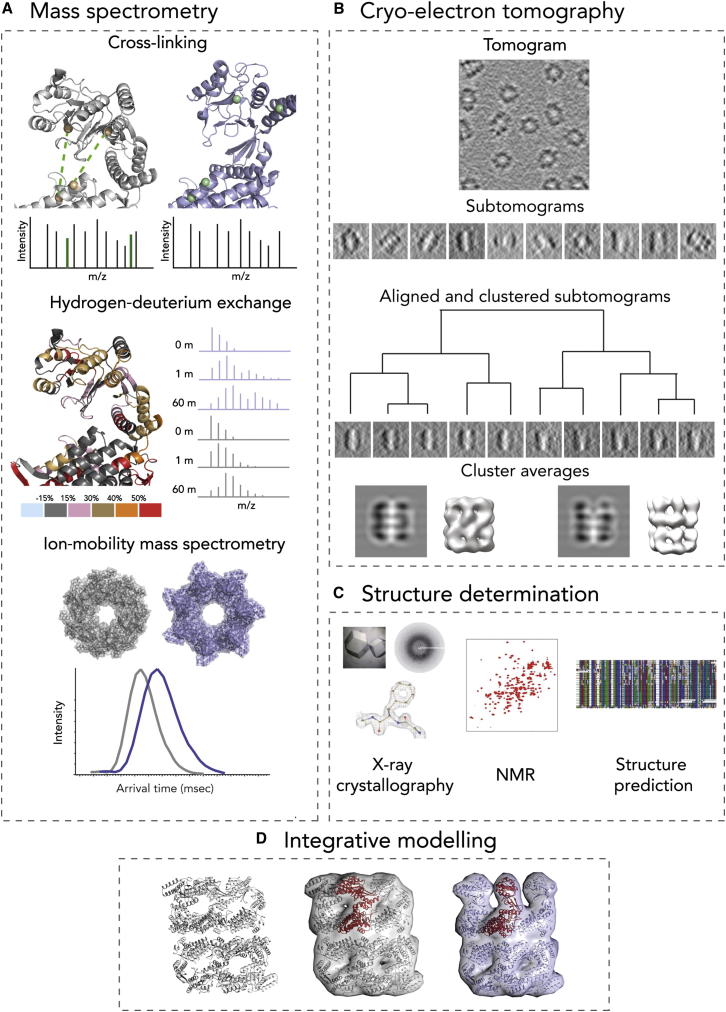
A detailed description of macromolecular assemblies in multiple conformational states can be very valuable for understanding cellular processes. At present, structural determination of most assemblies in different biologically relevant conformations cannot be achieved by a single technique and thus requires an integrative approach that combines information from multiple sources. Different techniques require different computational methods to allow efficient and accurate data processing and analysis. Here, we summarize the latest advances and future challenges in computational methods that help the interpretation of data from two techniques-mass spectrometry and three-dimensional cryo-electron microscopy (with focus on alignment and classification of heterogeneous subtomograms from cryo-electron tomography). We evaluate how new developments in these two broad fields will lead to further integration with atomic structures to broaden our picture of the dynamic behavior of assemblies in their native environment.
对处于多种构象状态的大分子组装体进行详细描述,对于理解细胞过程非常有价值。目前,大多数处于不同生物学相关构象的组装体的结构测定不能仅通过单一技术来实现,因此需要一种综合方法,结合来自多个来源的信息。不同的技术需要不同的计算方法来允许有效的和准确的数据处理和分析。在这里,我们总结了有助于解释两种技术(质谱和三维冷冻电子显微镜(重点是冷冻电子断层扫描中异质亚断层的对齐和分类))数据的计算方法的最新进展和未来挑战。我们评估了这两个广泛领域的新发展将如何与原子结构进一步整合,以拓宽我们对组装体在其自然环境中动态行为的认识。