Department of Anesthesia, Critical Care and Pain Medicine, Massachusetts General Hospital, Boston, MA, USA.
J Neural Eng. 2013 Oct;10(5):056017. doi: 10.1088/1741-2560/10/5/056017. Epub 2013 Sep 10.
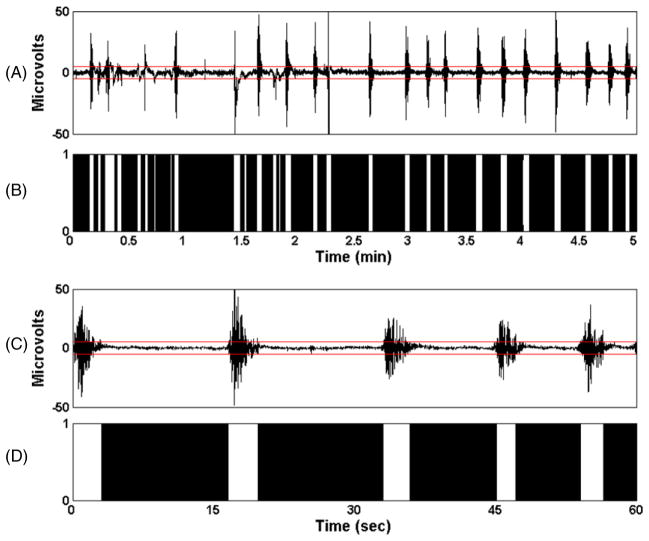
Burst suppression is an electroencephalogram pattern in which bursts of electrical activity alternate with an isoelectric state. This pattern is commonly seen in states of severely reduced brain activity such as profound general anesthesia, anoxic brain injuries, hypothermia and certain developmental disorders. Devising accurate, reliable ways to quantify burst suppression is an important clinical and research problem. Although thresholding and segmentation algorithms readily identify burst suppression periods, analysis algorithms require long intervals of data to characterize burst suppression at a given time and provide no framework for statistical inference.
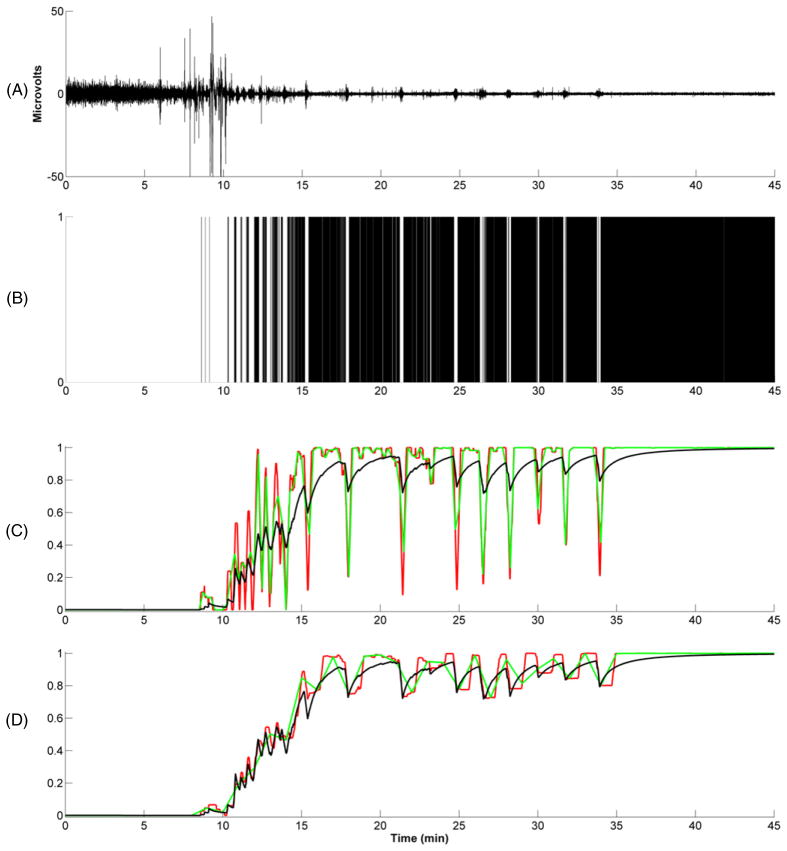
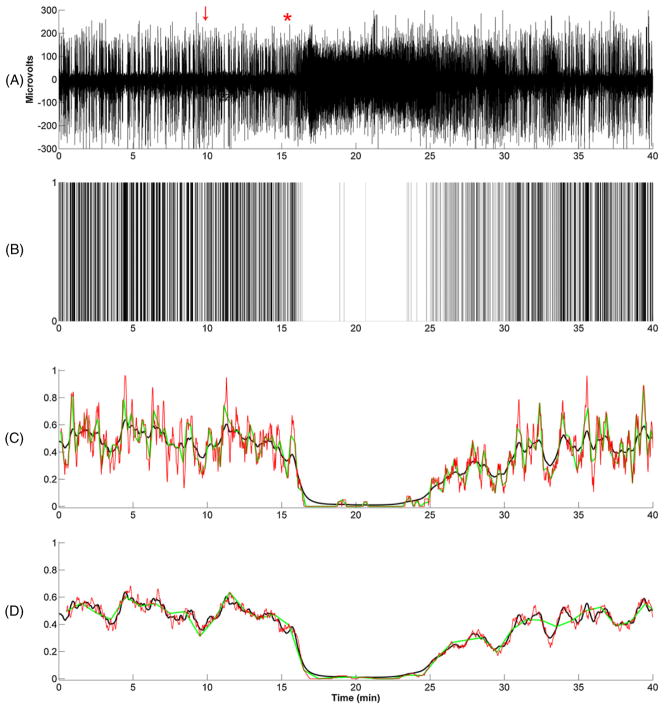
We introduce the concept of the burst suppression probability (BSP) to define the brain's instantaneous propensity of being in the suppressed state. To conduct dynamic analyses of burst suppression we propose a state-space model in which the observation process is a binomial model and the state equation is a Gaussian random walk. We estimate the model using an approximate expectation maximization algorithm and illustrate its application in the analysis of rodent burst suppression recordings under general anesthesia and a patient during induction of controlled hypothermia.
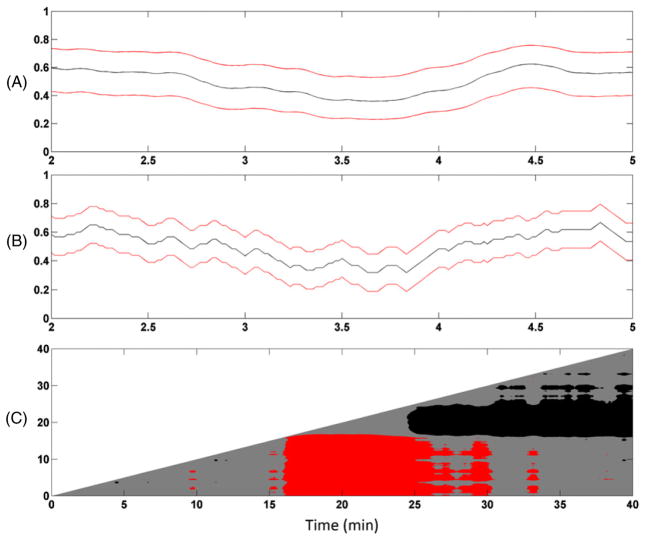
The BSP algorithms track burst suppression on a second-to-second time scale, and make possible formal statistical comparisons of burst suppression at different times.
The state-space approach suggests a principled and informative way to analyze burst suppression that can be used to monitor, and eventually to control, the brain states of patients in the operating room and in the intensive care unit.
爆发抑制是一种脑电图模式,其中电活动爆发与等电状态交替出现。这种模式通常见于大脑活动严重减少的状态,如深度全身麻醉、缺氧性脑损伤、低温和某些发育障碍。设计准确、可靠的方法来量化爆发抑制是一个重要的临床和研究问题。尽管阈值和分割算法可以很容易地识别爆发抑制期,但分析算法需要长时间的数据间隔来在给定时间内对爆发抑制进行特征描述,并且没有提供统计推断的框架。
我们引入爆发抑制概率(BSP)的概念来定义大脑在抑制状态下的瞬时倾向。为了对爆发抑制进行动态分析,我们提出了一个状态空间模型,其中观测过程是二项式模型,状态方程是高斯随机游走。我们使用近似期望最大化算法估计模型,并说明其在分析全身麻醉下啮齿动物爆发抑制记录和患者在控制性低温诱导期间的应用。
BSP 算法在秒级时间尺度上跟踪爆发抑制,并能够对不同时间的爆发抑制进行正式的统计比较。
状态空间方法为分析爆发抑制提供了一种有原则和信息丰富的方法,可以用于监测手术室和重症监护病房患者的脑状态,并最终控制脑状态。