Khedmat Sedigheh, Aligholi Marziyeh, Sadeghi Samaneh
Department of Endodontics, Dental School, Dental Research Center, Tehran University of Medical Sciences, Tehran, Iran.
Iran Endod J. 2009 Fall;4(4):139-43. Epub 2009 Oct 10.
It has been demonstrated that organic content of the root canals can influence the antimicrobial capability of chemical irrigants. The aim of this study was to evaluate the effect of bovine serum albumin (BSA), as an organic material, on the antimicrobial activity of several intracanal irrigants.
Bactericidal activity of Ethylenediaminetetraacetic acid (EDTA) 17%, citric acid 10%, Sodium hypochlorite (NaOCl) 5.25%, Chlorhexidine 0.2% (CHX), Smear Clear and Cetrimide 0.5% were tested by means of dilution-neutralization method. Contact times were 10 and 30 seconds, 5, 10, 30, 60 minutes and 24 hours. First 950 λ of the medicament was mixed with 50 λ of the bacterial suspension in an Eppendorf test tube. The suspensions were thoroughly mixed. Sterile water served as negative controls. After each contact time, 100 λ of samples was transferred to the Eppendorf test tubes which contained neutralizers. After 5 minutes, 50 λ of serial dilutions were cultured on brain heart infusion agar and incubated in aerobic conditions. Then colonies were counted and reported as cfu/mL. In half of the samples, medicaments were suspended in BSA 0.5% 30 minutes before examination to assess its possible inhibitory effect on the antibacterial activity.
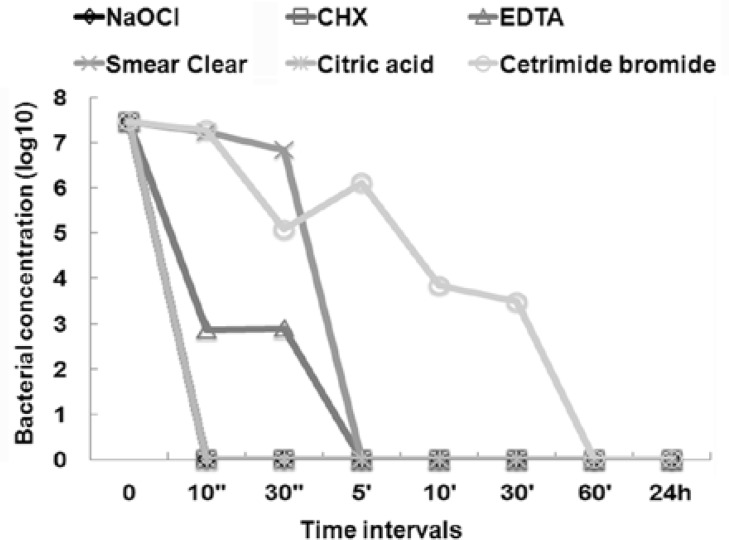
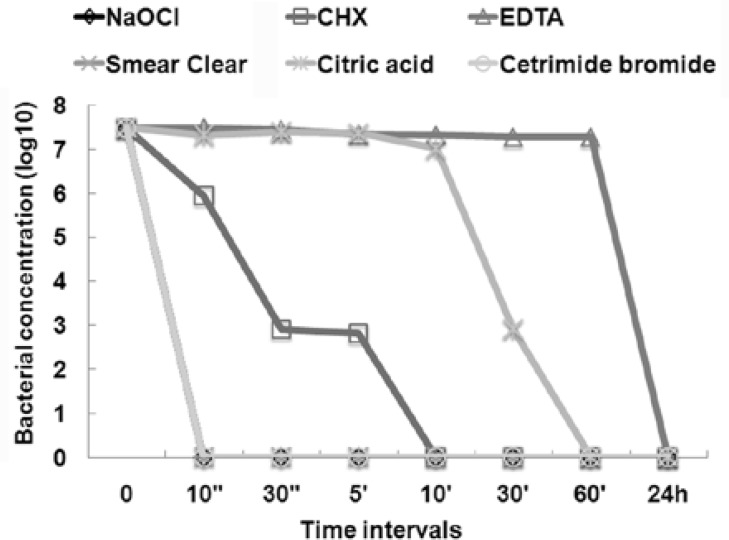
NaOCl 5.25%, Cetrimide 0.5% and Smear Clear showed bactericidal activity within seconds after the incubation. BSA had no inhibitory effect on bactericidal activity of these three medicaments. CHX took 5 and10 minutes to kill all bacterial cells in the absence and presence of BSA, respectively. Citric acid and EDTA showed the least antibacterial activity.
In this study, NaOCl 5.25%, Cetrimide 0.5% and Smear Clear were significantly more effective against E. faecalis than EDTA 17% and citric acid 10% in the presence and absence of BSA. Also, in the presence of BSA, bactericidal activity of CHX 0.2% against E. faecalis was significantly more than EDTA after 10 and 30 minutes of contact time. EDTA and citric acid showed the least bactericidal activity. [Iranian Endodontic Journal 2009;4(4):139-43].
已证实根管内的有机成分会影响化学冲洗剂的抗菌能力。本研究的目的是评估作为有机材料的牛血清白蛋白(BSA)对几种根管冲洗剂抗菌活性的影响。
采用稀释中和法检测17%乙二胺四乙酸(EDTA)、10%柠檬酸、5.25%次氯酸钠(NaOCl)、0.2%氯己定(CHX)、Smear Clear和0.5%西曲溴铵的杀菌活性。接触时间为10秒和30秒、5分钟、10分钟、30分钟、60分钟和24小时。首先,在一个艾本德试管中将950μl的药物与50μl的细菌悬液混合。将悬液充分混合。无菌水作为阴性对照。在每个接触时间后,将100μl的样品转移到含有中和剂的艾本德试管中。5分钟后,将5μl的系列稀释液接种在脑心浸液琼脂上,并在需氧条件下培养。然后计数菌落并报告为cfu/mL。在一半的样品中,在检测前30分钟将药物悬浮于0.5%的BSA中,以评估其对抗菌活性可能的抑制作用。
5.25%的NaOCl、0.5%的西曲溴铵和Smear Clear在孵育后数秒内即显示出杀菌活性。BSA对这三种药物的杀菌活性没有抑制作用。在不存在和存在BSA的情况下,CHX分别需要5分钟和10分钟杀死所有细菌细胞。柠檬酸和EDTA的抗菌活性最低。
在本研究中,无论有无BSA,5.25%的NaOCl、0.5%的西曲溴铵和Smear Clear对粪肠球菌的杀菌效果均显著优于17%的EDTA和10%的柠檬酸。此外,在存在BSA的情况下,接触10分钟和30分钟后,0.2%的CHX对粪肠球菌的杀菌活性显著高于EDTA。EDTA和柠檬酸的杀菌活性最低。[《伊朗牙髓病学杂志》2009年;4(4):139 - 143]