Plant Systems Biology Lab, Center of Biodiversity, Functional & Integrative Genomics (BioFIG), Science Faculty of Lisbon University, Lisboa, Portugal.
PLoS One. 2013 Sep 4;8(9):e72998. doi: 10.1371/journal.pone.0072998. eCollection 2013.
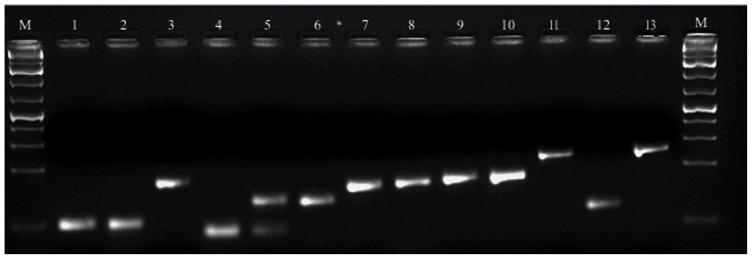
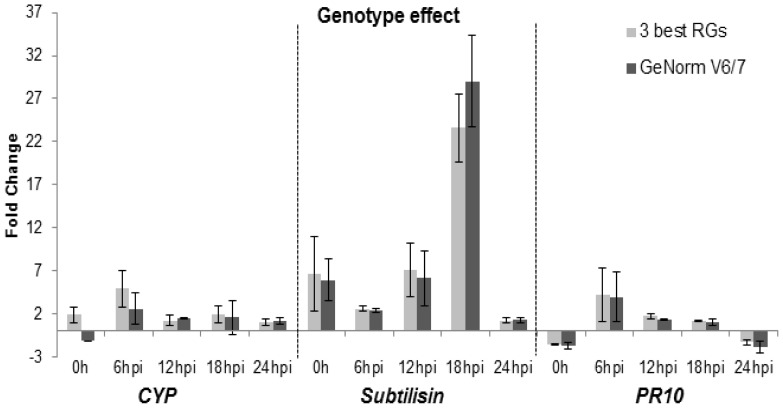
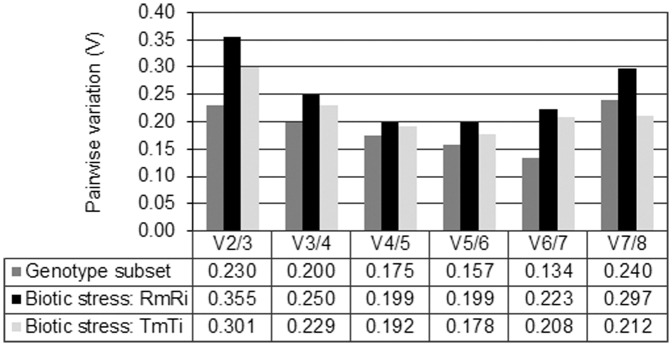
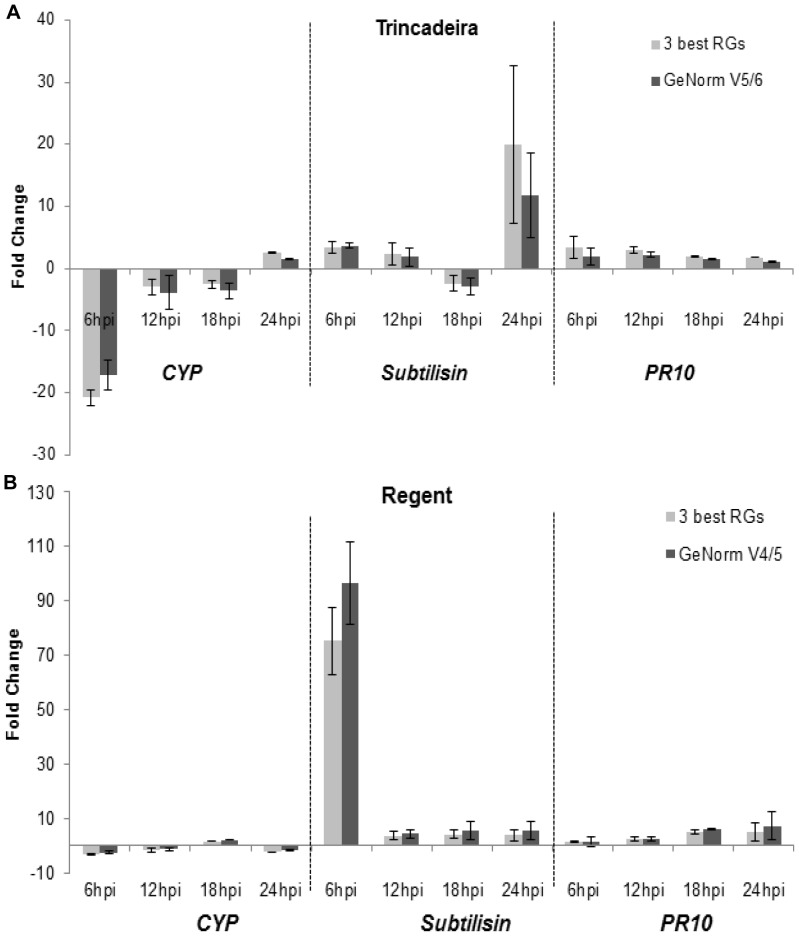
The pivotal role of cultivated grapevine (Vitis vinifera L.) in many countries economy is compromised by its high susceptibility to Plasmopara viticola, the causal agent of downy mildew disease. Recent research has identified a set of genes related to resistance which may be used to track downy mildew infection. Quantification of the expression of these resistance genes requires normalizing qPCR data using reference genes with stable expression in the system studied. In this study, a set of eleven genes (VATP16, 60 S, UQCC, SMD3, EF1α, UBQ, SAND, GAPDH, ACT, PsaB, PTB2) was evaluated to identify reference genes during the first hours of interaction (6, 12, 18 and 24 hpi) between two V. vinifera genotypes and P. viticola. Two analyses were used for the selection of reference genes: direct comparison of susceptible, Trincadeira, and resistant, Regent, V. vinifera cultivars at 0 h, 6, 12, 18 and 24 hours post inoculation with P. viticola (genotype effect); and comparison of each genotype with mock inoculated samples during inoculation time-course (biotic stress effect). Three statistical methods were used, GeNorm, NormFinder, and BestKeeper, allowing to identify UBQ, EF1α and GAPDH as the most stable genes for the genotype effect. For the biotic stress effect, EF1α, SAND and SMD3 were the most constant for the susceptible cultivar Trincadeira and EF1α, GAPDH, UBQ for the resistant cultivar Regent. In addition, the expression of three defense-related transcripts, encoding for subtilisin-like protein, CYP and PR10, was analysed, for both datasets, during inoculation time-course. Taken together, our results provide guidelines for reference gene(s) selection towards a more accurate and widespread use of qPCR to study the first hours of interaction between different grapevine cultivars and P. viticola.
葡萄(Vitis vinifera L.)在许多国家的经济中起着至关重要的作用,但它极易感染霜霉病病原菌——致病疫霉(Plasmopara viticola)。最近的研究已经确定了一系列与抗性相关的基因,这些基因可能被用于追踪霜霉病的感染。为了使 qPCR 数据更准确,需要使用在研究体系中表达稳定的参考基因对其进行归一化。在本研究中,我们评估了一组 11 个基因(VATP16、60S、UQCC、SMD3、EF1α、UBQ、SAND、GAPDH、ACT、PsaB、PTB2),以鉴定在两种葡萄基因型与致病疫霉互作的最初几小时(6、12、18 和 24 hpi)中表达稳定的参考基因。我们使用了两种分析方法来选择参考基因:直接比较易感品种特林卡代拉(Trincadeira)和抗源品种雷根特(Regent)在接种致病疫霉 0、6、12、18 和 24 小时后的参考基因表达(基因型效应);以及在接种过程中比较每个基因型与模拟接种样本的参考基因表达(生物胁迫效应)。我们使用了三种统计方法,即 GeNorm、NormFinder 和 BestKeeper,确定 UBQ、EF1α 和 GAPDH 是基因型效应下最稳定的基因。对于生物胁迫效应,易感品种特林卡代拉中 EF1α、SAND 和 SMD3 最稳定,而抗源品种雷根特中 EF1α、GAPDH 和 UBQ 最稳定。此外,我们还分析了两个数据集在接种过程中三个防御相关转录本的表达,它们分别编码枯草杆菌蛋白酶样蛋白、CYP 和 PR10。总的来说,我们的研究结果为参考基因的选择提供了指导,以更准确、更广泛地利用 qPCR 研究不同葡萄品种与致病疫霉互作的最初几小时。