Nickel Lindsay R, Thatcher Alyssa R, Keller Flavio, Wozniak Robert H, Iverson Jana M
Department of Psychology, University of Pittsburgh, Pittsburgh, PA.
Infancy. 2013 Sep;18(5):639-661. doi: 10.1111/infa.12025.
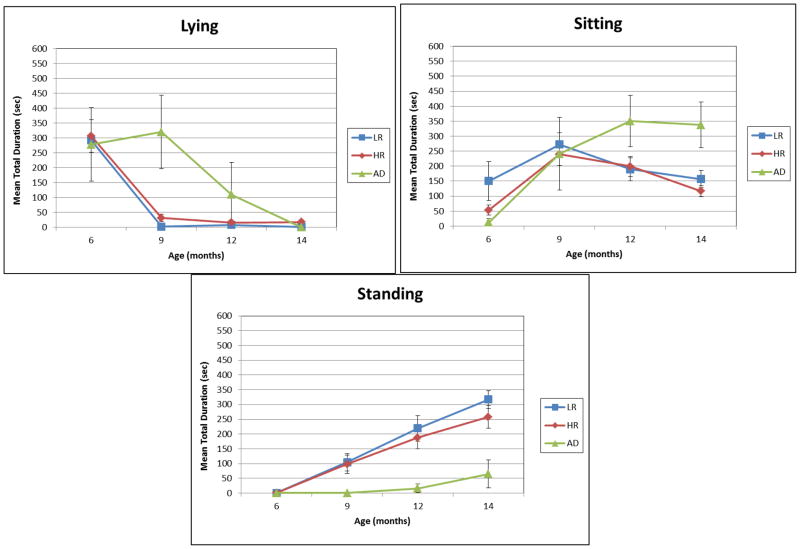
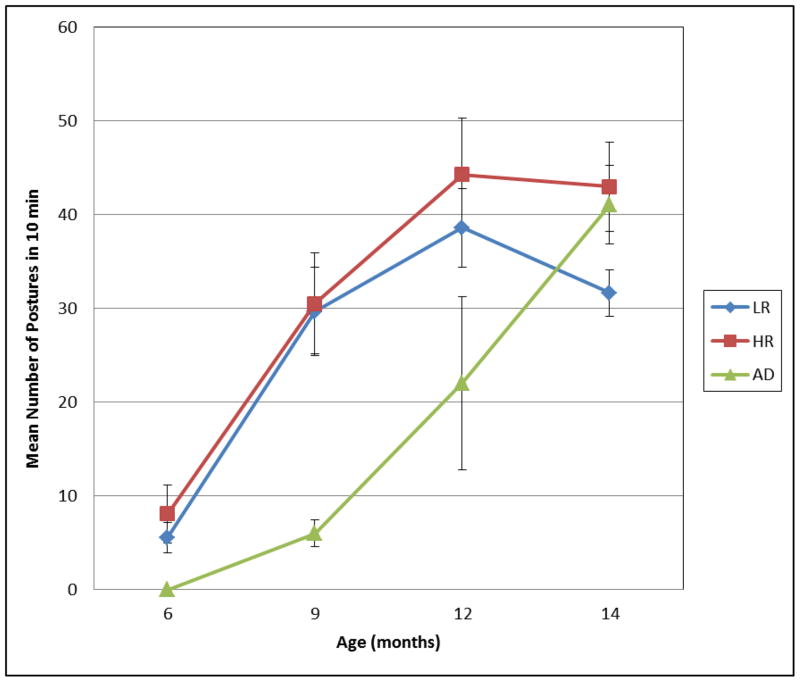
Evidence suggests that children and adults diagnosed with autism spectrum disorders (ASD) exhibit difficulties with postural control. Retrospective video studies of infants later diagnosed with ASD indicate that infants who eventually receive an ASD diagnosis exhibit delays in postural development. This study investigates early posture development prospectively and longitudinally in 22 infants at heightened biological risk for ASD (HR) and 18 infants with no such risk (Low Risk; LR). Four HR infants received an autism diagnosis (AD infants) at 36 months. Infants were videotaped at home at 6, 9, 12, and 14 months during everyday activities and play. All infant postures were coded and classified as to whether or not they were infant-initiated. Relative to LR infants, HR infants were slower to develop skill in sitting and standing postures. AD infants exhibited substantial delays in the emergence of more advanced postures and initiated fewer posture changes. Because posture advances create opportunities for infants to interact with objects and people in new and progressively more sophisticated ways, postural delays may have cascading effects on opportunities for infant exploration and learning. These effects may be greater for infants with ASD, for whom posture delays are more significant.
有证据表明,被诊断患有自闭症谱系障碍(ASD)的儿童和成人在姿势控制方面存在困难。对后来被诊断患有ASD的婴儿进行的回顾性视频研究表明,最终被诊断患有ASD的婴儿在姿势发育方面存在延迟。本研究对22名具有较高ASD生物学风险(HR)的婴儿和18名无此类风险(低风险;LR)的婴儿进行了早期姿势发育的前瞻性和纵向研究。4名HR婴儿在36个月时被诊断为自闭症(AD婴儿)。在6、9、12和14个月时,对婴儿在家中进行日常活动和玩耍时的情况进行录像。对所有婴儿的姿势进行编码,并分类为是否由婴儿发起。相对于LR婴儿,HR婴儿在坐姿和站姿技能发展方面较慢。AD婴儿在更高级姿势的出现方面表现出明显延迟,并且发起的姿势变化较少。由于姿势的进步为婴儿提供了以新的、越来越复杂的方式与物体和人互动的机会,姿势延迟可能会对婴儿探索和学习的机会产生连锁反应。对于患有ASD的婴儿来说,这些影响可能更大,因为他们的姿势延迟更为显著。