Clínica Alemana de Santiago.
J Appl Clin Med Phys. 2013 Sep 6;14(5):231-42. doi: 10.1120/jacmp.v14i5.4388.
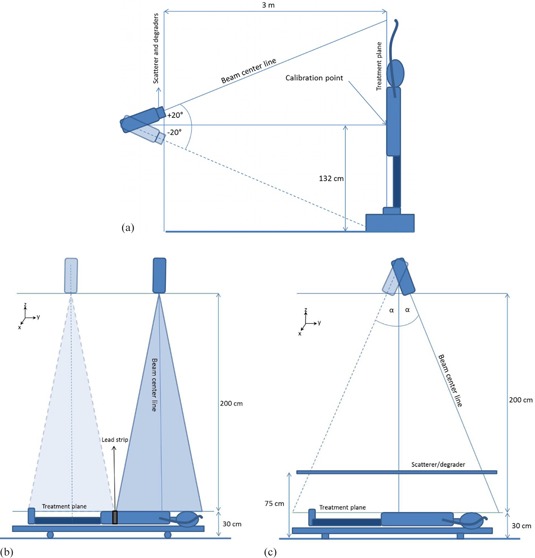
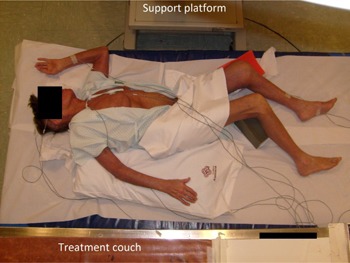
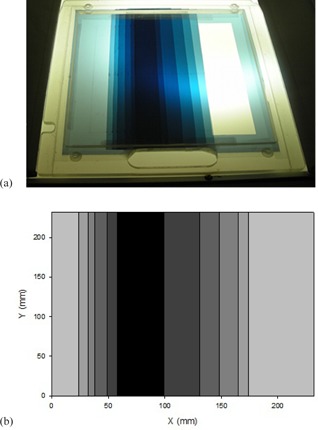
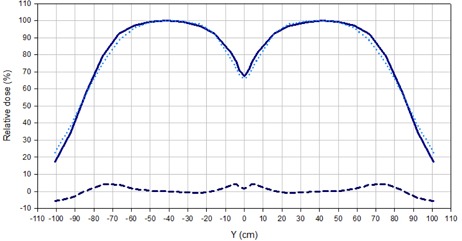
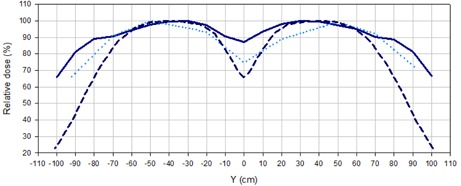
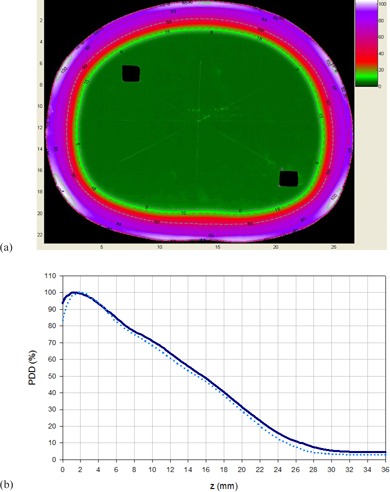
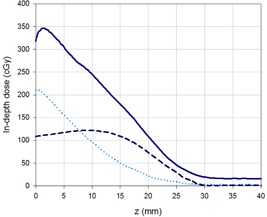
Total skin electron irradiation (TSEI) has been used as a treatment for mycosis fungoides. Our center has implemented a modified Stanford technique with six pairs of 6 MeV adjacent electron beams, incident perpendicularly on the patient who remains lying on a translational platform, at 200 cm from the source. The purpose of this study is to perform a dosimetric characterization of this technique and to investigate its optimization in terms of energy characteristics, extension, and uniformity of the treatment field. In order to improve the homogeneity of the distribution, a custom-made polyester filter of variable thickness and a uniform PMMA degrader plate were used. It was found that the characteristics of a 9 MeV beam with an 8 mm thick degrader were similar to those of the 6 MeV beam without filter, but with an increased surface dose. The combination of the degrader and the polyester filter improved the uniformity of the distribution along the dual field (180cm long), increasing the dose at the borders of field by 43%. The optimum angles for the pair of beams were ± 27°. This configuration avoided displacement of the patient, and reduced the treatment time and the positioning problems related to the abutting superior and inferior fields. Dose distributions in the transversal plane were measured for the six incidences of the Stanford technique with film dosimetry in an anthropomorphic pelvic phantom. This was performed for the optimized treatment and compared with the previously implemented technique. The comparison showed an increased superficial dose and improved uniformity of the 85% isodose curve coverage for the optimized technique.
全身电子线照射(TSEI)已被用于蕈样肉芽肿的治疗。我们中心采用改良的斯坦福技术,使用六对 6 MeV 相邻电子束,垂直入射到躺在平移平台上的患者,源皮距为 200 cm。本研究的目的是对该技术进行剂量学特征描述,并研究其在能量特性、治疗野的扩展和均匀性方面的优化。为了提高分布的均匀性,使用了定制的可变厚度聚酯滤过片和均匀的 PMMA 衰减器。结果发现,8mm 厚衰减器的 9 MeV 束的特性与无滤过片的 6 MeV 束相似,但表面剂量增加。衰减器和聚酯滤过片的组合改善了双野(180cm 长)沿野分布的均匀性,使野边缘的剂量增加了 43%。最佳的双野角度为±27°。这种配置避免了患者的移位,并减少了与相邻上下野相关的治疗时间和定位问题。在人体骨盆模型中使用胶片剂量学测量了斯坦福技术的六种入射角的横断平面剂量分布。这是为优化治疗进行的,并与之前实施的技术进行了比较。比较结果显示,优化后的技术可提高表面剂量,改善 85%等剂量曲线覆盖率的均匀性。