Computational Neurobiology Laboratory, The Salk Institute for Biological Studies, La Jolla, California, United States of America ; Center for Theoretical Biological Physics and Department of Physics, University of California, San Diego, La Jolla, California, United States of America.
PLoS Comput Biol. 2013;9(9):e1003206. doi: 10.1371/journal.pcbi.1003206. Epub 2013 Sep 5.
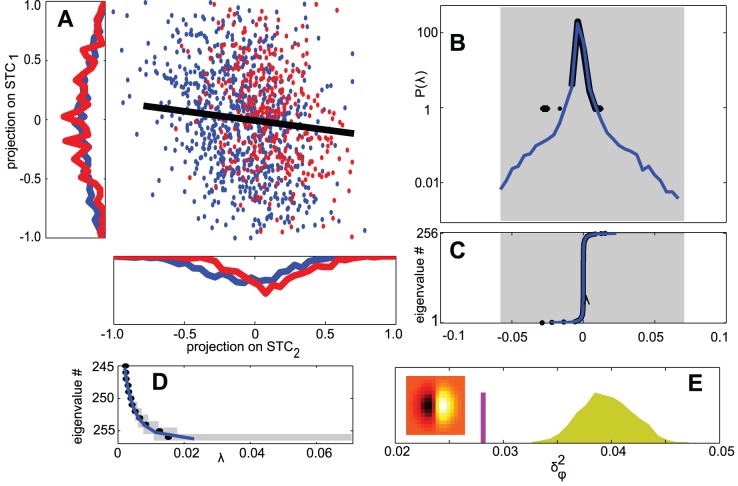
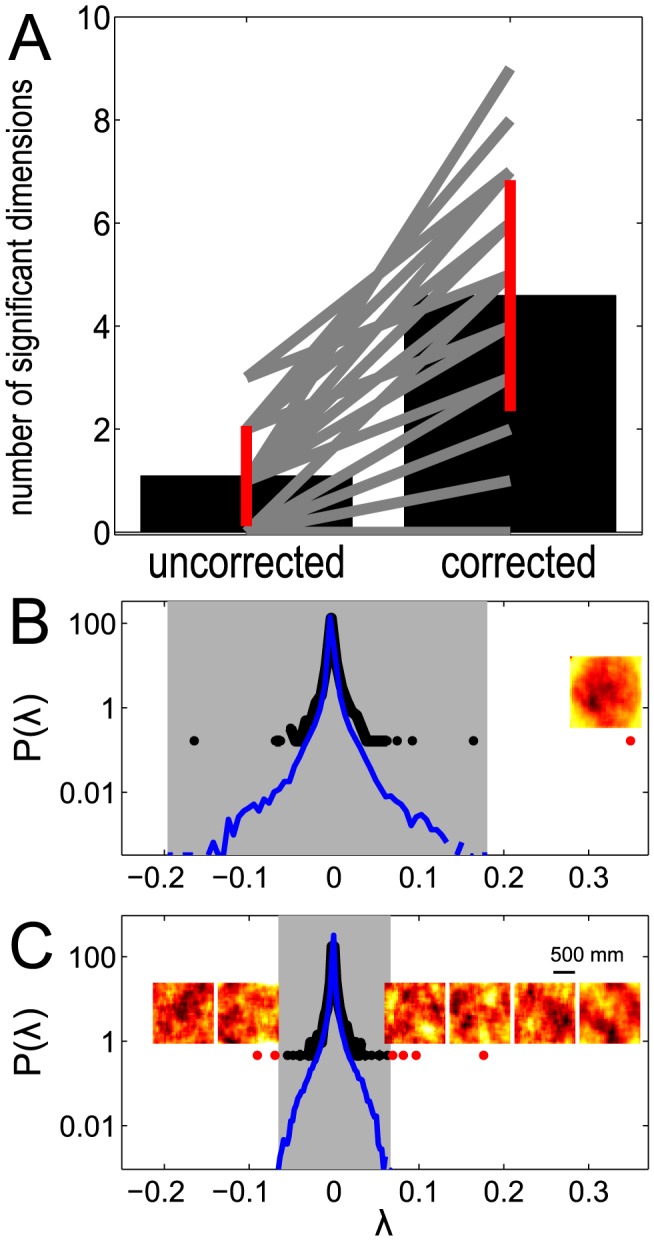
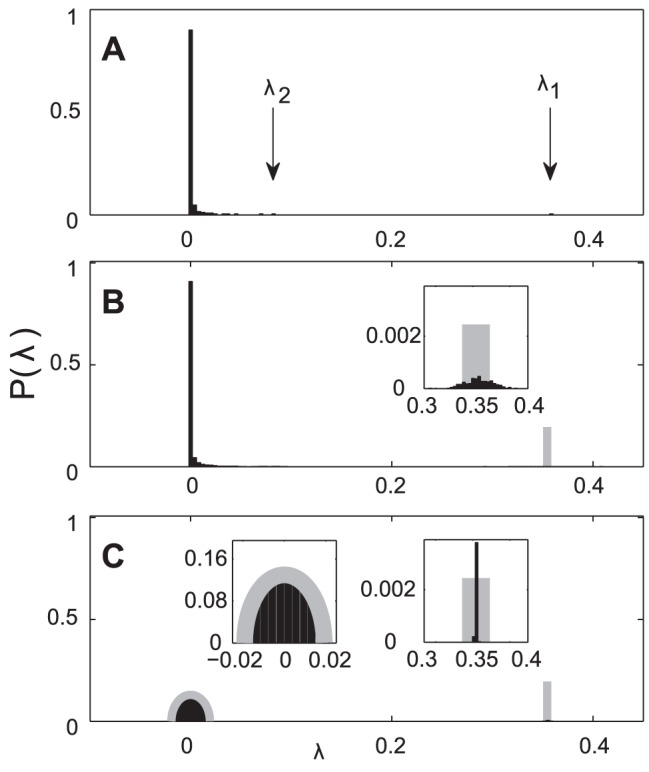
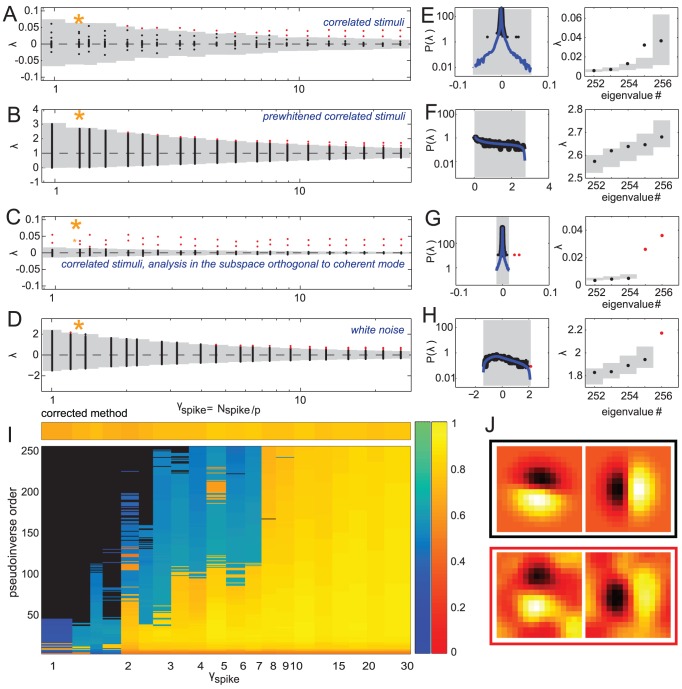
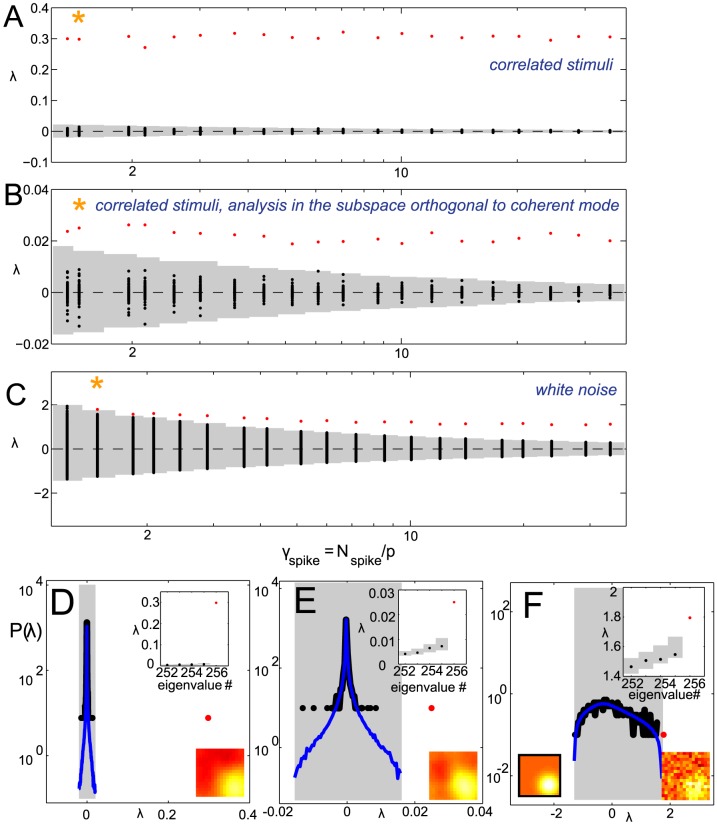
Many biological systems perform computations on inputs that have very large dimensionality. Determining the relevant input combinations for a particular computation is often key to understanding its function. A common way to find the relevant input dimensions is to examine the difference in variance between the input distribution and the distribution of inputs associated with certain outputs. In systems neuroscience, the corresponding method is known as spike-triggered covariance (STC). This method has been highly successful in characterizing relevant input dimensions for neurons in a variety of sensory systems. So far, most studies used the STC method with weakly correlated Gaussian inputs. However, it is also important to use this method with inputs that have long range correlations typical of the natural sensory environment. In such cases, the stimulus covariance matrix has one (or more) outstanding eigenvalues that cannot be easily equalized because of sampling variability. Such outstanding modes interfere with analyses of statistical significance of candidate input dimensions that modulate neuronal outputs. In many cases, these modes obscure the significant dimensions. We show that the sensitivity of the STC method in the regime of strongly correlated inputs can be improved by an order of magnitude or more. This can be done by evaluating the significance of dimensions in the subspace orthogonal to the outstanding mode(s). Analyzing the responses of retinal ganglion cells probed with [Formula: see text] Gaussian noise, we find that taking into account outstanding modes is crucial for recovering relevant input dimensions for these neurons.
许多生物系统对具有非常大维数的输入进行计算。确定特定计算的相关输入组合通常是理解其功能的关键。一种常见的方法是检查输入分布与与特定输出相关的输入分布之间的方差差异。在系统神经科学中,相应的方法称为尖峰触发协方差 (STC)。这种方法在表征各种感觉系统中神经元的相关输入维度方面非常成功。到目前为止,大多数研究都使用具有弱相关高斯输入的 STC 方法。然而,使用具有自然感觉环境典型的长程相关输入的这种方法也很重要。在这种情况下,刺激协方差矩阵具有一个(或多个)突出的特征值,由于采样变异性,这些特征值无法轻易均衡。这种突出的模式会干扰对调节神经元输出的候选输入维度的统计显着性的分析。在许多情况下,这些模式会使重要的维度变得模糊。我们表明,通过评估与突出模式(多个)正交的子空间中的维度的显着性,可以将强相关输入域中的 STC 方法的灵敏度提高一个数量级或更多。通过分析用 [公式:见文本] 高斯噪声探测的视网膜神经节细胞的响应,我们发现,对于这些神经元,考虑突出模式对于恢复相关输入维度至关重要。