Cell Biology Division, Medical Research Council Laboratory of Molecular Biology, Cambridge, Cambridgeshire, United Kingdom.
PLoS One. 2013 Sep 11;8(9):e74382. doi: 10.1371/journal.pone.0074382. eCollection 2013.
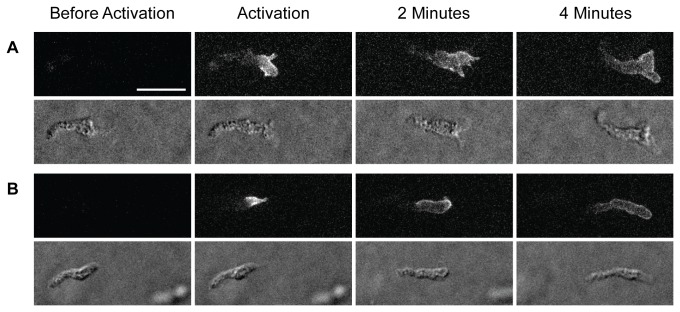
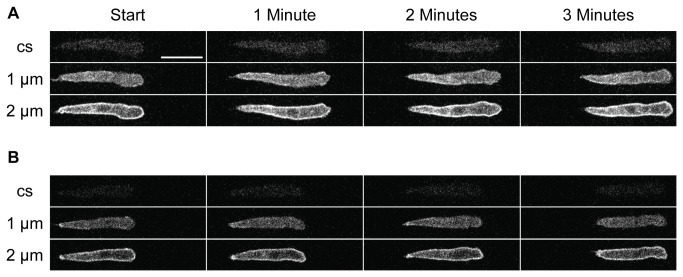
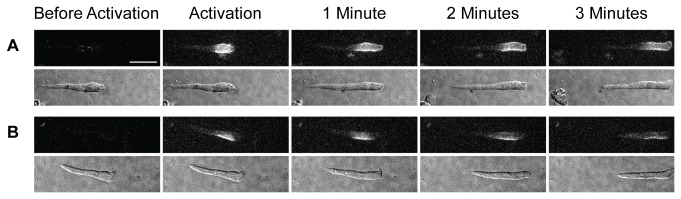
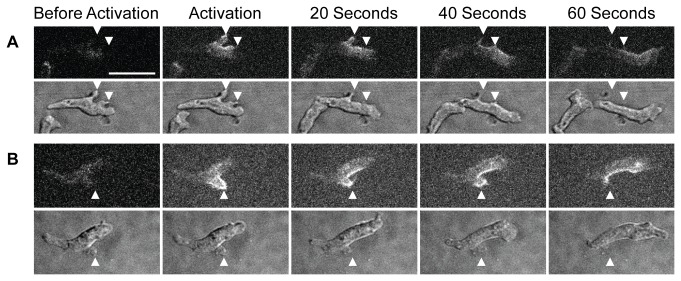
The surface behaviour of swimming amoebae was followed in cells bearing a cAR1-paGFP (cyclic AMP receptor fused to a photoactivatable-GFP) construct. Sensitized amoebae were placed in a buoyant medium where they could swim toward a chemoattractant cAMP source. paGFP, activated at the cell's front, remained fairly stationary in the cell's frame as the cell advanced; the label was not swept rearwards. Similar experiments with chemotaxing cells attached to a substratum gave the same result. Furthermore, if the region around a lateral projection near a crawling cell's front is marked, the projection and the labelled cAR1 behave differently. The label spreads by diffusion but otherwise remains stationary in the cell's frame; the lateral projection moves rearwards on the cell (remaining stationary with respect to the substrate), so that it ends up outside the labelled region. Furthermore, as cAR1-GFP cells move, they occasionally do so in a remarkably straight line; this suggests they do not need to snake to move on a substratum. Previously, we suggested that the surface membrane of a moving amoeba flows from front to rear as part of a polarised membrane trafficking cycle. This could explain how swimming amoebae are able to exert a force against the medium. Our present results indicate that, in amoebae, the suggested surface flow does not exist: this implies that they swim by shape changes.
研究人员在带有 cAR1-paGFP(环腺苷酸受体融合到光激活 GFP)构建体的细胞中观察游泳变形虫的表面行为。将敏化变形虫置于浮力介质中,它们可以向 cAMP 趋化源游动。在细胞前进时,在细胞前部激活的 paGFP 在细胞框架内相对静止;该标记物不会向后扫动。用附着在基质上的趋化细胞进行类似的实验也得到了相同的结果。此外,如果标记靠近爬行细胞前缘的侧向突起周围的区域,则突起和标记的 cAR1 的行为会有所不同。标记物通过扩散扩散,但在细胞框架内保持静止;侧向突起在细胞上向后移动(相对于基质保持静止),因此它最终位于标记区域之外。此外,当 cAR1-GFP 细胞移动时,它们偶尔会以非常直的线移动;这表明它们在基质上移动时不需要蜿蜒前行。此前,我们提出,运动变形虫的表面膜从前向后流动,作为极化膜运输循环的一部分。这可以解释游泳变形虫如何能够对介质施加力。我们目前的结果表明,在变形虫中,不存在所建议的表面流动:这意味着它们通过形状变化来游泳。