MMWR Morb Mortal Wkly Rep. 2013 Sep 20;62(37):768-72.
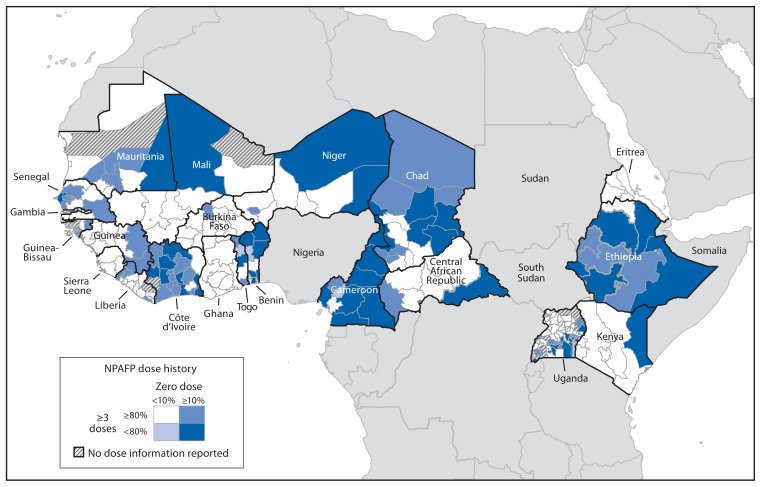
In 2012, the World Health Assembly of the World Health Organization (WHO) declared the completion of polio eradication a programmatic emergency. Indigenous wild poliovirus (WPV) transmission remains uninterrupted in Nigeria (in the WHO African Region [AFR]) and in Afghanistan and Pakistan (in the WHO Eastern Mediterranean Region [EMR]). In the WHO AFR, multiple WPV outbreaks have occurred since 2003 after importation of indigenous West African WPV into 21 previously polio-free countries in a "WPV importation belt"* that extends across the continent. The Global Polio Eradication Initiative (GPEI) and WHO regional offices have used indicators of population immunity, surveillance quality, and other factors (e.g., high-risk subpopulations and proximity to WPV-affected countries) to assess the risk for outbreaks in polio-free countries and guide the implementation of risk mitigation measures to limit poliovirus transmission after WPV importation and prevent the emergence of circulating vaccine-derived poliovirus (cVDPV). Despite risk mitigation efforts, a polio outbreak, first confirmed in May 2013, is ongoing; as of September 10, a total of 178 WPV type 1 (WPV1) cases have been reported in Somalia† (163 cases), Kenya (14 cases) and Ethiopia (1 case), after importation of WPV1 of West African origin. This report summarizes steps taken by the GPEI to assess and mitigate the risks for outbreaks after WPV importation or the emergence of cVDPV in polio-free countries within the WHO AFR's "WPV importation belt." All countries will continue to have some level of risk for WPV outbreaks as long as endemic circulation continues in Afghanistan, Nigeria, and Pakistan.
2012 年,世界卫生组织(世卫组织)的世界卫生大会宣布消灭脊灰行动取得的进展为一项突发公共卫生事件。尼日利亚(世卫组织非洲区域)、阿富汗和巴基斯坦(世卫组织东地中海区域)仍有野生脊灰病毒(WPV)传播。自 2003 年以来,在“脊灰病毒输入带”*内,曾有 21 个无脊灰国家从西非输入 WPV 后发生了多起 WPV 暴发。该“脊灰病毒输入带”跨越整个非洲大陆。全球消灭脊灰行动(GPEI)和世卫组织区域办事处利用人群免疫水平、监测质量和其他因素(例如高危亚人群以及与受 WPV 影响国家的毗邻程度)的指标来评估脊灰无脊灰国家发生暴发的风险,并指导实施减少风险措施,以限制 WPV 输入后的病毒传播,防止出现循环疫苗衍生脊灰病毒(cVDPV)。尽管采取了减少风险的措施,但 2013 年 5 月首次确认的脊灰疫情仍在持续。截至 9 月 10 日,在索马里报告了总共 178 例 1 型脊灰野病毒(WPV1)病例(索马里 163 例,肯尼亚 14 例,埃塞俄比亚 1 例),这些病例是输入 WPV1 西非起源株后发生的。本报告总结了 GPEI 为评估和减少脊灰无脊灰国家发生 WPV 输入或出现 cVDPV 风险所采取的措施,这些国家位于世卫组织非洲区域的“脊灰病毒输入带”内。只要阿富汗、尼日利亚和巴基斯坦仍存在脊灰地方性传播,所有国家仍将面临 WPV 暴发的一定风险。