Cherkasova Elena, Weisman Quinn, Childs Richard W
Hematology Branch, National Heart, Lung and Blood Institute, National Institutes of Health , Bethesda, MD , USA.
Front Oncol. 2013 Sep 17;3:243. doi: 10.3389/fonc.2013.00243.
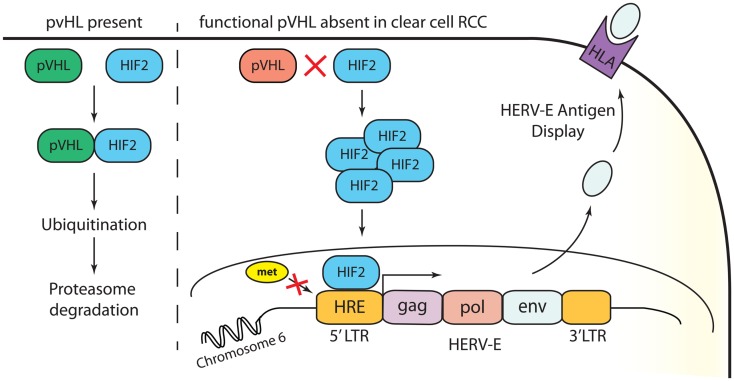
Human endogenous retroviruses (HERVs), remnants of ancient germ-line infections with exogenous retroviruses, are estimated to comprise up to 8% of human genome. Most HERVs have accumulated mutations and deletions that prevent their expression as an infectious virus. Nevertheless, a growing number of HERV genes and proteins have been found to be expressed in different cancers, raising the possibility that HERV-derived antigens might represent excellent targets for tumor immunotherapy. Here, we review data showing HERV-encoded antigens are capable of eliciting humoral and T-cells specific antitumor immunity. We also describe a novel HERV-E that was recently found to be selectively expressed in over 80% of clear cell kidney cancer but not in normal tissues. Remarkably, the restricted expression of HERV-E in kidney tumors was found to occur as a consequence of inactivation of the von Hippel-Lindau tumor suppressor. Importantly, antigens derived from this provirus are immunogenic, stimulating cytotoxic T-cells that kill kidney cancer cells in vitro and in vivo. Taken altogether, these data suggest efforts aimed at boosting human immunity against HERV-derived antigens could be used as a strategy to treat advanced tumors including kidney cancer.
人类内源性逆转录病毒(HERVs)是古代生殖系感染外源性逆转录病毒的残余物,估计占人类基因组的8%。大多数HERVs积累了突变和缺失,从而阻止它们作为感染性病毒表达。然而,越来越多的HERV基因和蛋白质已被发现在不同癌症中表达,这增加了HERV衍生抗原可能成为肿瘤免疫治疗极佳靶点的可能性。在此,我们综述了表明HERV编码抗原能够引发体液和T细胞特异性抗肿瘤免疫的数据。我们还描述了一种新发现的HERV-E,最近发现它在80%以上的透明细胞肾癌中选择性表达,但在正常组织中不表达。值得注意的是,发现HERV-E在肾肿瘤中的限制性表达是由于冯·希佩尔-林道肿瘤抑制基因失活所致。重要的是,源自这种前病毒的抗原具有免疫原性,能刺激细胞毒性T细胞在体外和体内杀死肾癌细胞。综上所述,这些数据表明,旨在增强人类针对HERV衍生抗原的免疫力的努力可作为治疗包括肾癌在内的晚期肿瘤的一种策略。