Ministry of Health and Social Welfare, Banjul, The Gambia ; National Cancer Registry, Fajara, The Gambia ; University of Tampere, Tampere, Finland ; The Gambia Hepatitis Intervention Study (GHIS) project, Fajara, The Gambia.
PLoS One. 2013 Sep 30;8(9):e75775. doi: 10.1371/journal.pone.0075775. eCollection 2013.
The Gambia Hepatitis Intervention Study (GHIS) was designed as a randomised control trial of infant hepatitis B vaccination applied to public health policy, with the main goal of preventing primary liver cancer later in adult life in The Gambia. To that effect, the National Cancer Registry of The Gambia (NCR), a population-based cancer registry (PBCR), was established in 1986 to actively collect data on all cancer diagnosis nation-wide. We extracted 20-years (1990-2009) of data to assess for the first time, the evolution of the most common cancers, also describe and demonstrate the role of the PBCR in a hepatitis B and liver cancer prevention programme in this population.
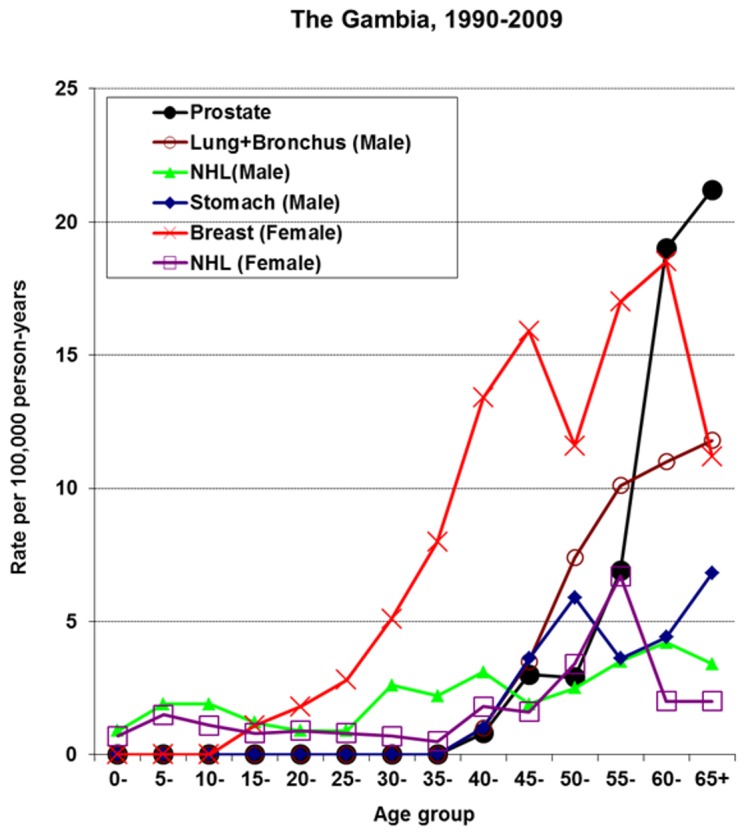
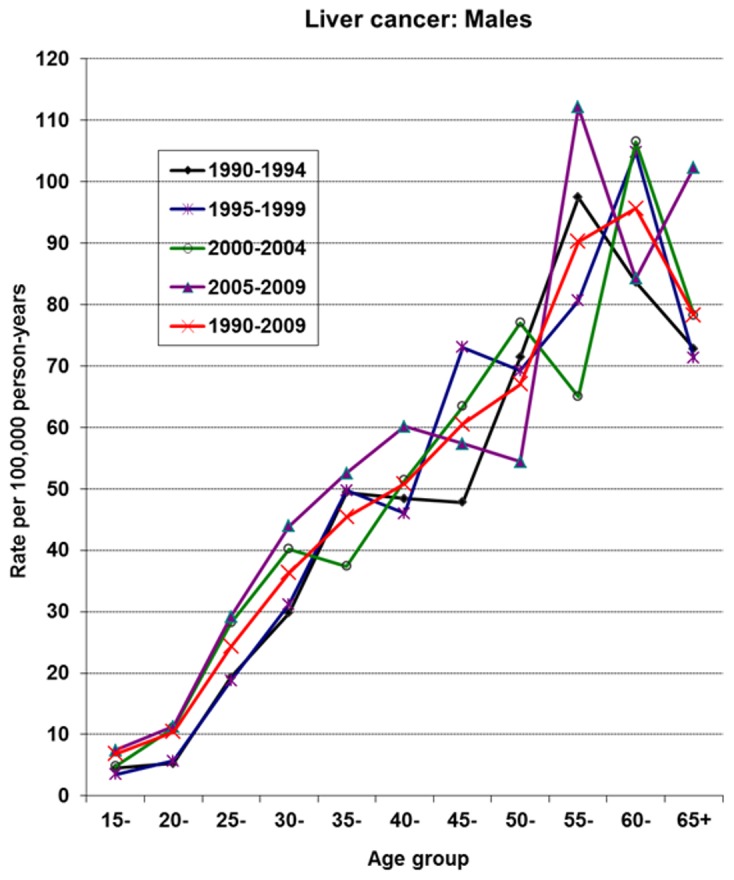
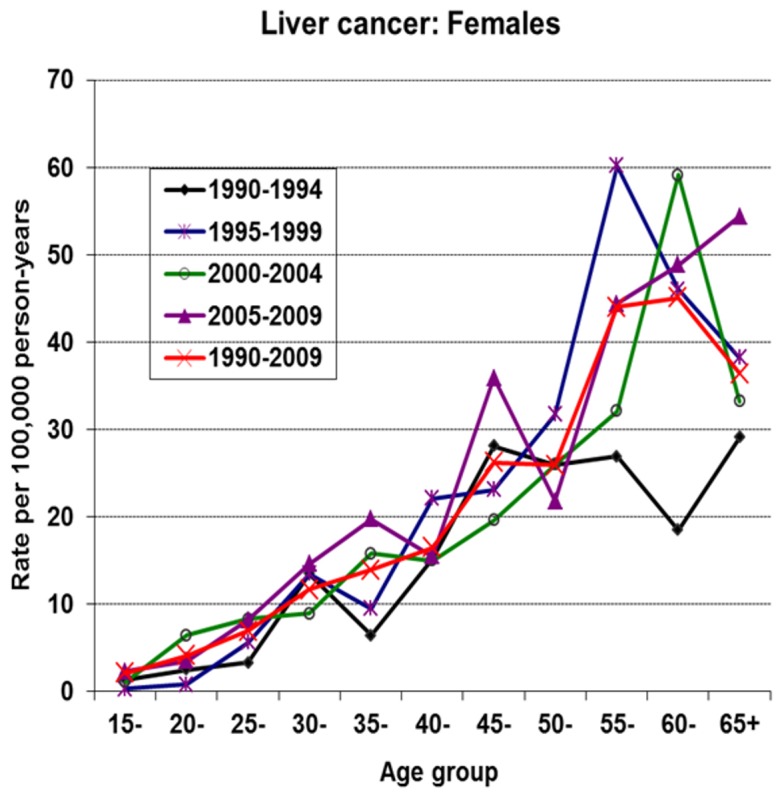
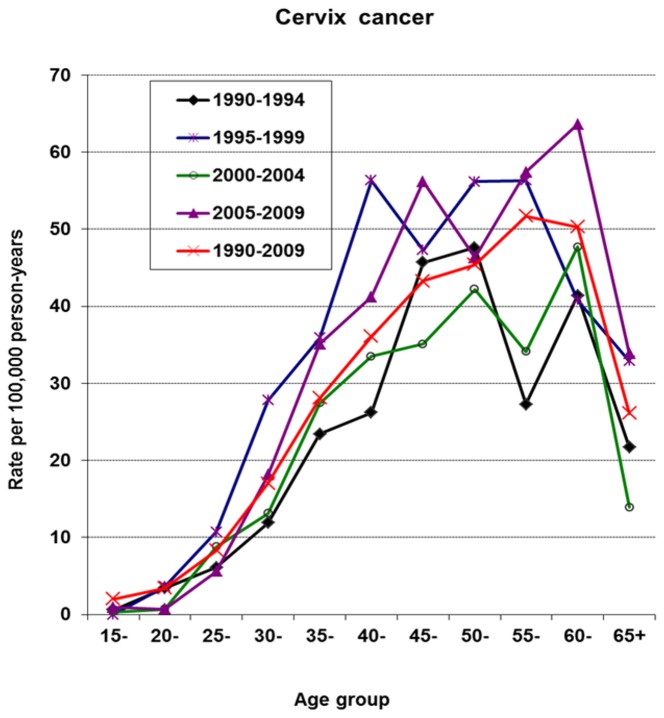
We estimated Age-Standardised Incidence Rates (ASR (W)) of the most common cancers registered during the period by gender. The registration period was divided into four 5-year intervals and incidence rates were estimated for each interval. The most common cancers in males were liver, prostate, lung plus bronchus, non-Hodgkin lymphoma (NHL) and stomach, accounting for 60%, 5%, 4%, 5% and 3%, respectively. Similarly, cancers of the cervix uteri, liver, breast and NHL, were the most common in females, accounting for 33%, 24%, 11% and 4% of the female cancers, respectively.
Cancer incidence has remained relatively stable over time, but as shown elsewhere in sub-Saharan Africa the disease is a threat in The Gambia. The infection related cancers which are mostly preventable (HBV in men and HPV/HIV in women) were the most common. At the moment the data is not enough to detect an effect of hepatitis B vaccination on liver cancer incidence in The Gambia. However, we observed that monitoring case occurrence through PBCR is a key public health pre-requisite for rational planning and implementation of targeted interventions for improving the health of the population.
冈比亚乙型肝炎干预研究(GHIS)是一项针对公共卫生政策的婴儿乙型肝炎疫苗接种随机对照试验,主要目标是预防冈比亚成年人原发性肝癌。为此,冈比亚国家癌症登记处(NCR)作为一个基于人群的癌症登记处(PBCR)于 1986 年成立,积极收集全国范围内所有癌症诊断的数据。我们提取了 20 年(1990-2009 年)的数据,首次评估了最常见癌症的演变情况,还描述并展示了 PBCR 在该人群乙型肝炎和肝癌预防计划中的作用。
我们按性别估计了该时期登记的最常见癌症的年龄标准化发病率(ASR(W))。登记期分为四个 5 年间隔,每个间隔都估计了发病率。男性最常见的癌症是肝癌、前列腺癌、肺癌加支气管癌、非霍奇金淋巴瘤(NHL)和胃癌,分别占 60%、5%、4%、5%和 3%。同样,女性最常见的癌症是宫颈癌、肝癌、乳腺癌和 NHL,分别占女性癌症的 33%、24%、11%和 4%。
癌症发病率随时间相对稳定,但正如在撒哈拉以南非洲其他地方所示,该疾病在冈比亚是一个威胁。大多数可预防的感染相关癌症(男性中的 HBV 和女性中的 HPV/HIV)最为常见。目前,数据还不足以检测乙型肝炎疫苗接种对冈比亚肝癌发病率的影响。然而,我们观察到,通过 PBCR 监测病例发生是合理规划和实施针对改善人口健康的靶向干预措施的关键公共卫生前提。