Ishida Mitsuaki, Okabe Hidetoshi
Department of Clinical Laboratory Medicine and Division of Diagnostic Pathology, Shiga University of Medical Science, Otsu, Shiga 520-2192, Japan.
Oncol Lett. 2013 Sep;6(3):655-658. doi: 10.3892/ol.2013.1431. Epub 2013 Jun 28.
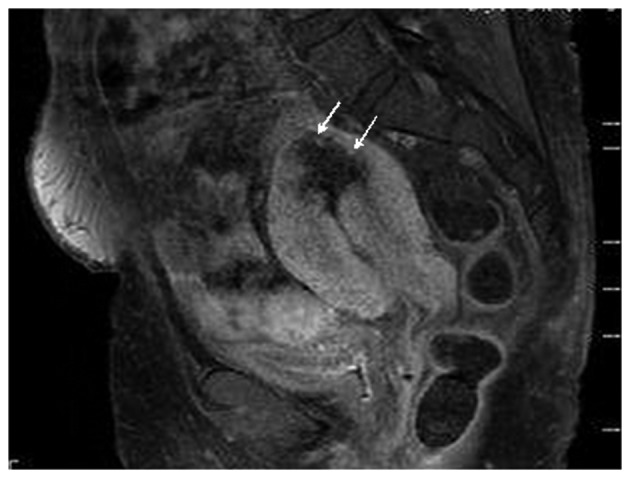
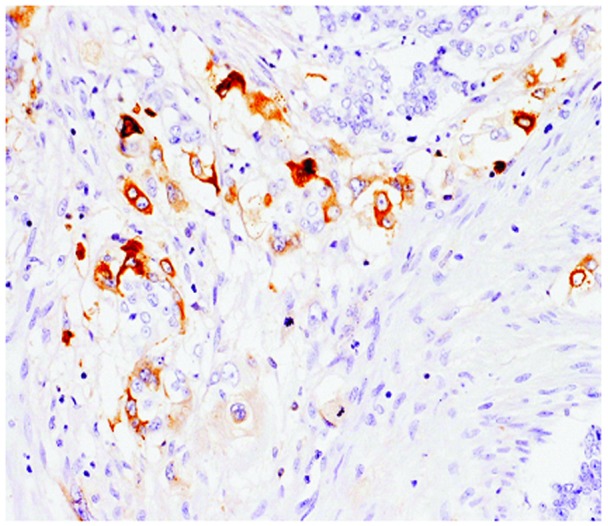
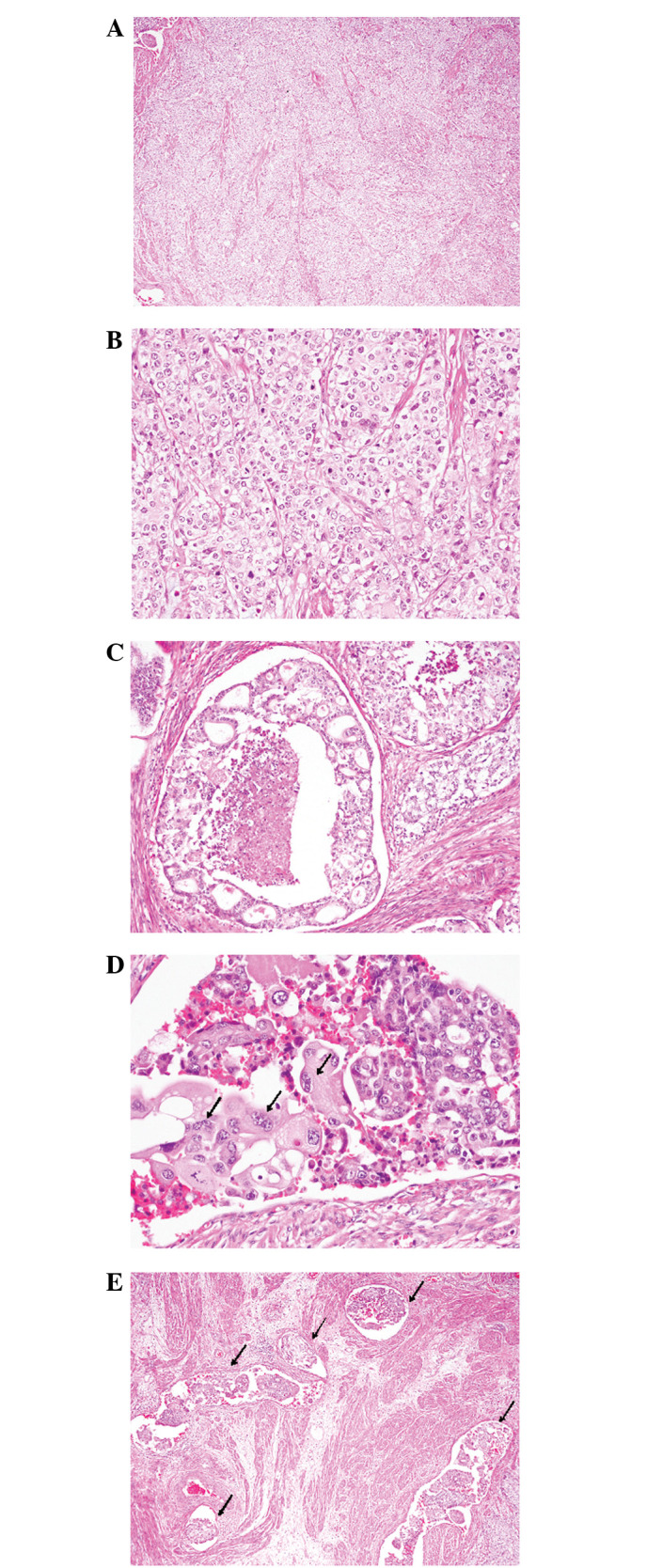
A choriocarcinomatous component is rarely present in carcinomas of certain sites and few cases of choriocarcinomatous differentiation in endometrioid adenocarcinoma have been reported. The present study reports a case of endometrioid adenocarcinoma of the uterine corpus with choriocarcinomatous differentiation, and discusses the clinicopathological features of this rare tumor. A 59-year-old post-menopausal female presented with abnormal vaginal bleeding. Magnetic resonance imaging demonstrated a relatively well-circumscribed tumor in the uterine corpus and a total cystectomy was subsequently performed. A histopathological examination revealed two distinct components in the uterine corpus tumor. The first component comprised ~80% of the tumor and was composed of poorly-differentiated endometrioid adenocarcinoma. The remaining component consisted of mononucleated and syncytial giant cells containing rich eosinophilic cytoplasm and large pleomorphic nuclei with coarse chromatin. An immunohistochemical analysis revealed that these syncytial giant cells were positive for β-human chorionic gonadotropin (hCG). Therefore, a diagnosis of endometrioid adenocarcinoma with choriocarcinomatous differentiation was confirmed. The clinicopathological features of nine previously reported cases of this tumor were analyzed in addition to the present case. The majority of the patients were post-menopausal. Endometrial choriocarcinoma may be considered to have a highly aggressive clinical course, since nine of the 10 cases displayed metastases and four patients succumbed to the disease. The pathogenesis of the choriocarcinomatous component is not well understood. However, genetic studies have demonstrated that conventional carcinoma and choriocarcinomatous components share common genetic alterations. The choriocarcinomatous component represents aberrant differentiation of the conventional carcinoma, however, genetic analyses of endometrioid adenocarcinoma with choriocarcinomatous differentiation have not been performed.
绒毛膜癌成分很少出现在某些部位的癌中,且子宫内膜样腺癌中具有绒毛膜癌分化的病例报道较少。本研究报告了一例具有绒毛膜癌分化的子宫体子宫内膜样腺癌病例,并讨论了这种罕见肿瘤的临床病理特征。一名59岁绝经后女性出现阴道异常出血。磁共振成像显示子宫体有一个边界相对清晰的肿瘤,随后进行了全子宫切除术。组织病理学检查显示子宫体肿瘤有两个不同的成分。第一个成分约占肿瘤的80%,由低分化子宫内膜样腺癌组成。其余成分由单核和合体巨细胞组成,这些细胞含有丰富的嗜酸性细胞质和大的多形性核,染色质粗糙。免疫组织化学分析显示这些合体巨细胞β-人绒毛膜促性腺激素(hCG)呈阳性。因此,确诊为具有绒毛膜癌分化的子宫内膜样腺癌。除本病例外,还分析了9例先前报道的该肿瘤病例的临床病理特征。大多数患者为绝经后女性。子宫内膜绒毛膜癌可被认为具有高度侵袭性的临床病程,因为10例病例中有9例出现转移,4例患者死于该病。绒毛膜癌成分的发病机制尚不清楚。然而,基因研究表明,传统癌和绒毛膜癌成分具有共同的基因改变。绒毛膜癌成分代表传统癌的异常分化,然而,尚未对具有绒毛膜癌分化的子宫内膜样腺癌进行基因分析。