1] Department of Mechanical Engineering, Vanderbilt University, Nashville, TN 37235, USA [2] Interdisciplinary Materials Science Program, Vanderbilt University, Nashville, TN 37235.
Sci Rep. 2013 Oct 22;3:3020. doi: 10.1038/srep03020.
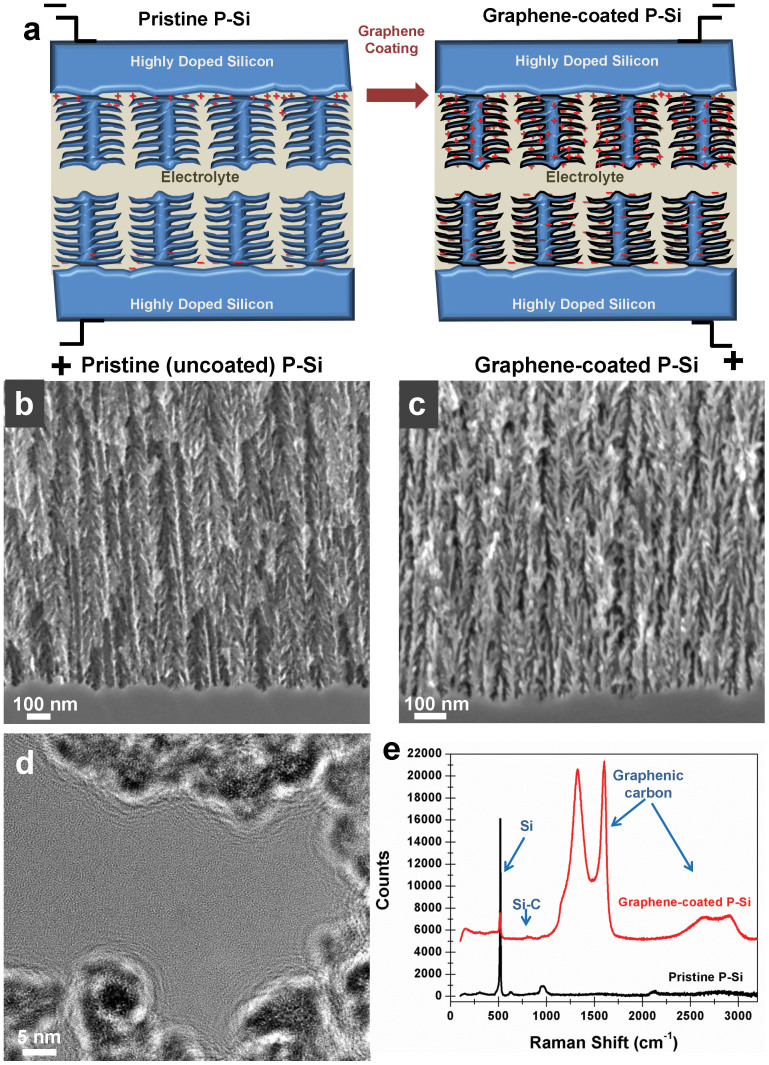
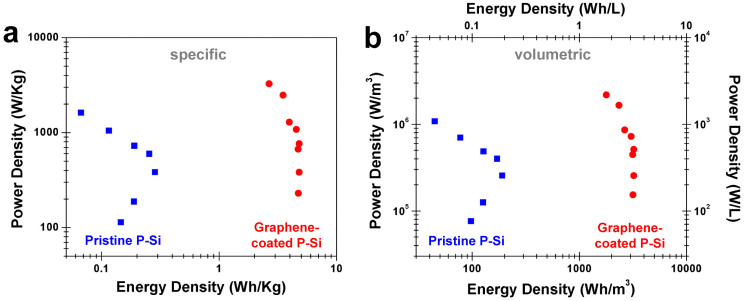
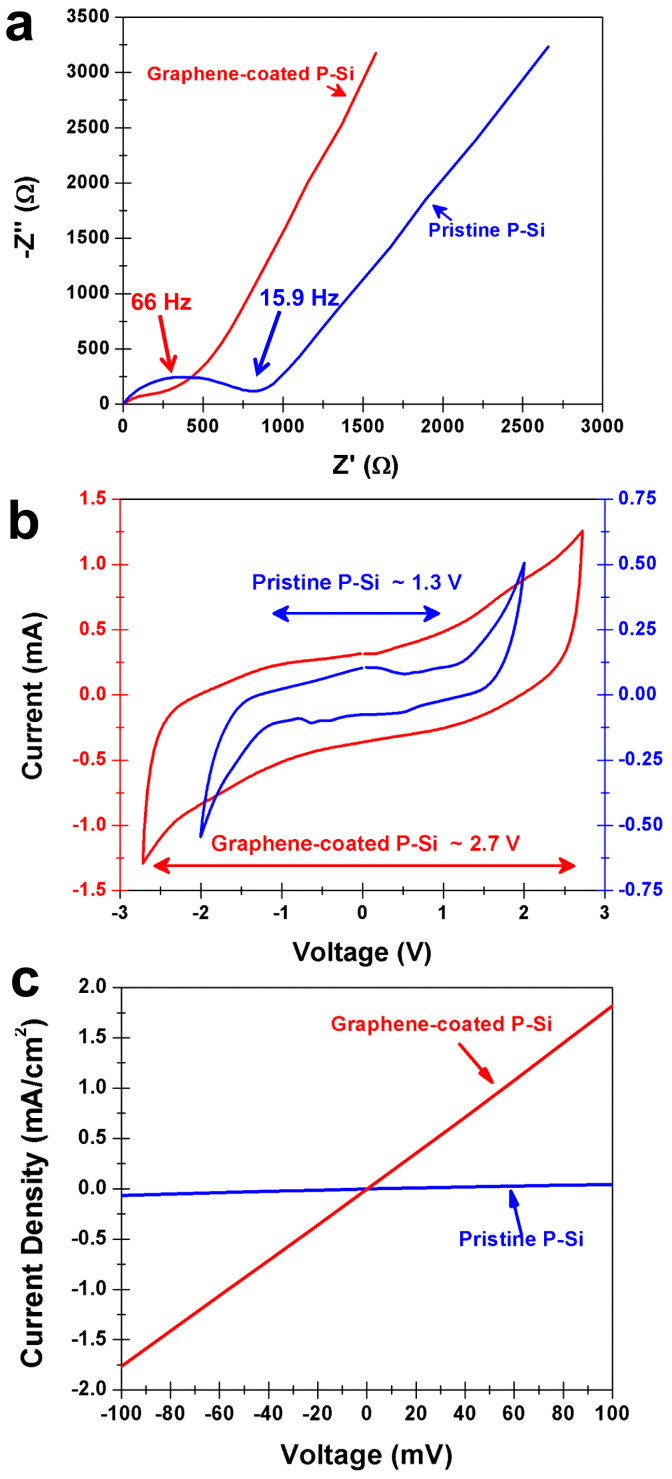
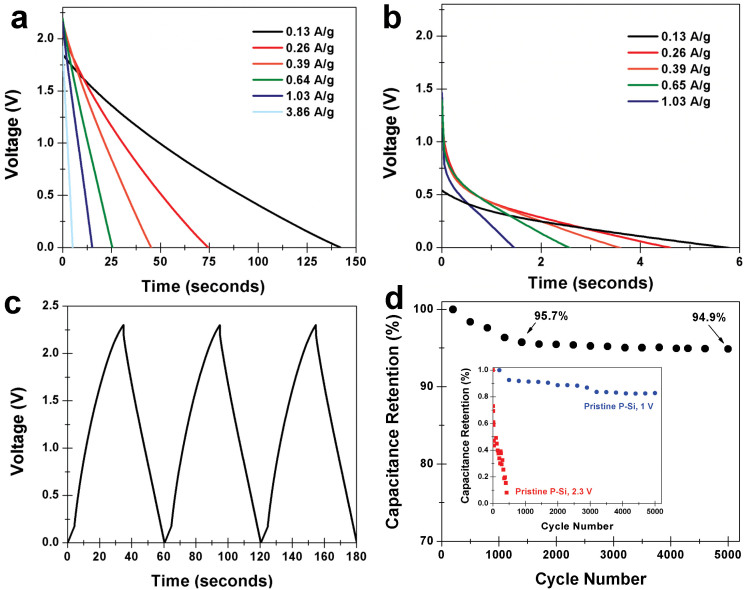
Silicon materials remain unused for supercapacitors due to extreme reactivity of silicon with electrolytes. However, doped silicon materials boast a low mass density, excellent conductivity, a controllably etched nanoporous structure, and combined earth abundance and technological presence appealing to diverse energy storage frameworks. Here, we demonstrate a universal route to transform porous silicon (P-Si) into stable electrodes for electrochemical devices through growth of an ultra-thin, conformal graphene coating on the P-Si surface. This graphene coating simultaneously passivates surface charge traps and provides an ideal electrode-electrolyte electrochemical interface. This leads to 10-40X improvement in energy density, and a 2X wider electrochemical window compared to identically-structured unpassivated P-Si. This work demonstrates a technique generalizable to mesoporous and nanoporous materials that decouples the engineering of electrode structure and electrochemical surface stability to engineer performance in electrochemical environments. Specifically, we demonstrate P-Si as a promising new platform for grid-scale and integrated electrochemical energy storage.
由于硅与电解液的极端反应性,硅材料在超级电容器中仍未得到应用。然而,掺杂硅材料具有低质量密度、优异的导电性、可控制的纳米多孔结构以及结合的地球丰度和技术存在,吸引了各种能量存储框架。在这里,我们展示了一种通用的方法,通过在多孔硅(P-Si)表面生长超薄、保形的石墨烯涂层,将多孔硅转化为用于电化学器件的稳定电极。这种石墨烯涂层同时钝化表面电荷陷阱,并提供理想的电极-电解质电化学界面。与相同结构的未钝化 P-Si 相比,这导致能量密度提高了 10-40 倍,电化学窗口宽了 2 倍。这项工作展示了一种可推广到介孔和纳米多孔材料的技术,该技术将电极结构的工程和电化学表面稳定性解耦,以在电化学环境中实现性能工程化。具体来说,我们证明了 P-Si 是一种有前途的新型网格规模和集成电化学储能平台。