Park Sang-Hee, Hwang Kyu-Jam, Chu Hyuk, Park Mi-Yeoun
Division of Zoonoses, Center for Immunology and Pathology, Korea National Institute of Health, Osong, Korea.
Osong Public Health Res Perspect. 2011 Jun;2(1):29-33. doi: 10.1016/j.phrp.2011.04.004. Epub 2011 Apr 14.
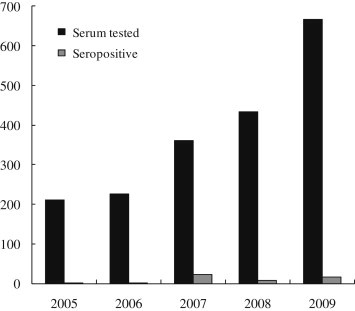
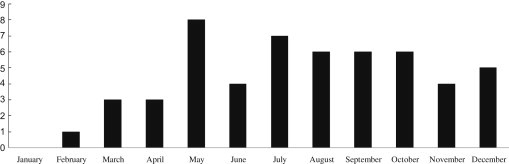
Laboratory tests are now being used to identify seropositive cases in patients suspected of having a Lyme borreliosis (LB) infection. From 2005 to 2009, we analyzed the serological and epidemiological characteristics of 53 LB positive cases in Korea using immunoblot assay.
During the five-year study period, a total of 1897 serum samples from suspected LB cases were referred to us for further laboratory diagnosis. The bacterial strains Borrelia afzeli pKo, Borrelia garinii 935T and Borrelia burgdorferi B31 were used for indirect immunofluorescent antibody assay. Immunoblot assay was performed using the recomBlot Borrelia.
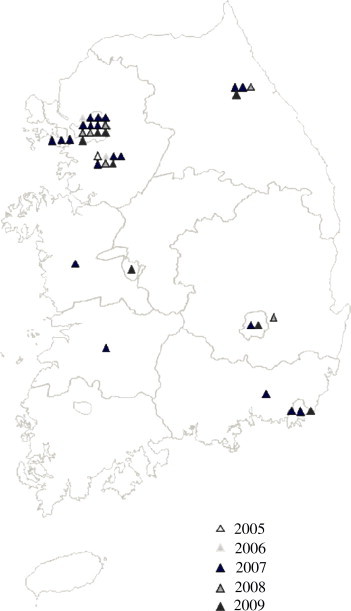
Based on the information from the clinicians, the main symptoms of LB infection were rash and fever (66.0%), neurological symptoms (30.2%), and arthritis (5.7%). Of the 53 cases, 16 (30.2%) were infected abroad and the remaining 37 cases (69.8%) were suspected to have been infected in Korea. Immunoblot assays detected high levels of the antigens p41 (FlaB) of B. burgdorferi and OspC of B. garinii in infected samples.
The causative bacteria of LB were not isolated from humans yet but from vector ticks and rodents in Korea, and a few cases were reported with serological diagnosis. Our results suggest that LB is present in all areas of Korea and indicate that B. garinii and B. burgdorferi may be the predominant bacteria in patients with LB. However, further studies are needed to isolate and identify the causative bacteria for LB in patients.
目前实验室检测正用于识别疑似莱姆病(LB)感染患者中的血清学阳性病例。2005年至2009年,我们采用免疫印迹法分析了韩国53例LB阳性病例的血清学和流行病学特征。
在为期五年的研究期间,共有1897份疑似LB病例的血清样本被送至我们这里进行进一步实验室诊断。使用阿氏疏螺旋体pKo菌株、伽氏疏螺旋体935T菌株和伯氏疏螺旋体B31菌株进行间接免疫荧光抗体检测。采用重组印迹疏螺旋体进行免疫印迹检测。
根据临床医生提供的信息,LB感染主要症状为皮疹和发热(66.0%)、神经症状(30.2%)以及关节炎(5.7%)。53例病例中,16例(30.2%)在国外感染,其余37例(69.8%)疑似在韩国感染。免疫印迹检测在感染样本中检测到高水平的伯氏疏螺旋体抗原p41(FlaB)和伽氏疏螺旋体OspC。
LB的致病细菌尚未从人类中分离出来,但在韩国已从媒介蜱和啮齿动物中分离出来,并且有少数病例进行了血清学诊断报告。我们的结果表明LB在韩国所有地区均有存在,并且表明伽氏疏螺旋体和伯氏疏螺旋体可能是LB患者中的主要细菌。然而,需要进一步研究以分离和鉴定LB患者中的致病细菌。