Department of Genetics, Stanford University Medical School, Stanford, CA 94305-5120, USA.
Nucleic Acids Res. 2014 Jan;42(Database issue):D711-6. doi: 10.1093/nar/gkt1046. Epub 2013 Oct 31.
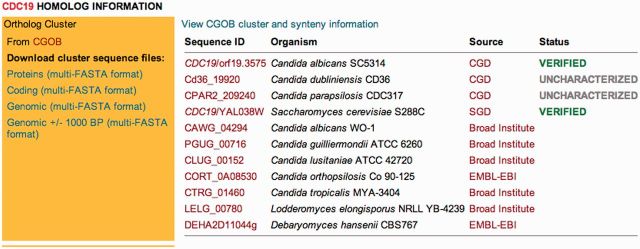
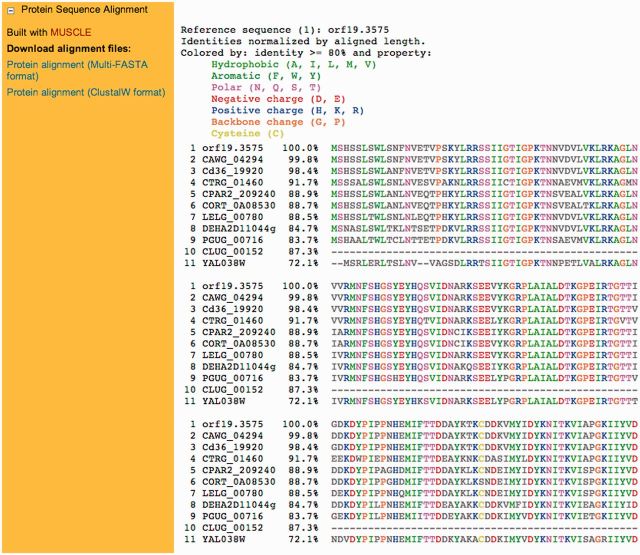
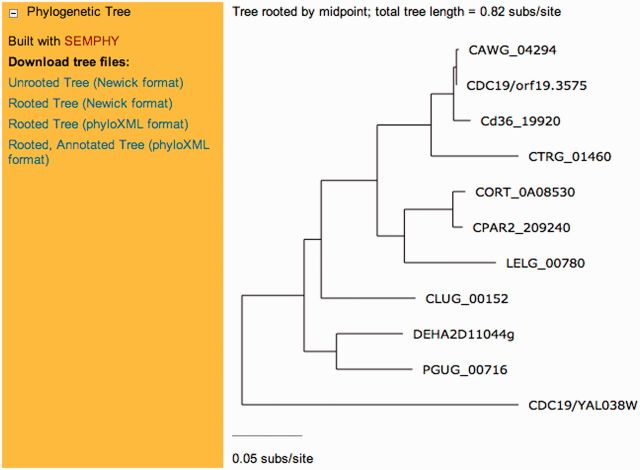
The Candida Genome Database (CGD, http://www.candidagenome.org/) is a freely available online resource that provides gene, protein and sequence information for multiple Candida species, along with web-based tools for accessing, analyzing and exploring these data. The goal of CGD is to facilitate and accelerate research into Candida pathogenesis and biology. The CGD Web site is organized around Locus pages, which display information collected about individual genes. Locus pages have multiple tabs for accessing different types of information; the default Summary tab provides an overview of the gene name, aliases, phenotype and Gene Ontology curation, whereas other tabs display more in-depth information, including protein product details for coding genes, notes on changes to the sequence or structure of the gene and a comprehensive reference list. Here, in this update to previous NAR Database articles featuring CGD, we describe a new tab that we have added to the Locus page, entitled the Homology Information tab, which displays phylogeny and gene similarity information for each locus.
《念珠菌基因组数据库》(CGD,http://www.candidagenome.org/)是一个免费提供的在线资源,提供了多种念珠菌物种的基因、蛋白质和序列信息,以及用于访问、分析和探索这些数据的基于网络的工具。CGD 的目标是促进和加速对念珠菌发病机制和生物学的研究。CGD 网站围绕着基因座页面进行组织,这些页面显示了有关单个基因的收集信息。基因座页面有多个选项卡用于访问不同类型的信息;默认的“摘要”选项卡提供了基因名称、别名、表型和基因本体论注释的概述,而其他选项卡则显示更深入的信息,包括编码基因的蛋白质产物详细信息、基因序列或结构变化的说明以及全面的参考列表。在此,在之前介绍 CGD 的 NAR 数据库文章的更新中,我们描述了在基因座页面上添加的一个新选项卡,名为“同源信息”选项卡,该选项卡显示了每个基因座的系统发育和基因相似性信息。