Orchard John, James Trefor, Kountouris Alex, Portus Marc
School of Public Health, University of Sydney, Sydney, Australia.
Open Access J Sports Med. 2010 May 19;1:63-76. doi: 10.2147/oajsm.s9671. eCollection 2010.
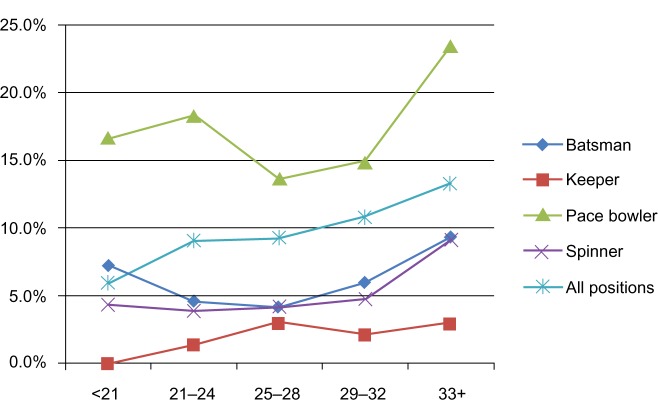
This study analyzes injuries occurring prospectively in Australian men's cricket at the state and national levels over 11 seasons (concluding in season 2008-09). In the last four of these seasons, there was more cricket played, with most of the growth being a new form of the game - Twenty20 cricket. Since the introduction of a regular Twenty20 program, injury incidence rates in each form of cricket have been fairly steady. Because of the short match duration, Twenty20 cricket exhibits a high match injury incidence, expressed as injuries per 10,000 hours of play. Expressed as injuries per days of play, Twenty20 cricket injury rates compare more favorably to other forms of cricket. Domestic level Twenty20 cricket resulted in 145 injuries per 1000 days of play (compared to 219 injuries per 1000 days of domestic one day cricket, and 112 injuries per 1000 days of play in first class domestic cricket). It is therefore recommended that match injury incidence measures be expressed in units of injuries per 1000 days of play. Given the high numbers of injuries which are of gradual onset, seasonal injury incidence rates (which typically range from 15-20 injuries per team per defined 'season') are probably a superior incidence measure. Thigh and hamstring strains have become clearly the most common injury in the past two years (greater than four injuries per team per season), perhaps associated with the increased amount of Twenty20 cricket. Injury prevalence rates have risen in conjunction with an increase in the density of the cricket calendar. Annual injury prevalence rates (average proportion of players missing through injury) have exceeded 10% in the last three years, with the injury prevalence rates for fast bowlers exceeding 18%. As the amount of scheduled cricket is unlikely to be reduced in future years, teams may need to develop a squad rotation for fast bowlers, similar to pitching staff in baseball, to reduce the injury rates for fast bowlers. Consideration should be given to rule changes which may reduce the impact of injury. In particular, allowing the 12th man to play as a full substitute in first class cricket (and therefore take some of the bowling workload in the second innings) would probably reduce bowling injury prevalence in cricket.
本研究分析了11个赛季(截至2008 - 09赛季)澳大利亚男子板球在州级和国家级比赛中前瞻性发生的损伤情况。在这11个赛季的最后四个赛季中,板球比赛场次增多,其中大部分增长来自一种新的比赛形式——20 Twenty板球。自常规20 Twenty比赛项目引入以来,每种板球形式的损伤发生率一直相当稳定。由于比赛时长较短,20 Twenty板球每10000小时比赛的损伤发生率较高。若以每比赛日的损伤数来表示,20 Twenty板球的损伤率相比其他板球形式更具优势。国内级别20 Twenty板球每1000比赛日导致145例损伤(相比之下,国内一日板球每1000比赛日有219例损伤,国内一流板球每1000比赛日有112例损伤)。因此,建议比赛损伤发生率的衡量指标采用每1000比赛日的损伤数。鉴于大量损伤是逐渐发生的,季节性损伤发生率(通常每支球队每定义的“赛季”为15 - 20例损伤)可能是更好的发生率衡量指标。在过去两年中,大腿和腘绳肌拉伤显然已成为最常见的损伤(每支球队每个赛季超过4例损伤),这可能与20 Twenty板球比赛量的增加有关。损伤患病率随着板球赛程密度的增加而上升。在过去三年中,年度损伤患病率(因伤缺阵球员的平均比例)超过了10%,快速投球手的损伤患病率超过了18%。由于未来几年计划内的板球比赛量不太可能减少,球队可能需要为快速投球手制定类似于棒球投手阵容轮换的策略,以降低快速投球手的损伤率。应考虑可能减少损伤影响的规则变化。特别是,允许第12名球员在一流板球比赛中作为正式替补上场(从而在第二局承担一些投球工作量)可能会降低板球比赛中投球手的损伤患病率。