Departments of Nutrition (M.D., S.N.B., A.S., R.M.v.D., F.B.H.) and Epidemiology (F.B.H.), Harvard School of Public Health, Boston, MA; Saw Swee Hock School of Public Health and Department of Medicine, Yong Loo Lin School of Medicine, National University of Singapore and National University Health System, Singapore (R.M.v.D.); and Channing Division of Network Medicine, Brigham and Women's Hospital and Harvard Medical School, Boston, MA (F.B.H.).
Circulation. 2014 Feb 11;129(6):643-59. doi: 10.1161/CIRCULATIONAHA.113.005925. Epub 2013 Nov 7.
Considerable controversy exists on the association between coffee consumption and cardiovascular disease (CVD) risk. A meta-analysis was performed to assess the dose-response relationship of long-term coffee consumption with CVD risk.
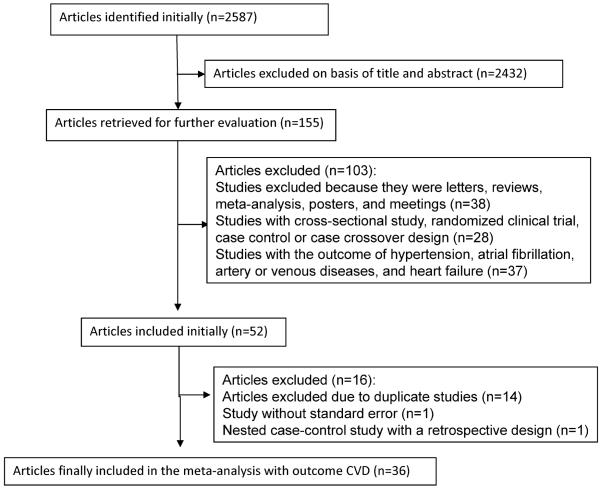
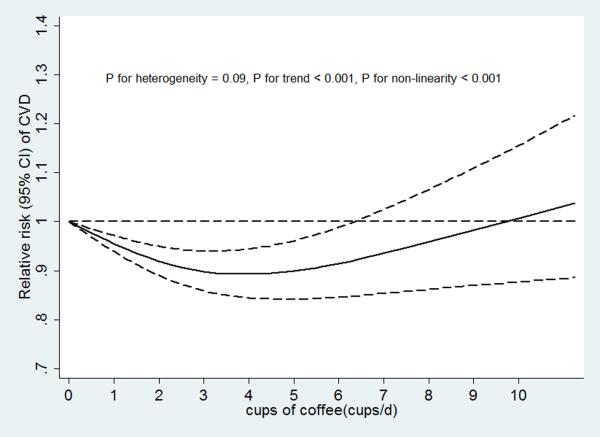
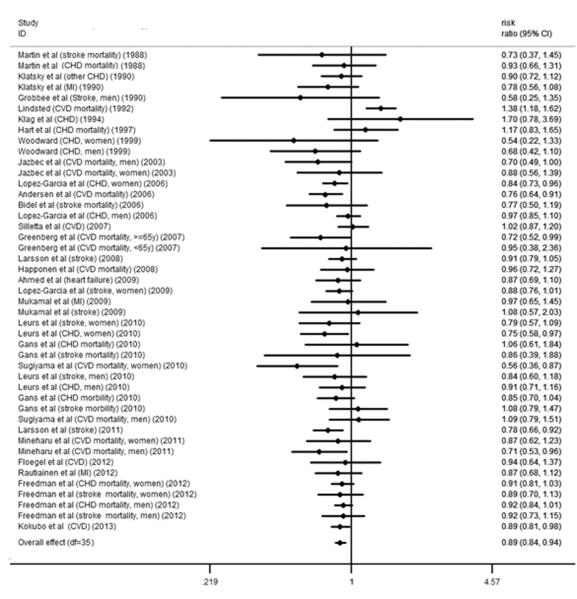
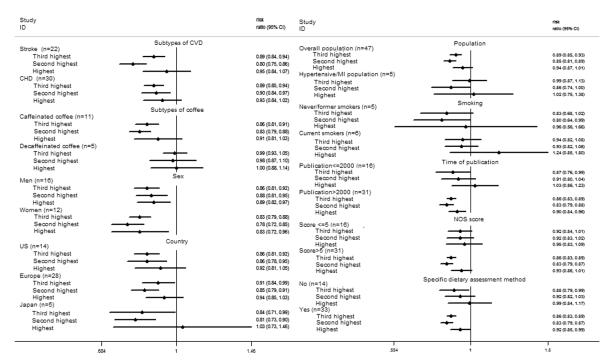
PubMed and EMBASE were searched for prospective cohort studies of the relationship between coffee consumption and CVD risk, which included coronary heart disease, stroke, heart failure, and CVD mortality. Thirty-six studies were included with 1 279 804 participants and 36 352 CVD cases. A nonlinear relationship of coffee consumption with CVD risk was identified (P for heterogeneity=0.09, P for trend <0.001, P for nonlinearity <0.001). Compared with the lowest category of coffee consumption (median, 0 cups per day), the relative risk of CVD was 0.95 (95% confidence interval, 0.87-1.03) for the highest category (median, 5 cups per day) category, 0.85 (95% confidence interval, 0.80-0.90) for the second highest category (median, 3.5 cups per day), and 0.89 (95% confidence interval, 0.84-0.94) for the third highest category (median, 1.5 cups per day). Looking at separate outcomes, coffee consumption was nonlinearly associated with both coronary heart disease (P for heterogeneity=0.001, P for trend <0.001, P for nonlinearity <0.001) and stroke (P for heterogeneity=0.07, P for trend <0.001, P for nonlinearity <0.001; P for trend differences >0.05) risks.
A nonlinear association between coffee consumption and CVD risk was observed in this meta-analysis. Moderate coffee consumption was inversely significantly associated with CVD risk, with the lowest CVD risk at 3 to 5 cups per day, and heavy coffee consumption was not associated with elevated CVD risk.
关于咖啡摄入与心血管疾病(CVD)风险之间的关联存在大量争议。进行了一项荟萃分析,以评估长期咖啡摄入与 CVD 风险之间的剂量-反应关系。
检索了评估咖啡摄入与 CVD 风险之间关系的前瞻性队列研究,包括冠心病、中风、心力衰竭和 CVD 死亡率。共纳入 36 项研究,涉及 1279804 名参与者和 36352 例 CVD 病例。确定了咖啡摄入与 CVD 风险之间存在非线性关系(异质性 P=0.09,趋势 P<0.001,非线性 P<0.001)。与最低咖啡摄入量类别(中位数,每天 0 杯)相比,最高咖啡摄入量类别(中位数,每天 5 杯)的 CVD 相对风险为 0.95(95%置信区间,0.87-1.03),第二高摄入量类别(中位数,每天 3.5 杯)的相对风险为 0.85(95%置信区间,0.80-0.90),第三高摄入量类别(中位数,每天 1.5 杯)的相对风险为 0.89(95%置信区间,0.84-0.94)。单独观察各个结局,咖啡摄入与冠心病(异质性 P=0.001,趋势 P<0.001,非线性 P<0.001)和中风(异质性 P=0.07,趋势 P<0.001,非线性 P<0.001;趋势差异 P>0.05)风险均呈非线性相关。
本荟萃分析观察到咖啡摄入与 CVD 风险之间存在非线性关联。适度咖啡摄入与 CVD 风险呈显著负相关,每天 3 至 5 杯咖啡摄入时 CVD 风险最低,大量咖啡摄入与升高的 CVD 风险无关。