Department of Radiation Oncology, University of Michigan, Ann Arbor, MI 48109, USA.
Phys Med Biol. 2013 Dec 7;58(23):8419-35. doi: 10.1088/0031-9155/58/23/8419. Epub 2013 Nov 11.
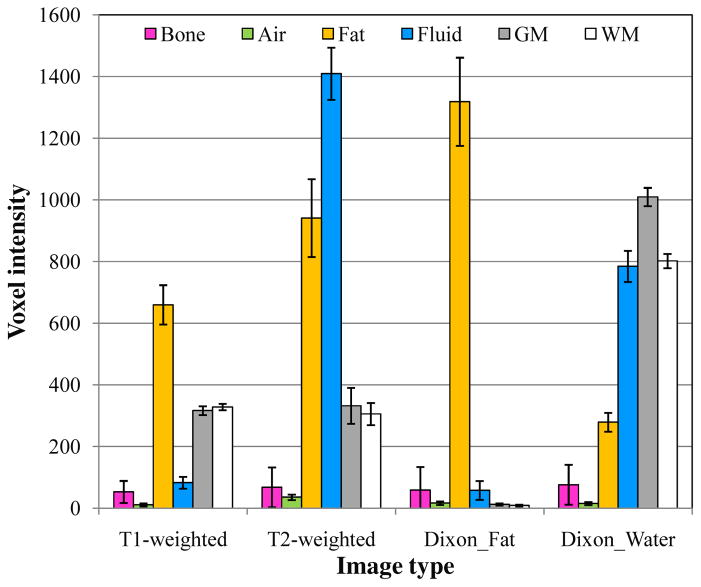
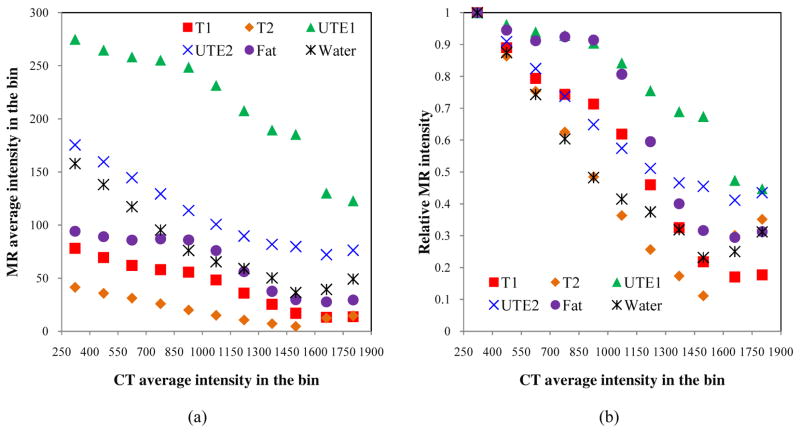
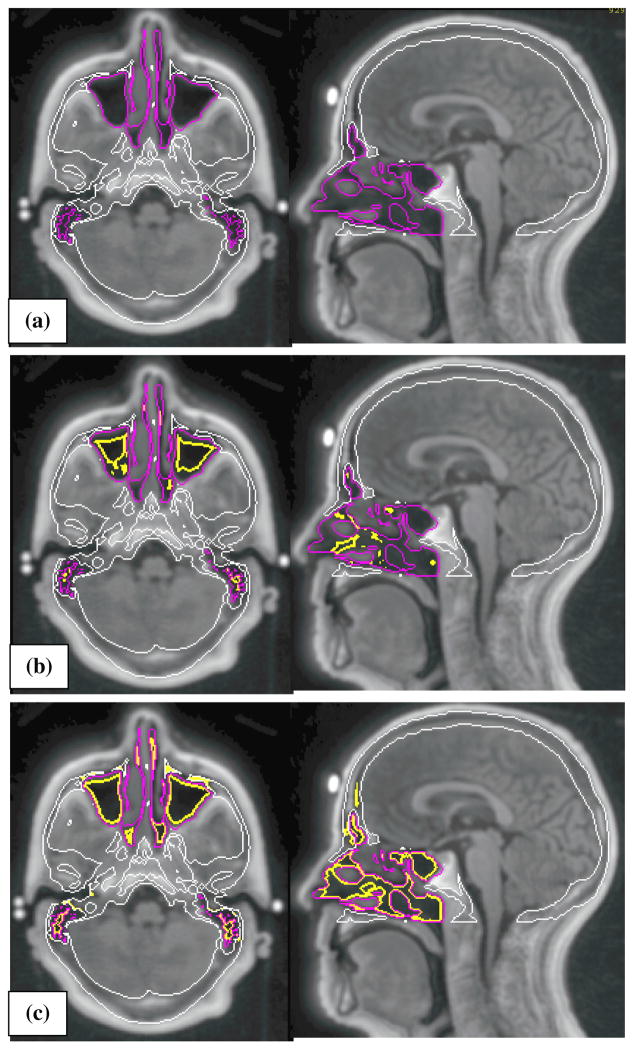
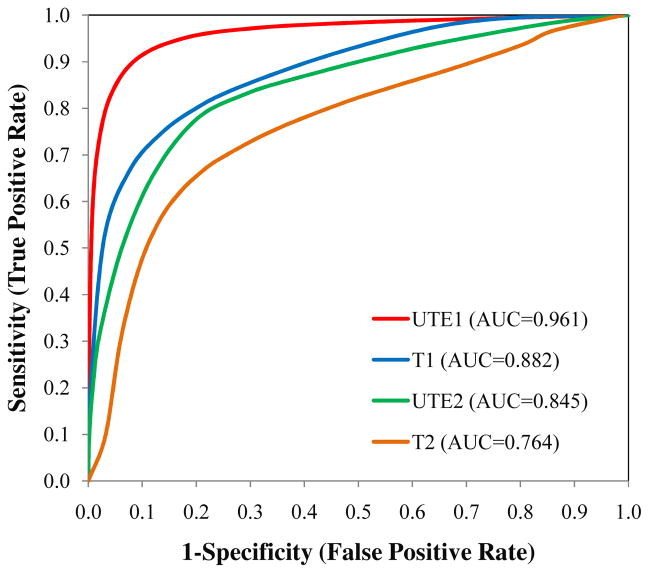
Magnetic resonance (MR) images often provide superior anatomic and functional information over computed tomography (CT) images, but generally are not used alone without CT images for radiotherapy treatment planning and image guidance. This study aims to investigate the potential of probabilistic classification of voxels from multiple MRI contrasts to generate synthetic CT ('MRCT') images. The method consists of (1) acquiring multiple MRI volumes: T1-weighted, T2-weighted, two echoes from a ultra-short echo time (UTE) sequence, and calculated fat and water image volumes using a Dixon method, (2) classifying tissues using fuzzy c-means clustering with a spatial constraint, (3) assigning attenuation properties with weights based on the probability of individual tissue classes being present in each voxel, and (4) generating a MRCT image volume from the sum of attenuation properties in each voxel. The capability of each MRI contrast to differentiate tissues of interest was investigated based on a retrospective analysis of ten patients. For one prospective patient, the correlation of skull intensities between CT and MR was investigated, the discriminatory power of MRI in separating air from bone was evaluated, and the generated MRCT image volume was qualitatively evaluated. Our analyses showed that one MRI volume was not sufficient to separate all tissue types, and T2-weighted images was more sensitive to bone density variation compared to other MRI image types. The short echo UTE image showed significant improvement in contrasting air versus bone, but could not completely separate air from bone without false labeling. Generated MRCT and CT images showed similar contrast between bone and soft/solid tissues. These results demonstrate the potential of the presented method to generate synthetic CT images to support the workflow of radiation oncology treatment planning and image guidance.
磁共振(MR)图像通常提供比计算机断层扫描(CT)图像更优越的解剖和功能信息,但通常不单独使用,而需要与 CT 图像结合,用于放射治疗计划和图像引导。本研究旨在探讨从多种 MRI 对比中对体素进行概率分类以生成合成 CT(“MRCT”)图像的潜力。该方法包括:(1)获取多个 MRI 容积:T1 加权、T2 加权、来自超短回波时间(UTE)序列的两个回波,以及使用 Dixon 方法计算脂肪和水图像容积;(2)使用具有空间约束的模糊 c-均值聚类对组织进行分类;(3)根据每个体素中存在的各个组织类别的概率为衰减特性分配权重;(4)根据每个体素中的衰减特性总和生成一个 MRCT 图像容积。基于对十名患者的回顾性分析,研究了每种 MRI 对比在区分感兴趣组织方面的能力。对于一名前瞻性患者,研究了 CT 和 MR 之间颅骨强度的相关性,评估了 MRI 在区分空气与骨骼方面的区分能力,并对生成的 MRCT 图像容积进行了定性评估。我们的分析表明,一个 MRI 容积不足以分离所有组织类型,与其他 MRI 图像类型相比,T2 加权图像对骨密度变化更敏感。短回波 UTE 图像在对比空气与骨骼方面显示出显著改善,但在没有虚假标记的情况下,无法完全分离空气与骨骼。生成的 MRCT 和 CT 图像显示出骨与软/固组织之间相似的对比度。这些结果表明,所提出的方法具有生成合成 CT 图像以支持放射肿瘤学治疗计划和图像引导工作流程的潜力。