Department of Public Health, Erasmus MC, University Medical Center, Rotterdam, The Netherlands ; Student of China Scholarship Council, Beijing, China.
PLoS One. 2013 Nov 13;8(11):e79320. doi: 10.1371/journal.pone.0079320. eCollection 2013.
The objective of this review was to investigate whether Chinese population groups that do not belong to classical high risk groups show an increasing trend of engaging in high-risk sexual behaviors.
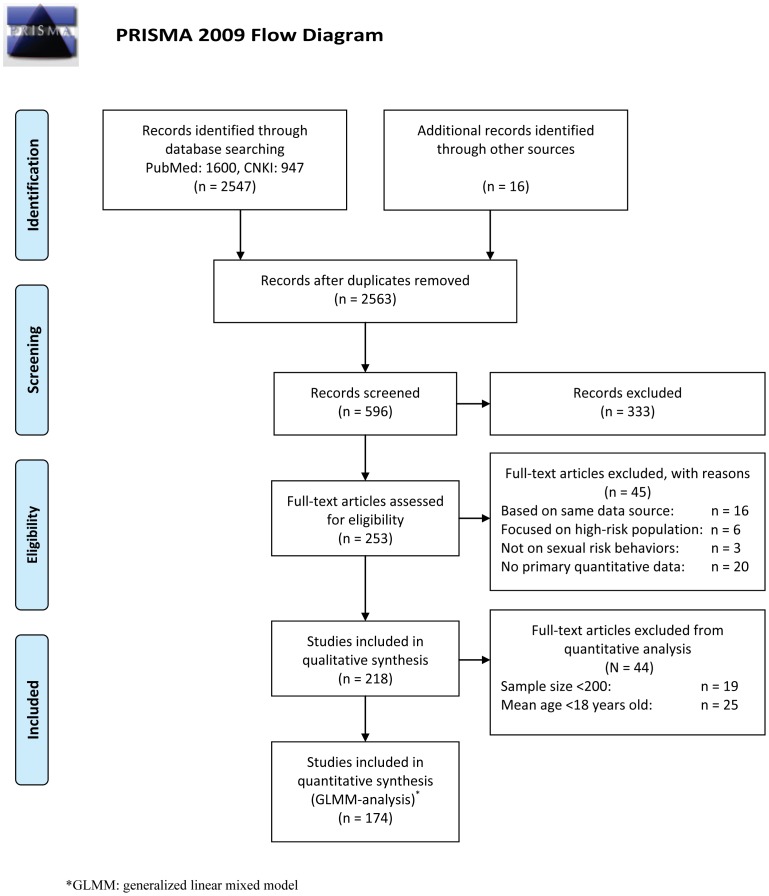
We systematically searched the English and Chinese literature on sexual risk behaviors published between January 1980 and March 2012 in PubMed and the China National Knowledge Infrastructure (CNKI). We included observational studies that focused on population groups other than commercial sex workers (CSWs) and their clients, and men who have sex with men (MSM) and quantitatively reported one of the following indicators of recent high-risk sexual behavior: premarital sex, commercial sex, multiple sex partners, condom use or sexually transmitted infections (STIs). We used generalized linear mixed model to examine the time trend in engaging in high-risk sexual behaviors.
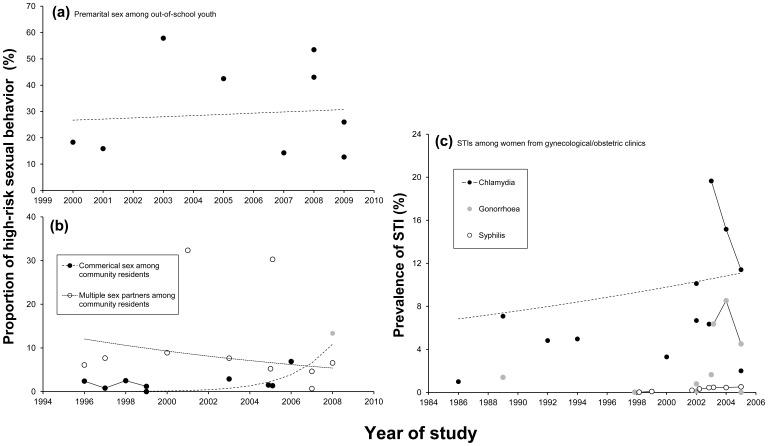
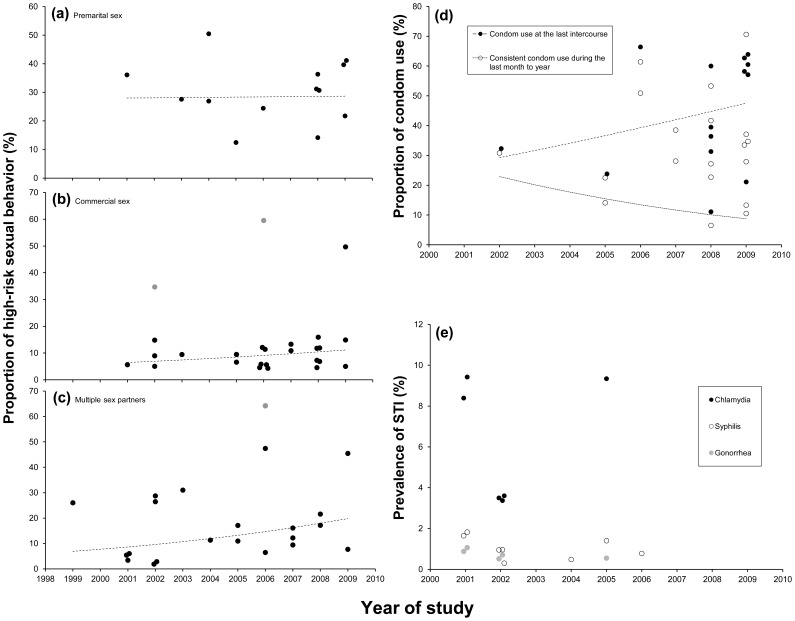
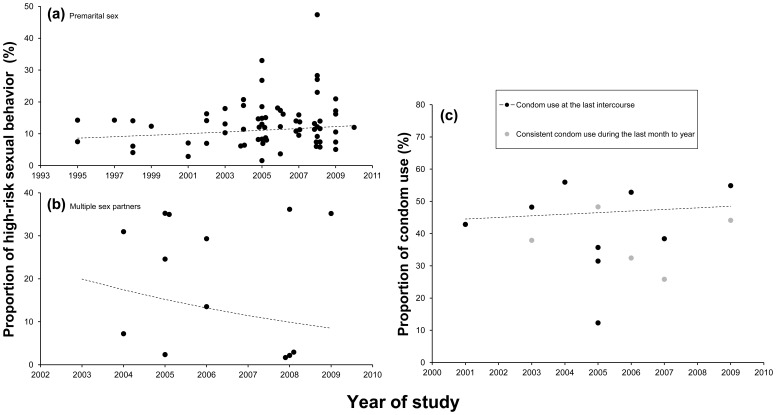
We included 174 observational studies involving 932,931 participants: 55 studies reported on floating populations, 73 on college students and 46 on other groups (i.e. out-of-school youth, rural residents, and subjects from gynecological or obstetric clinics and premarital check-up centers). From the generalized linear mixed model, no significant trends in engaging in high-risk sexual behaviors were identified in the three population groups.
Sexual risk behaviors among certain general population groups have not increased substantially. These groups are therefore unlikely to incite a STI/HIV epidemic among the general Chinese population. Because the studied population groups are not necessarily representative of the general population, the outcomes found may not reflect those of the general population.
本研究旨在探讨中国非经典高危人群是否存在高危性行为发生率增加的趋势。
我们系统检索了 1980 年 1 月至 2012 年 3 月间 PubMed 和中国知识基础设施工程(CNKI)收录的英文和中文关于性行为风险的文献,纳入了除商业性工作者及其顾客和男男性行为者之外的目标人群,定量报道了最近发生高危性行为的以下指标之一的观察性研究:婚前性行为、商业性行为、多性伴、安全套使用和性传播感染(STIs)。我们采用广义线性混合模型分析高危性行为的时间趋势。
共纳入 174 项观察性研究,涉及 932931 名参与者:55 项研究报道了流动人口,73 项研究报道了大学生,46 项研究报道了其他人群(即校外青年、农村居民、妇产科门诊和婚前检查中心的对象)。广义线性混合模型分析未发现这三组人群高危性行为有显著的变化趋势。
某些一般人群的性行为风险并没有显著增加。因此,这些人群不太可能在普通中国人群中引发性传播感染/艾滋病疫情。由于研究人群不一定代表普通人群,因此发现的结果可能无法反映普通人群的情况。