Zasada Aleksandra A, Rastawicki Waldemar, Rokosz Natalia, Jagielski Marek
Department of Bacteriology, National Institute of Public Health - National Institute of Hygiene, Chocimska 24, Warsaw 00-791, Poland.
BMC Infect Dis. 2013 Nov 19;13:551. doi: 10.1186/1471-2334-13-551.
Recommendations for diphtheria immunization are to apply an effective primary immunization in infancy and to maintain immunity throughout life. Immunity against diphtheria depends primarily on antibody to the diphtheria toxin. This study evaluated the seroprevalence of IgG diphtheria antitoxin in sera of healthy children, adolescents and adults in Poland.
A total of 1387 serum samples collected between 2010 and 2012 from individuals with ages ranging from 1 month to 85 years were investigated. Antibody concentrations were measured with an enzyme-linked immunosorbent assay (Anti-Diphtheria Toxoid ELISA IgG, Euroimmun, Germany).
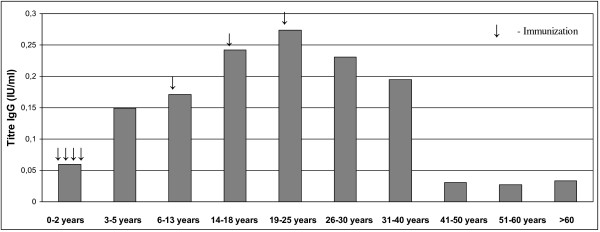
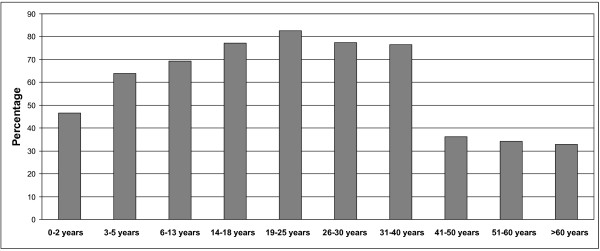
The results showed that among 1387 individuals examined, 547 (39.4%) had anti-diphtheria toxoid IgG antibody levels below 0.1 IU/ml (36.9% ≤ 18 years and 40.5% >18 years old, respectively). The 212 (50.8%) children and 542 (55.9%) adults showed only basic protection (0.1-1.0 IU/ml) and need immediate booster. High levels of anti-diphtheria toxoid IgG antibodies (>1.0 IU/ml) were found more often in children and adolescent (12.2%) than in adults (3.6%) and this was statistically significant (P < 0.05). The proportion of seronegatives (< 0.1 IU/ml) in children below 2 years old, adolescents and young adults to 25 years old decreased from 53.5% to 17.4%. However, in older individuals the seronegative proportion tended to increase with age, from 22.7% in adults (26-30 years old) to 67.1% in subjects > 60 years old. Characteristically, in individuals > 40 years old high levels of anti-diphtheria toxoid IgG antibodies (>1.0 IU/ml) were not seen. There were no statistically significant differences in results in relation to gender.
The present study showed inadequate immunity levels to diphtheria amongst the Polish population, especially in adults > 40 years old and children ≤ 2 years old. To prevent reemergence of diphtheria an information campaign reminding people about recommendations concerning diphtheria booster vaccination in adults should be conducted. Moreover, the immunogenicity of the DTP vaccine used in Poland should be verified.
白喉免疫接种的建议是在婴儿期进行有效的基础免疫,并终生维持免疫力。对白喉的免疫力主要取决于对白喉毒素的抗体。本研究评估了波兰健康儿童、青少年和成人血清中白喉抗毒素IgG的血清流行率。
对2010年至2012年间收集的1387份血清样本进行了调查,这些样本来自年龄在1个月至85岁之间的个体。采用酶联免疫吸附测定法(德国欧蒙公司的抗白喉类毒素ELISA IgG)测量抗体浓度。
结果显示,在1387名受检个体中,547人(39.4%)的抗白喉类毒素IgG抗体水平低于0.1 IU/ml(1岁及以下儿童中为36.9%,18岁以上人群中为40.5%)。212名儿童(50.8%)和542名成人(55.9%)仅表现出基础保护水平(0.1 - 1.0 IU/ml),需要立即加强免疫。抗白喉类毒素IgG抗体高水平(>1.0 IU/ml)在儿童和青少年中(12.2%)比在成人中(3.6%)更常见,且具有统计学意义(P < 0.05)。2岁以下儿童、青少年以及25岁以下年轻人中血清阴性(< 0.1 IU/ml)的比例从53.5%降至17.4%。然而,在年龄较大的个体中,血清阴性比例倾向于随年龄增加,从26至30岁成人中的22.7%增至60岁以上人群中的67.1%。其特点是,40岁以上个体中未发现抗白喉类毒素IgG抗体高水平(>1.0 IU/ml)。结果在性别方面无统计学显著差异。
本研究表明波兰人群对白喉的免疫水平不足,尤其是在40岁以上成人和2岁及以下儿童中。为预防白喉再次出现,应开展宣传活动,提醒人们注意成人白喉加强疫苗接种的建议。此外,应核实波兰使用的百白破疫苗的免疫原性。