Department of Psychology, Lund University , Lund , Sweden.
PeerJ. 2013 Nov 5;1:e197. doi: 10.7717/peerj.197. eCollection 2013.
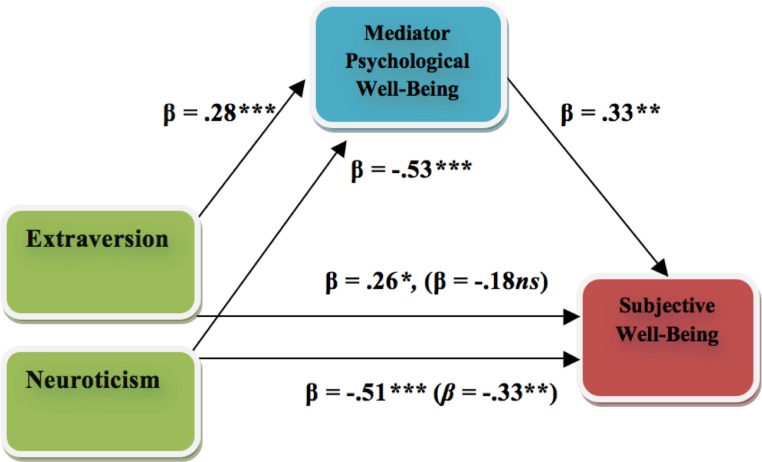
Introduction. This study addresses the need to further contextualize research on well-being (e.g., Kjell, 2011) in terms of cross-cultural aspects of personality traits among adolescents and by examining two different conceptualizations of well-being: subjective well-being (i.e., life satisfaction, positive and negative affect) and psychological well-being (i.e., positive relations with others, environmental mastery, self-acceptance, autonomy, personal growth, and life purpose). Methods. Iranian (N = 122, mean age 15.23 years) and Swedish (N = 109, mean age 16.69 years) adolescents were asked to fill out a Big Five personality test, as well as questionnaires assessing subjective well-being and psychological well-being. Results. Swedes reported higher subjective and psychological well-being, while Iranians reported higher degree of Agreeableness, Openness and Conscientiousness. Neuroticism and Extraversion did not differ between cultures. Neuroticism was related to well-being within both cultures. Openness was related to well-being only among Iranians, and Extraversion only among Swedes. A mediation analysis within the Swedish sample, the only sample meeting statistical criteria for mediation analysis to be conducted, demonstrated that psychological well-being mediated the relationship between Neuroticism and subjective well-being as well as between Extraversion and subjective well-being. Conclusions. Certain personality traits, such as Extraversion, Openness, and Conscientiousness, relate differently to well-being measures across cultures. Meanwhile, Neuroticism seems to relate similarly across cultures at least with regard to subjective well-being. Furthermore, the results give an indication on how psychological well-being might mediate the relationship between certain personality traits and subjective well-being. Overall, the complexity of the results illustrates the need for more research whilst supporting the importance of contextualizing well-being research.
简介。本研究旨在进一步从跨文化角度探讨人格特质与青少年幸福感之间的关系,以充实幸福感(例如,Kjell,2011)的研究,并通过考察两种不同的幸福感概念:主观幸福感(即生活满意度、积极和消极情绪)和心理幸福感(即与他人的积极关系、环境掌控、自我接纳、自主性、个人成长和生活目标)。方法。要求伊朗(N=122,平均年龄 15.23 岁)和瑞典(N=109,平均年龄 16.69 岁)青少年填写大五人格测试问卷以及主观幸福感和心理幸福感问卷。结果。瑞典青少年报告了更高的主观幸福感和心理幸福感,而伊朗青少年则报告了更高的宜人性、开放性和尽责性。两种文化的青少年在神经质和外向性方面没有差异。神经质与两种文化的幸福感都相关。开放性仅与伊朗青少年的幸福感相关,外向性仅与瑞典青少年的幸福感相关。在瑞典样本中进行的中介分析(唯一符合进行中介分析的统计标准的样本)表明,心理幸福感在神经质与主观幸福感之间以及外向性与主观幸福感之间起中介作用。结论。某些人格特质,如外向性、开放性和尽责性,在跨文化的幸福感测量中具有不同的相关性。同时,神经质似乎与主观幸福感至少在跨文化上具有相似的相关性。此外,结果表明心理幸福感可能在某些人格特质与主观幸福感之间的关系中起中介作用。总体而言,结果的复杂性说明了需要更多的研究,同时支持了将幸福感研究置于具体情境中的重要性。